

Understanding Bot Openings

The opening sets the tone for the entire game. With Bots 3.0, every bot has a unique opening repertoire based on real human games at their rating level. You can see exactly what lines they play, how often they play them, and prepare accordingly.
What is Bots 3.0?
Bots 3.0 is our third major rework of how Chessiverse bots play chess. It's a significant improvement over 2.0, which we released about a year ago. One of the biggest changes is how bots handle openings.
While the 2.0 update was also based on human games, this update takes it a step further and mimics a whole opening repertoire for each bot. Before the bots had a few favorite openings it went for in every game, now they have a full repertoire, with alternative lines, mistakes, deep preparation or shallow experimentation. Just like a human.
Below I'll go through how the opening books work, some of it is the same as before, some of it is brand new.
Opening Books Based on Real Humans
Every bot has an opening repertoire derived from real human games played at their rating level. This means:
- A 1200-rated bot plays openings that real 1200-rated humans actually play
- The repertoires include common mistakes that humans at that level make
- They also include strong moves when humans at that level find them
- The frequency of each line matches what you'd see playing real humans
Every bot has a complete repertoire based on real human games played at their rating. Some bots will stick to the mainlines and rarely deviate, some will have a favorite opening but experiments from time to time, and some have a loose idea of what they play but deviates a lot.
This creates realistic and diverse opening play. You'll see the same variety of openings you'd encounter in online games against real players.
The Opening Style Dimensions
Just like playstyles, opening preferences are mapped onto a 2D plane:
Solid
Plays safe, positional openings that lead to stable, strategic games. Focuses on sound development and avoiding risk.
Sharp
Plays dynamic, double-edged openings with attacking chances. Creates complex positions where both sides have opportunities.
Unprepared
Varies openings frequently and leaves theory early. Hard to prepare against but less deeply studied in any single line.
Theoretical
Sticks to main lines and knows their theory deeply. More predictable but also more dangerous in their preparation.
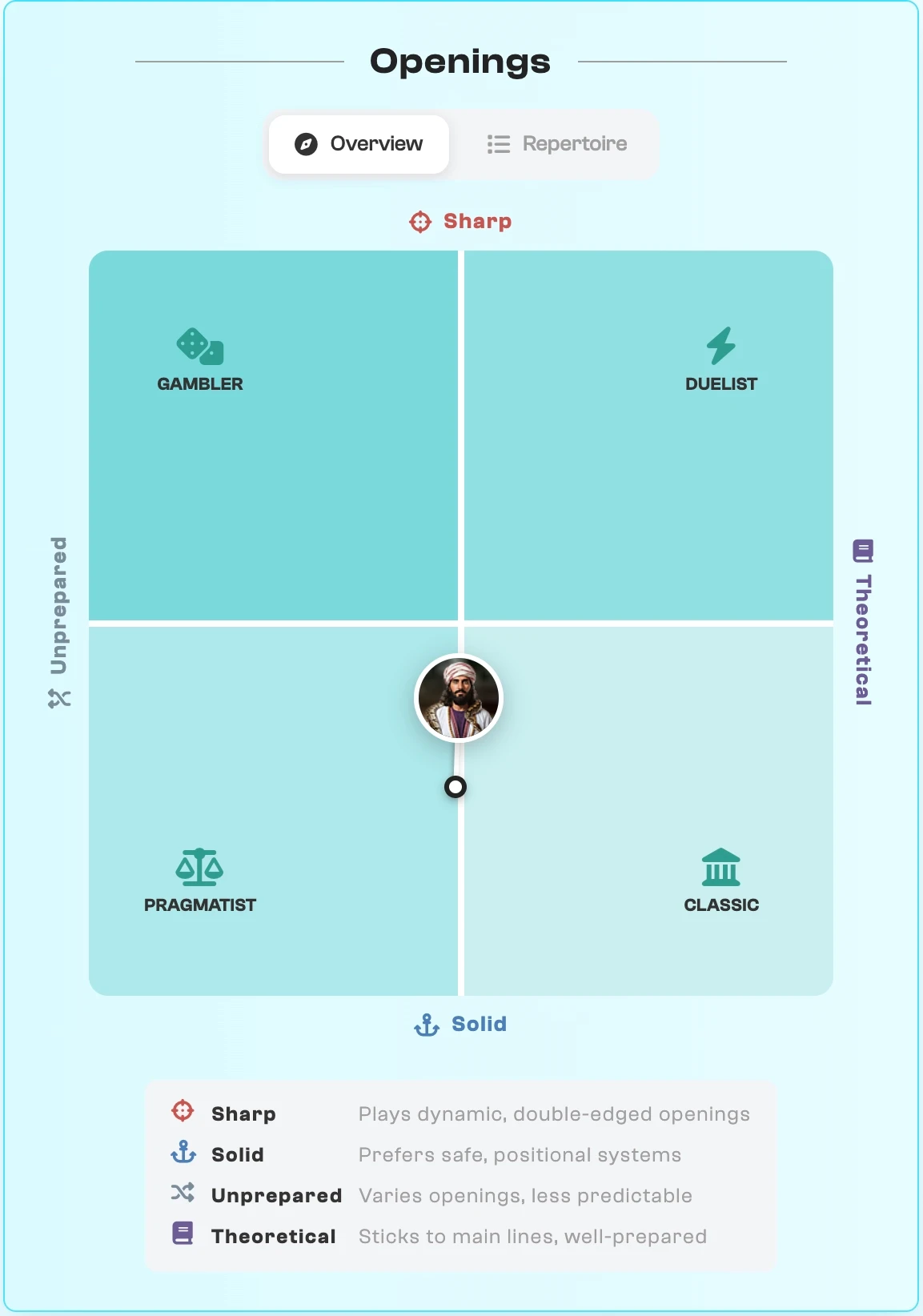
How The Opening Dimensions are Measured
We analyze several factors to determine if an opening is sharp or solid, for example:
- Pawn structure: Symmetrical structures are solid, asymmetrical are sharp
- King safety: Same-side castling is solid, opposite-side is sharp
- Material: Equal material is solid, gambits and sacrifices are sharp
- Position type: Closed positions are solid, open positions are sharp
We measure how "theoretical" a bot's repertoire is by looking at:
- Repertoire narrowness: Does the bot play few openings deeply, or many openings shallowly?
- Theory adherence: How often do the bot's moves match the most popular master continuations?
- Book depth: How many moves deep does the bot stay in theory before playing on their own?
The Four Opening Categories
Once we have the dimensions, we can categorize the bots into four main categories. These can overlap and be close to each other, but you'll get a general idea of what to expect.
Gambler
Sharp + Unprepared
Plays dynamic, double-edged openings but varies them frequently. Hard to prepare against because they might play anything aggressive. Less predictable but also less deeply prepared in any single line.
Duelist
Sharp + Theoretical
Plays sharp, tactical openings and knows them deeply. They have specific aggressive repertoires they've studied. Dangerous if you walk into their preparation, but vulnerable if you know their lines.
Pragmatist
Solid + Unprepared
Plays safe, positional openings but varies them. Flexible and hard to catch in preparation, but won't surprise you with sharp tactics. Good all-rounders who rely on middlegame skill.
Classic
Solid + Theoretical
Plays solid openings and knows them well. The most predictable but also the most well-prepared. They'll play main lines accurately and have studied the typical plans deeply.
Viewing a Bot's Repertoire
You can view exactly which openings each bot plays in their profile. The repertoire view shows:
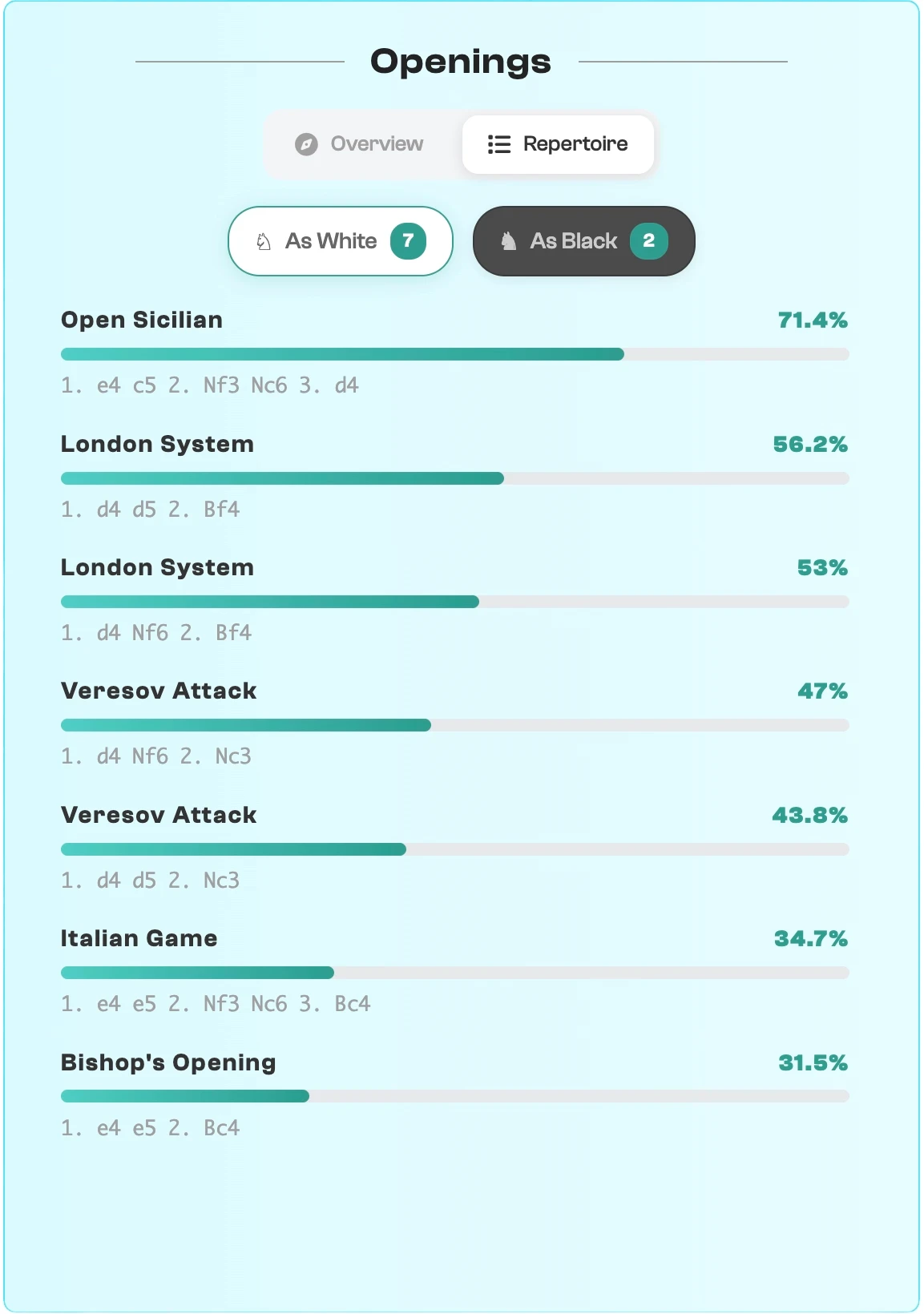
- Opening name: The specific opening or variation
- Frequency: How often the bot plays this line (as a percentage)
- Move sequence: The actual moves that define the opening
- Color: Whether it's a White or Black repertoire
The percentage shows how likely the bot is to enter that specific line when given the choice. Higher percentages mean more predictable opening choices.
Note that this is a summary of the line you're most likely to face when playing this bot. However, as with any human, the bot might mix it up even on the first move. If might play 1. e4 90% of the time, which sounds like like a lot, but that of course means every tenth game they will open with something else.
Using This Against Bots
Understanding a bot's opening style helps you prepare:
- Against Gamblers: Play solidly and don't take unnecessary risks. They'll try to complicate but may not know the positions deeply.
- Against Duelists: Study their specific repertoire. If you can avoid their preparation or know their lines better, you'll have a big advantage.
- Against Pragmatists: Don't expect opening advantages. Focus on outplaying them in the middlegame.
- Against Classics: Either prepare deeply against their specific lines, or play offbeat openings to take them out of theory.
Start Preparing
The opening book system is just one part of Bots 3.0. Combined with our new playstyle system, each bot now has a truly unique chess personality that you can learn and counter.
Check out any bot's profile to see their opening repertoire and style. Use this information to prepare your own opening choices. If you have questions or feedback, reach out in our Discord or contact us directly.