




Understanding Bot Playstyles

Every chess player has a style. Some attack relentlessly, others defend patiently. Some love tactical chaos, others prefer clean technical play. With Bots 3.0, every Chessiverse bot now has a measurable playstyle you can see, understand, and exploit.
What is Bots 3.0 and What Did We Change?
Bots 3.0 is our third major rework of how Chessiverse bots play chess. It's a significant improvement over 2.0, which we released about a year ago where we first introduced playstyles. The focus of 3.0 is giving each bot a more distinct, measurable playstyle that you can understand and exploit.
So did we change? The old bots relied solely on the neural net to introduce playstyles. We had bots trained on different games, and depending on what went in, the bots inherently played differently. We then measured this and categorized the bots on different criteria, like tenacity and temperament, and then grouped them into main categories (Guardian, Savage etc).
The end result was a step in the right direction, but the difference was simply not big enough. A guardian neural net didn't feel that different from a savage.
For bots 3.0, we use our Move Curator technique to strongly encourage certain behaviours. This way we can push the neural nets into certain directions. The moves are still generated by the neural net, but we evaluate them based on a whole host of criteria. For example a queen trade for a savage bot needs to be a very strong move for it to be selected, if there are valid alternatives, the bot will choose those more often than not.
The Different Styles
Every bot in Chessiverse is positioned on a 2D plane defined by two axes:
Defensive
Keeps the king safe and stays compact and solid. Unlikely to push pawns if it exposes their own king. Waits for an opportunity to counterattack rather than dictate the game.
Aggressive
Moves pieces towards the enemy king, pushes pawns aggressively, and might neglect their own king safety. Likely to overextend, but will put a lot of pressure on your position.
Complicating
Avoids exchanges and creates tension. Expect more complex positions with all the pieces still on the board.
These are measured on how much we encourage certain behaviours. For example a bot that is discouraged from trading pieces will get a higher complicating score and so on.
The Five Categories
Now that we have scores from the previous section, we can map it into a playstyle category. We do this to make it easy to find a bot that plays in a certain way. We have also tried to make clear distinctions between the categories, so you won't find bots that are on the border between these for now, they will all have distinct playstyles and therefore categories.
Below is an example. As you can see this bot is clearly in the Savage-area, and you'll find that it plays very aggressive and complicated.
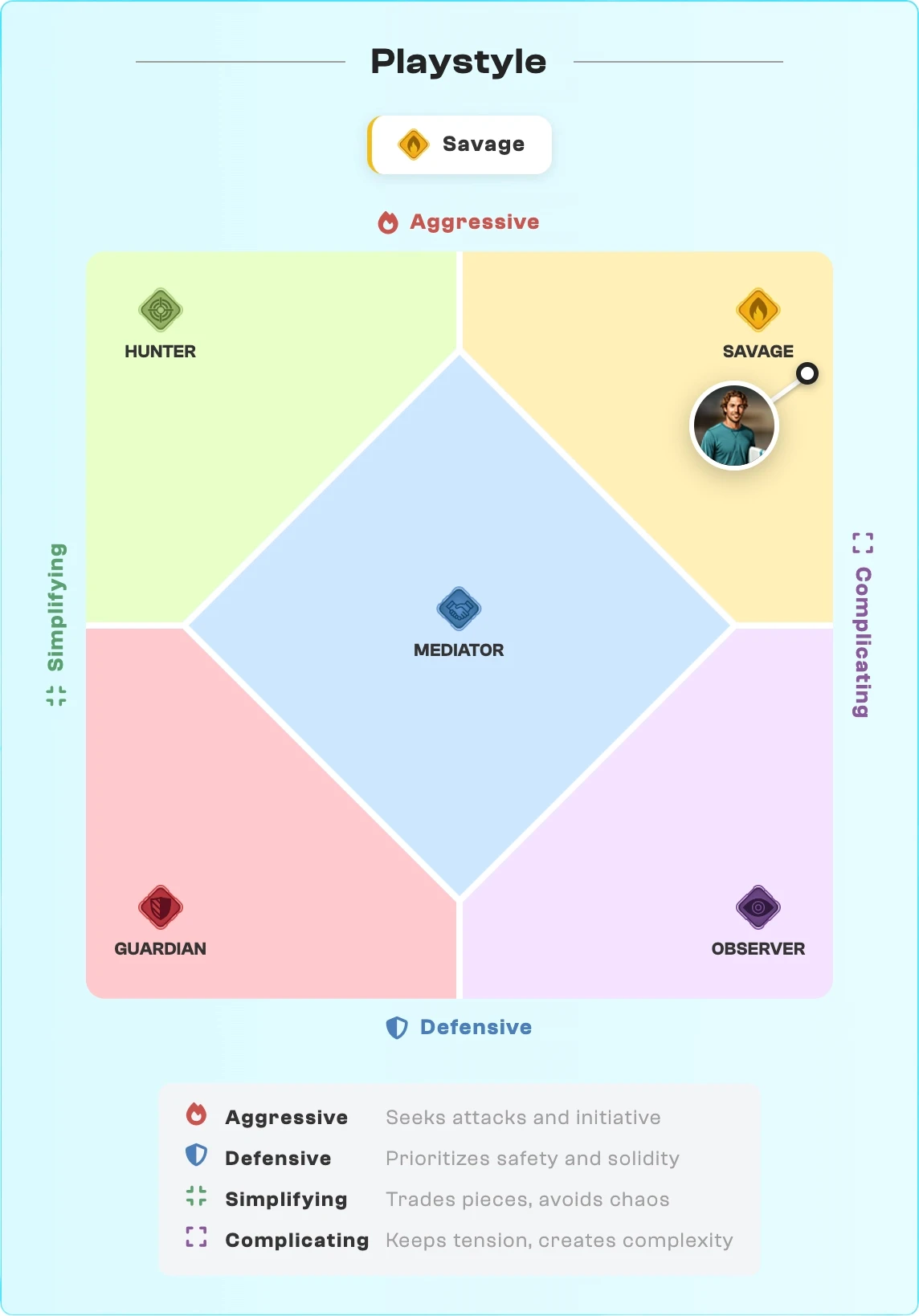 Below is what you can expect from each category.
Guardian
Defensive + Simplifying
The solid fortress builder. Guardians prioritize king safety, maintain clean pawn structures, and happily trade pieces to reach safe endgames.

Observer
Defensive + Complicating
The patient strategist. Observers play defensively but keep pieces on the board, waiting for the opponent to overextend. They thrive in complex positions where they can exploit mistakes.

Mediator
Balanced
The flexible all-rounder. Mediators sit in the center of the plane, adapting their play to the position. They don't have extreme tendencies, making them versatile and less predictable.

Hunter
Aggressive + Simplifying
The clean attacker. Hunters play aggressively but convert their attacks into clear advantages. They seek decisive combinations and trade down when ahead.

Savage
Aggressive + Complicating
The chaos creator. Savages attack relentlessly while keeping all the pieces on the board. They thrive in tactical melees where anything can happen.
How Playstyles Affect Strength
The playstyles do affect playing strength quite a bit. If we change a bot from being Mediator to a Savage, the absolute playing strength drops by a few hundred rating points. However, we compensate this by using stronger neural nets and less likelihood to blunder and similar levers. So a 2000 rated Savage will play at the same level as a 2000 rated Mediator, just much more aggressive.
Finding Your Counter-Playstyle
Understanding playstyles helps you choose the right strategy. This is of course true against bots or humans. Below are a few tips that you can try out:
- Against Guardians: Claim the free space and using it to coordinate your pieces and eventually find openings in their defence. But be aware to not overextend, just because a Guardian is defensive doesn't mean they won't pounce given the opportunity
- Against Observers: Observers will leave more pieces on and the positions can become complicated, it's even more important to coordinate and make sure you launch your attack at the right opportunity
- Against Hunters: Hunters will attack you relentlessly, but will also trade down given the right opportunity. Make sure you're ready for their attack and trade pieces to alleviate the pressure. Aggressive bots will leave opportunities for counterattacks, so don't miss it when it comes.
- Against Savages: Relentless attacking in complex position can be one of the most difficult playstyles to face. Be patient, try to trade pieces if possible, and make sure you pressure back when possible.
How Playstyles Affect Moves
Let's dig a bit deeper and look at actual move differences between the playstyles. Like I mentioned, our aim is to have the playstyles having a big impact on how the bots played, we don't want subtle differences you feel over many games, but rather every single game should be shaped by the playstyle.
To demonstrate this, I've selected four bots at similar ratings (around 2000), each with a different playstyle category. This way, we can see how the same position leads to very different move choices based purely on playstyle.

 Guardian
 Observer
 Hunter
 Savage
Position 1
This is a position from Carlsen-Ding, 2019, and Carlsen has just offered a queen trade with Qg2. Ding declined with Qc8, and Stockfish doesn't have any strong opinions really, a lot of moves are given about the same evaluation.
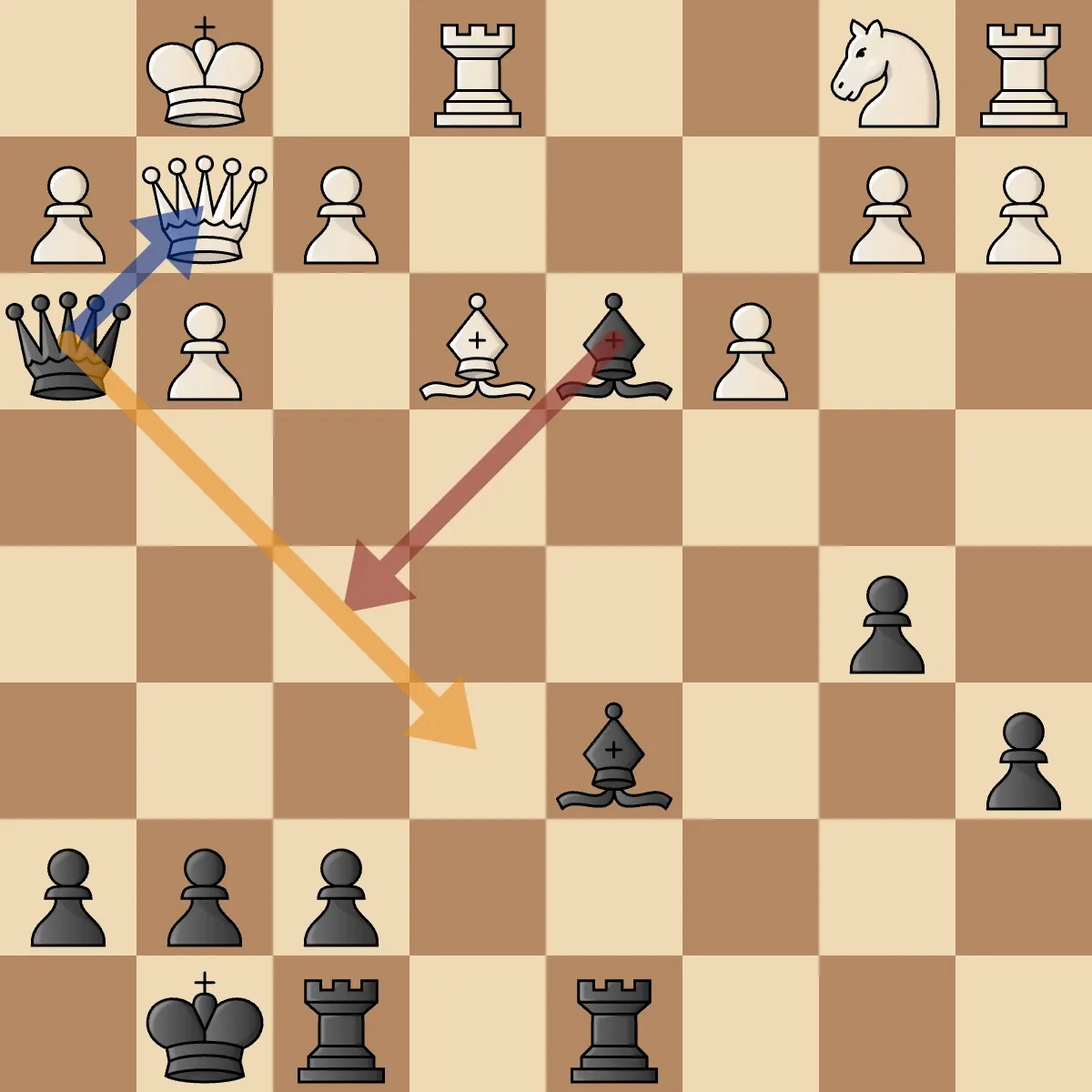
The four bots come up with three different moves between them.
Art E. Ficial and Oscar Overlap chooses Qe6. For Art, which is defensive and simplifying, this is a close call between trading queens and keeping the position compact, in this case it chooses the more compact move. For Oscar it makes a lot of sense, keeping queens on, while thinking about king safety.
Marco Mirror chooses the queentrade with Qxg2. This is again a close call between a more aggressive mindset and simplifying the position.
Betty Rookwood chooses Bf5, but it's interesting to note that it's not considered a "playstyle" move, which means the bot didn't really find a move that is following the playstyle more than others, which means it falls back to a "normal" move. So Bf5 is not indicative of an aggressive+complicating playstyle, but rather a sign of not fitting moves being find (which is of course not always the case).
Position 2
Another position from Carlsen, this time it's Carlsen-Topalov, 2015. White is not castled yet and instead pushing on the queenside.
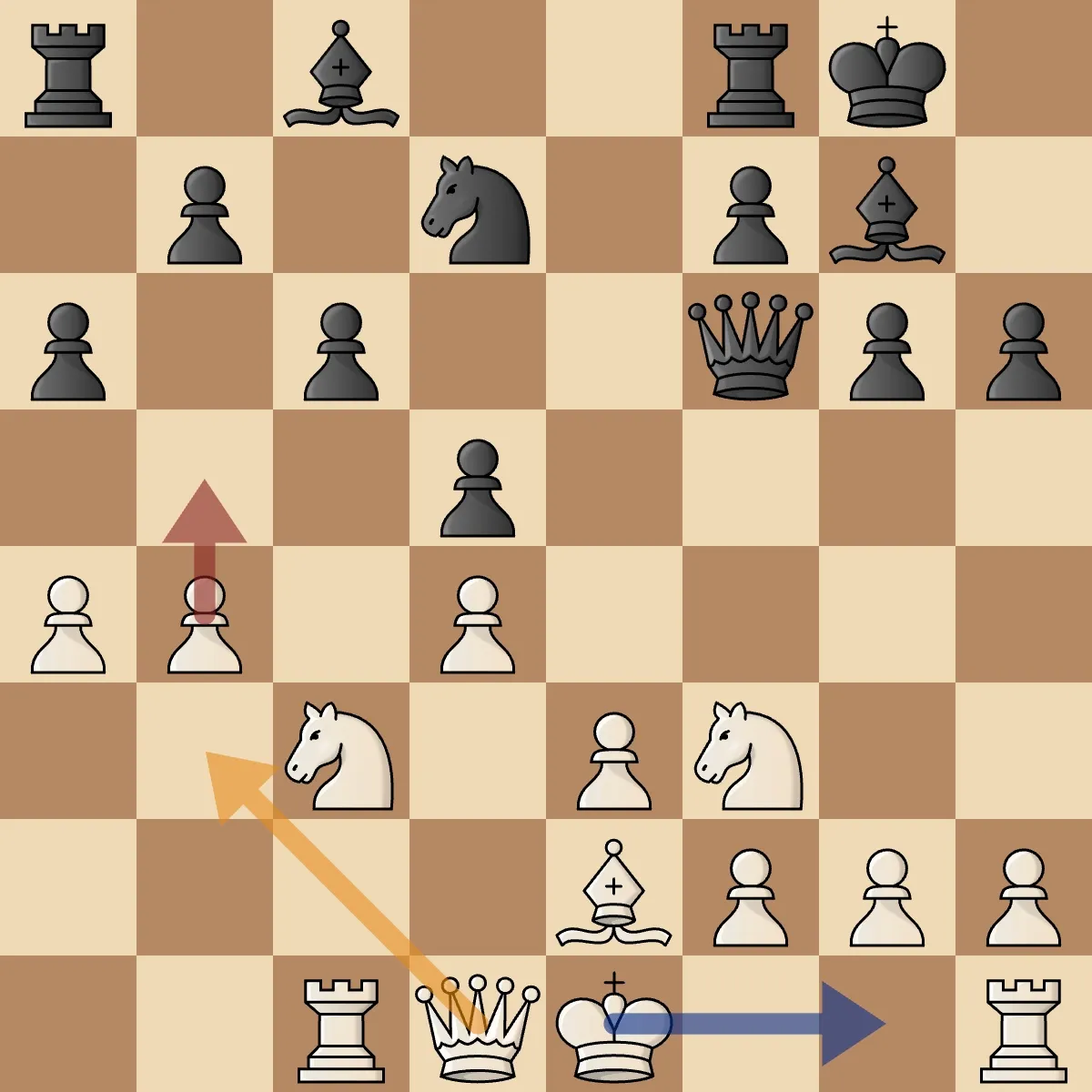
Again the bots pick three different moves between them.
Betty Rookwood and Oscar Overlap goes for the aggressive looking b5. This makes a ton of sense for Betty, who are looking for space and complications. In this specific position there's no clear path to the black king, so attacking on the queenside suffices. Oscar is also looking for complications, and in this case favors that over castling (which would be a close second).
Art E. Ficial non-surprisingly goes for safe castling.
Marco Mirror also chooses an aggressive looking move over castling. In this case it's the aggressiveness of the Hunter playstyle shining through.
Conclusion
As you can see, these four bots are around the same rating, but choose very different moves. Sometimes they overlap, sometimes there are only "normal" moves to choose from, but over the course of a game you will see a lot of moves indicative of their assigned playstyles.Start Exploring
The playstyle system is just one part of Bots 3.0. Combined with our new opening book system, each bot now has a truly unique chess personality that you can really feel in every move.
We're excited to see how you use this to improve your game. If you have questions or feedback, reach out in our Discord or contact us directly. We're always looking for ways to make our bots feel more human.