



The Science Behind Human-Like Chess Bots
At Chessiverse, our goal is simple yet ambitious: make chess bots feel as human as possible. Traditional chess engines play with machine-like precision that feels nothing like facing a real person. Our bots are different. Each one has a distinct personality, playing style, and set of tendencies that make every game feel like sitting across from a unique human opponent.
This guide explains the complete process of how we design, train, and refine hundreds of chess bot personalities so that every bot you face on Chessiverse offers a fresh, realistic challenge when you play chess against computer opponents. If you'd rather skip the methodology and just browse the catalog of opponents, visit our chess bot page.
The Two Core Components of Every Chess Bot
Every chess bot, whether it is a simple beginner or a grandmaster-level engine, is built from two fundamental components that work together to produce moves.
The Search Engine
The search component scans ahead through possible move sequences, exploring lines deeply to find the strongest continuations. This is the raw computational power of the bot. It determines how far ahead the bot can calculate and how many variations it considers before choosing a move.
Search gives a bot its strength. A deeper search means the bot considers more possibilities and is less likely to miss important tactical ideas.
The Evaluation Function
The evaluation component decides how good any given position is. Classic chess engines used hand-tuned mathematical formulas that weighted factors like material balance, king safety, pawn structure, and piece mobility. Modern engines, including ours, use neural networks that learn to evaluate positions by studying millions of games.
Evaluation gives a bot its personality. Two bots with the same search depth but different evaluation functions will play completely different chess. One might love open positions with active pieces, while another prefers closed, strategic battles.
Bot Technology Comparison
| Approach | How It Works | Realism | Weakness |
|---|---|---|---|
| Traditional engine + difficulty slider | Reduce search depth or add random errors | Low — alternates between perfect and random | Unrealistic mistake patterns |
| Weakened neural network | Train one network, reduce confidence | Medium — somewhat human-like | Still one "personality" for all |
| PersonaPlay (Chessiverse) | Unique neural network per bot + custom opening book | High — consistent, human-like at each rating | Requires extensive calibration |
How Chessiverse Trains Its Neural Network Bots
We lean heavily on neural networks for our bot training process. Instead of manually programming a specific playing style, we train models on varied datasets and then measure the results. The beauty of this approach is that distinct personalities emerge naturally from the training process.
A neural network trained on aggressive grandmaster games may emerge as a sharp tactician, while one trained on solid positional play develops into a cautious strategist. Some networks surprise us by developing unusual tendencies that we did not anticipate, creating bots with genuinely unique characters.
This diversity is exactly what we want. When you play against 1000+ Chessiverse bots, you should encounter as many different playing experiences as possible, just like you would facing different human opponents in a tournament. See how this variety translates into practical training by reading about the benefits of playing Chessiverse bots.
How We Control Bot Strength and Playing Style
Creating bots that play at different strength levels while maintaining realistic behavior is one of the biggest technical challenges we face.
Search Depth Adjustment
The most straightforward way to weaken a bot is to reduce its search depth. A bot that looks three moves ahead is naturally weaker than one that calculates ten moves deep. However, simply reducing search depth can create unnatural play where the bot makes moves that no human would consider.
The Move Curator System
To solve this problem, we developed the Move Curator, a filtering system that monitors the bot's move choices and flags anything that looks unnatural. When the bot selects an odd move, such as a reckless king walk or an inexplicable piece sacrifice with no follow-up, the Move Curator flags it and consults a stronger engine for approval.
If the stronger engine confirms the move is within an acceptable range of play, it stands. If not, the bot reconsiders. This system ensures that even our weakest bots lose in believable ways, through realistic mistakes like missing a fork, misjudging a trade, or choosing a slightly inferior plan rather than through random piece drops that no human would make.
How Bot Personalities Are Discovered
One of the most common questions we receive is whether we program each bot's personality directly. The answer is that styles are mostly discovered, not assigned. Here is how the process works:
After training a neural network, we run thousands of automated games and analyze the results using comprehensive style metrics, similar to the "Style Report" feature in ChessBase. This analysis reveals each bot's natural tendencies across dimensions like aggression, positional play, tactical sharpness, risk tolerance, and endgame preference.
Based on these measurements, we categorize bots into the PersonaPlay framework:
- Guardian bots emerge from networks that naturally play solid, defensive chess
- Savage bots come from networks that gravitate toward aggressive, sacrificial play
- Observer bots develop from networks that prefer quiet, positional maneuvering
- Hunter bots arise from networks that consistently seek tactical complications
- Mediator bots result from networks that play balanced, practical chess
This discovery-based approach produces more authentic personalities than manual programming ever could. Each bot's style is genuinely its own, not an artificial overlay.
Opening Repertoire Design
Openings are the primary lever we adjust to give bots human-like flavor at every rating level. We use two approaches:
Fixed Opening Repertoires
Some bots have carefully curated opening repertoires based on human games played at their target rating level. A bot rated 1200 will play the same openings that real 1200-rated players choose, complete with the typical inaccuracies and suboptimal lines that characterize play at that level.
This approach creates immediately recognizable playing patterns. When you face a fixed-repertoire bot, its opening choices feel familiar and human because they are drawn directly from real human games.
Statistical Opening Bots
Other bots use statistical opening selection, mirroring the probability distributions of how humans at a given rating choose their openings. For example, after 1.e4, a statistical bot might play the French Defense 15 percent of the time, the Sicilian 30 percent, and the Caro-Kann 10 percent, matching the real distribution at its rating level.
This keeps play fresh and unpredictable without requiring us to create thousands of separate bots for every possible opening preference. You might face the same statistical bot multiple times and encounter a different opening each game.
Why Chessiverse Creates Hundreds of Bots
A single perfect chess engine, no matter how strong, provides a limited training experience. Chessiverse is about breadth, not just peak strength. With 1000+ bots and plans to scale to 30,000 to 40,000 in coming years, players can train against:
- Different skill levels from absolute beginner to expert
- Different playing styles across all five PersonaPlay categories
- Different opening preferences and repertoire depths
- Different tendencies in middlegame strategy and endgame technique
This variety means you never plateau from facing the same type of opponent. Every bot presents a new challenge, a new personality to understand, and a new opportunity to develop your skills. Our recent expansion added 40 new bots in one update alone -- read about the new bot system with updated ratings for details. Understand exactly how strong each bot is by learning about how Chessiverse ratings work.
The Challenge of Designing Natural Mistakes
One of the most surprising aspects of bot development is that creating believable weaknesses is harder than creating strength. Players are remarkably forgiving of their own blunders but expect bots to make "smart mistakes."
Even a bot designed to play at the 800 level must lose pieces in believable ways. A real 800-rated player might lose a bishop to a discovered attack they did not see, or trade into a losing endgame because they misjudged the resulting position. These are natural, understandable errors.
What feels wrong is when a bot randomly drops a piece on an empty square for no reason, or makes a move that has no chess logic behind it. Designing bots that make the right kinds of mistakes at every level is an ongoing engineering challenge that we take seriously. For a detailed look at how we ensure ratings reflect this nuance, see our guide on everything you need to know about Chessiverse bot ratings.
How Bots Express Personality Through Chat
Beyond playing style, we experimented with chat messages to give bots a voice during games. These messages are generated from a combination of evaluation data (how the bot thinks the game is going), time usage patterns, and bot-specific personality traits, then refined using AI language models.
The results add an extra dimension to the playing experience, but we acknowledge they are still a work in progress. Our current focus is on improving message quality and ensuring they feel authentic to each bot's character rather than generic. We are rethinking the system to prioritize fewer, higher-quality messages over constant commentary.
AI-Generated Art for Bot Avatars
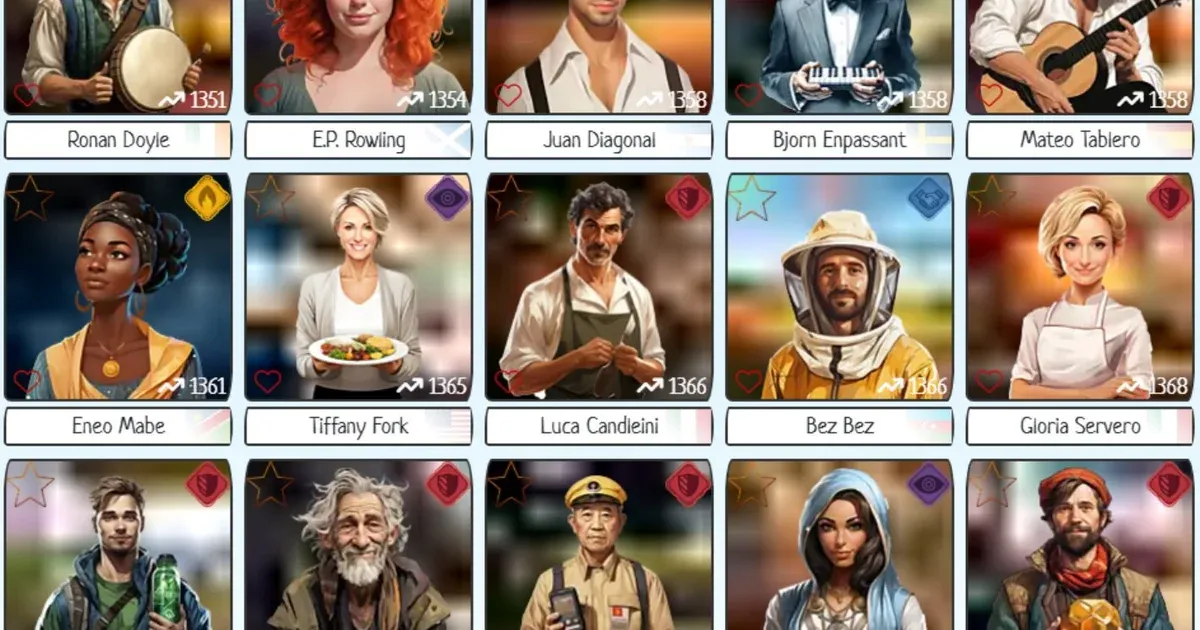
With 1000+ bots and thousands more planned, commissioning custom artwork for each character is not feasible. We use AI-generated art to give every bot a unique face and visual identity that matches its personality and backstory.
This approach allows us to maintain visual diversity across the entire bot library while keeping development sustainable. As AI art technology improves, we plan to enhance the quality of these portraits and potentially blend AI-generated elements with artist input for our most popular characters.
The Ongoing Craft of Building Human-Like Chess Bots
Building lifelike chess bots is not a solved problem. It is an ongoing craft that combines neural network training, intelligent filtering systems, curated opening books, and careful personality discovery. Each component works together to create bots that feel human, from the moves they play to the mistakes they make.
If you ever spot a bot making a puzzling move, share it in our Discord community or send feedback directly through the platform. Your games help us shape the next generation of Chessiverse personalities. Unlock the full experience with Chessiverse Premium for access to all bots and advanced training features, or see how our approach compares with rivals in Chessiverse vs Noctie.
Related Comparisons
- Chess Bot Rating Accuracy — How honest are bot ratings across platforms?
- Best Chess Bot Personalities — How platforms create AI characters