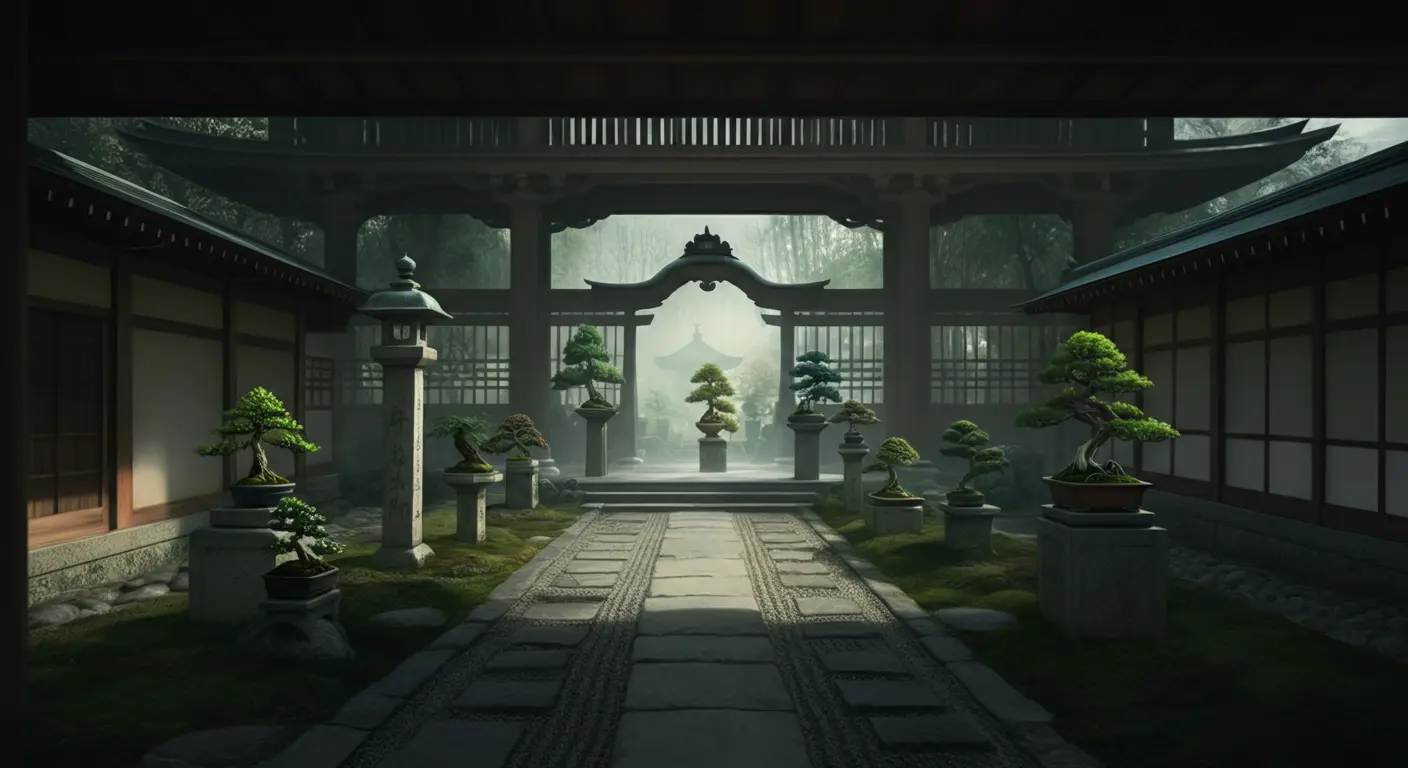
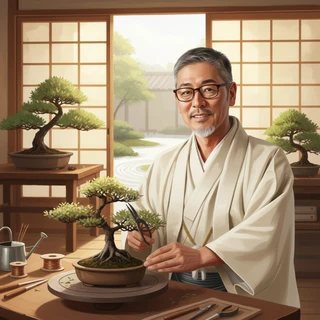
Konnichiwa friend... Sit by my bonsai table... Chess grows like a tree... Patience feeds the root... Knight moves like wind through cedar... Return we shall play... Checkmate comes softly... like autumn claiming the leaves... Be still then begin... 🌿
Hiro Bonsai is a 62-year-old bonsai artist from Japan who approaches chess with the same care he gives his miniature trees. His backstory describes living sculptures of great precision, and he sees the strategic elegance of chess reflected in that craft. His favorite quote pairs nature's wisdom and patience with the delicate dance of chess, and an ancient jade pendant is his lucky charm. With an estimated Elo of 2095, Hiro sits in the strong club player range, with a refined positional sense, a reliable tactical eye, and a working knowledge of the main lines of opening theory. As White he leans on e4 systems, most often the Vienna Game (265 games on file), followed by the open Sicilian with d4, the Exchange Caro-Kann, and the Classical French. These choices show a taste for classical centers and early tension rather than quick simplification. Players who face Hiro should expect a patient but pressing opponent who keeps the position complicated and looks for chances to attack.
How Hiro plays
Hiro plays aggressively, preferring initiative and attacking plans over passive defense. His defining trait is keeping tension on the board, since he almost always avoids trades that would simplify the position. His lines are moderately sharp rather than wild, and he leans slightly toward established theory instead of offbeat ideas. Typical examples include the Vienna Game and the Exchange Caro-Kann, where White builds a strong center and plays for activity.
Who should play Hiro
Players rated roughly 1850 to 2300 will get the most from facing Hiro, whose estimated rating is 2095. Because he plays aggressively and refuses to simplify, the matchup suits those who want to improve at handling prolonged tension, calculating in complex middlegames, and defending against initiative. Club players who usually trade pieces early to reach comfortable endgames will be pushed out of that habit and forced to find active counterplay.