

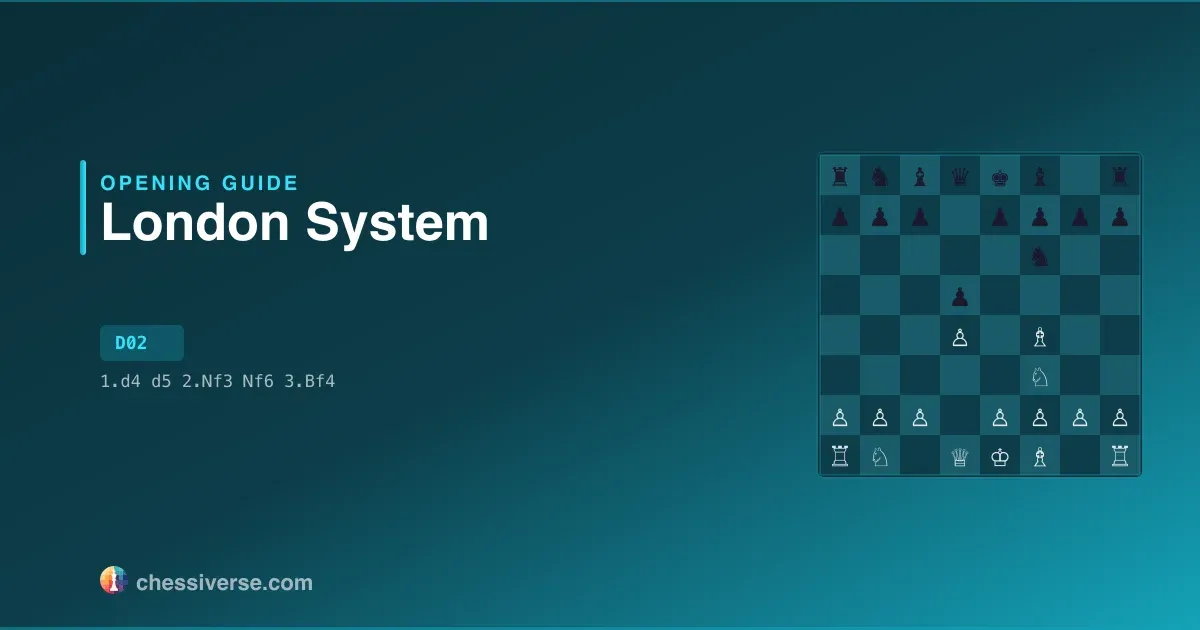
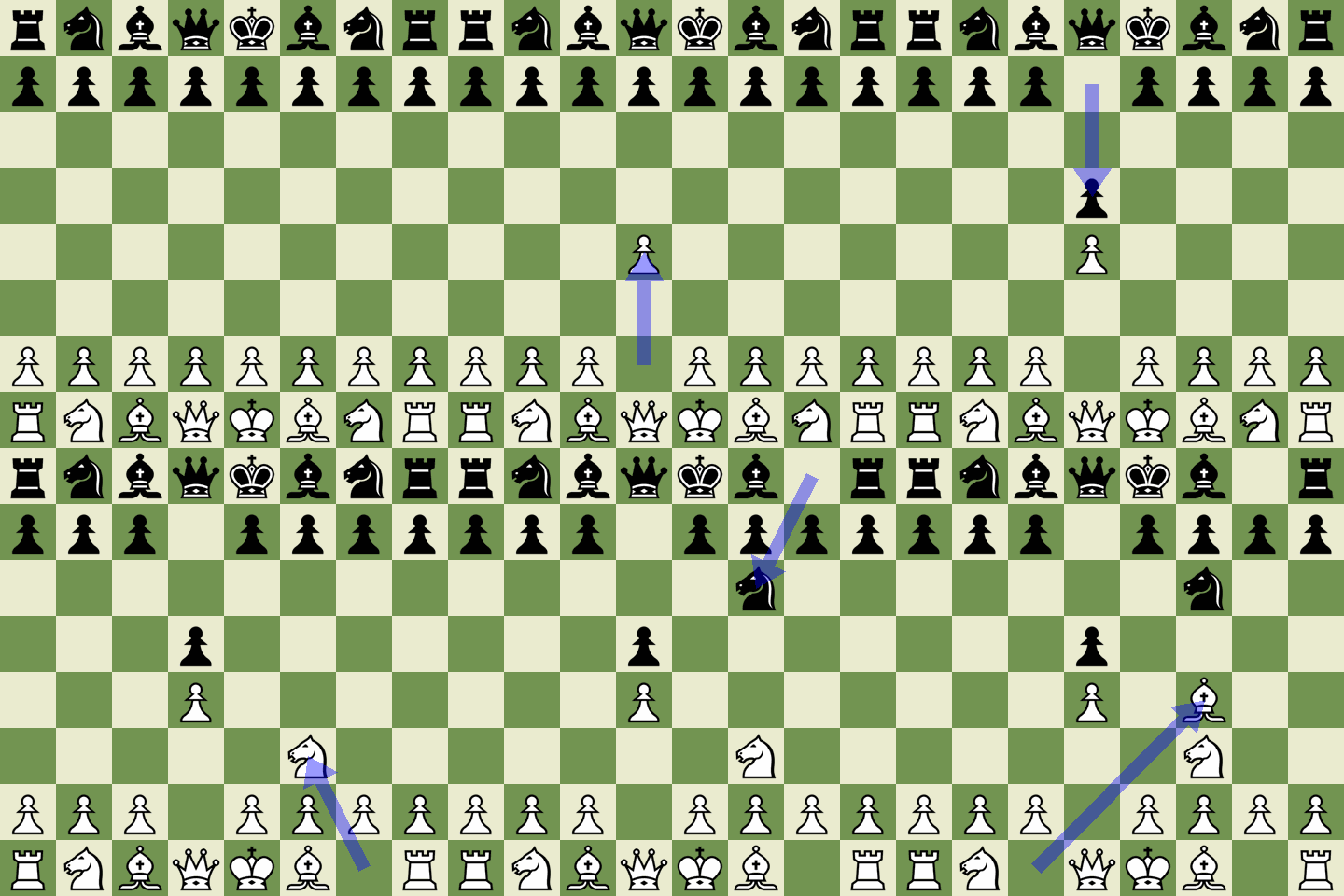
The London System arises after 1.d4 d5 2.Nf3 Nf6 3.Bf4 and falls under ECO code D02. In this system, White's plan revolves around supporting d4 with e3 and eventually establishing a knight on e5, where it is reinforced by both the e-pawn and the dark-squared bishop. By developing the bishop to f4 before playing e3, White avoids entombing it behind the pawn chain. A hallmark of the London System is its flexibility: White follows the same general strategic blueprint regardless of Black's setup, and the specific move order is highly adaptable. The same position can also be reached via the Accelerated London (1. d4 d5 2. Bf4 Nf6 3. Nf3). Black has several ways to challenge the structure, including ...c5 to strike at the centre and ...Qb6 to target the b2 pawn, which is left somewhat exposed after the bishop has moved away from the queenside. With 17.9 million Lichess games across all rating levels, it is one of the most popular openings.
- White builds the same solid structure against almost anything: d4, Bf4, e3, c3, Nbd2 and Bd3, developing the bishop before it gets shut in by e3.
- A key plan is parking a knight on e5, where it is supported by the d4 pawn and the dark-squared bishop.
- Against a castled king, White can sometimes sacrifice the light-squared bishop on h7 and follow up with Qh5+.
History and Notable Players
It arises from the Queen's Pawn Systems (1...d5). Among the most prolific practitioners on the White side are Pia Cramling (248 games), Ulf Andersson (182 games), Michal Krasenkow (154 games). On the Black side, notable exponents include Oleg Korneev (118 games), Jonny Hector (111 games), Zoltan Varga (103 games).
Irish-American master James Mason was the first to use the setup regularly, in tournaments of the 1880s. It took its name from the London 1922 tournament but stayed rare in master play for decades. A 2005 book by Johnsen and Kovacevic helped spark a 21st-century boom, and it is now hugely popular at club level.
Named after: The London 1922 tournament, where the setup appeared seven times in games involving stars like Capablanca, Alekhine and Rubinstein.
Notable players: James Mason, Gata Kamsky, Magnus Carlsen, Ding Liren
Often mocked for producing repetitive, low-drama chess, the London had the last laugh in 2023: Ding Liren used it to beat Ian Nepomniachtchi in Game 6 of their World Championship match.
Statistics
Based on 17.9 million Lichess games across all rating levels:
- White wins: 50.5%
- Black wins: 44.2%
- Draws: 5.3%
White holds a moderate edge statistically, though Black has good practical chances.
Practice on Chessiverse
The best way to learn the London System is through practice. On Chessiverse, you can play chess against computer opponents that specialize in this opening. Our AI bots range from beginner to grandmaster level, each with unique playing styles — from aggressive attackers to solid defenders. Choose a bot that matches your rating and work your way up as you master the opening's key ideas.
Performance Across Rating Levels
How well the London System works depends on what level you're playing at. The 1200 bracket has 1,983,699 games (0.29% of all games at that level); White wins 52.4%, Black 43.6%, 4% are drawn. At 1800 the opening surfaces in 0.47% of games; White wins 49.9%, Black 44.4%, draws 5.7%. Among 2500-rated players the line appears in 0.68% of games and draws spike to 11%, indicating tight preparation. White's edge erodes by 4.9pp from 1200 to 2500 Elo, suggesting Black's counterplay is easier to find with experience.
Time Control Patterns
Look at the same opening across time controls and blitz stands out. In bullet, it appears in 0.31% of games (8,266,989); White wins 52%. Blitz shows 0.40% adoption across 14,290,055 games, White scoring 50.6%. In rapid, the share rises to 0.33% — 3,623,707 games, White 50.3%.
Move Diversity and Theory Depth
What players actually play after the opening moves depends heavily on rating. At 1200 Elo (1,983,699 games), the top reply is Nc6, played 33.5% of the time. Four other moves each take at least 5% of games, and the top three moves account for 73.2% of games. Entropy: 2.68. By 2500 (92,283 games), c5 takes over as the top reply at 55.8%; only three other moves still reach 5% and the top three moves account for 89.6% of games. Entropy drops to 1.83. The narrowing is significant — strong players consolidate around a small set of best moves, while amateurs scatter across many plausible-looking options.
Historical Trends
Long-term, the trajectory of this opening is informative. Adoption peaked in 2023 at 0.40% (3,205,332 games). By 2025 it sits at 0.39%, 2% below the peak but still 191% above its 2013 level, so the line is up over the full period despite easing from the high.