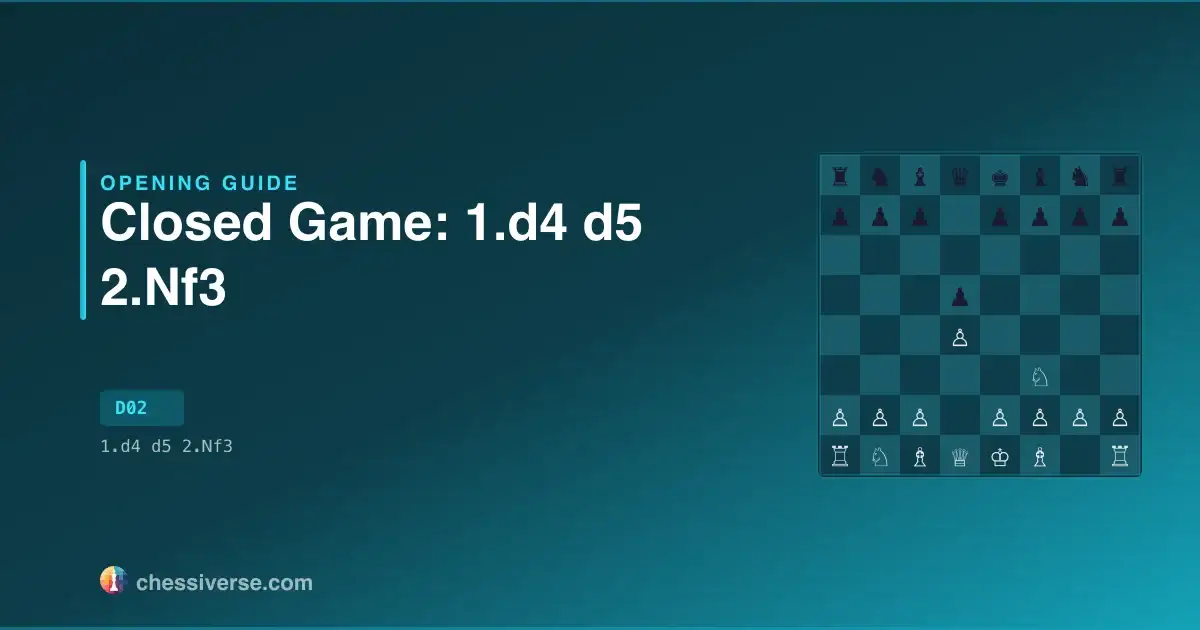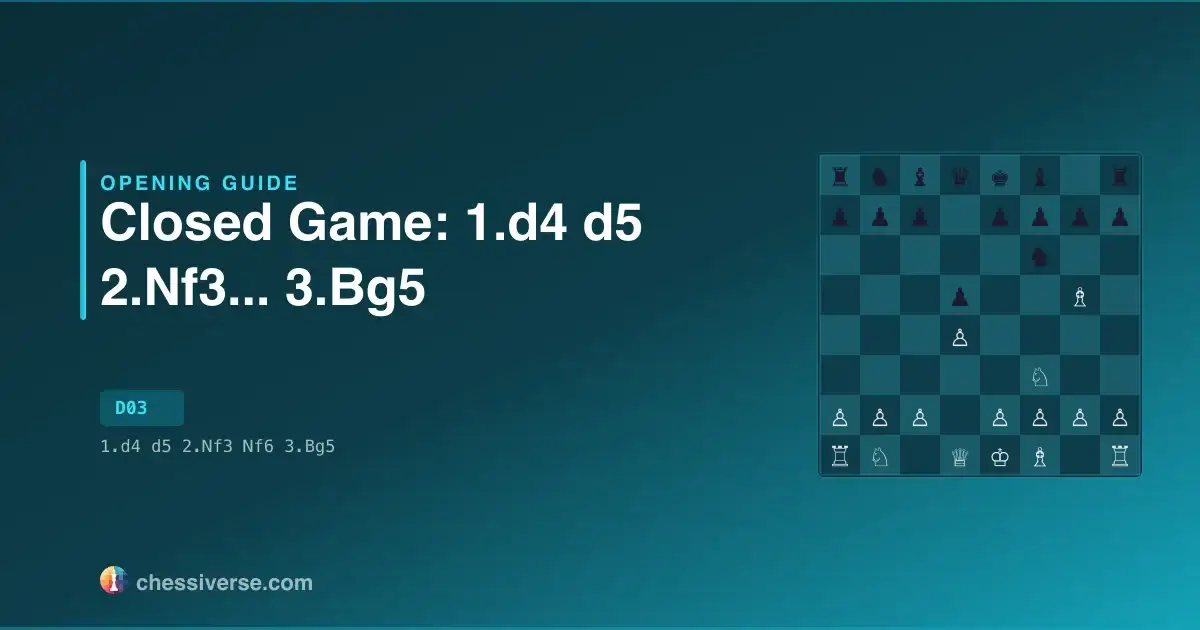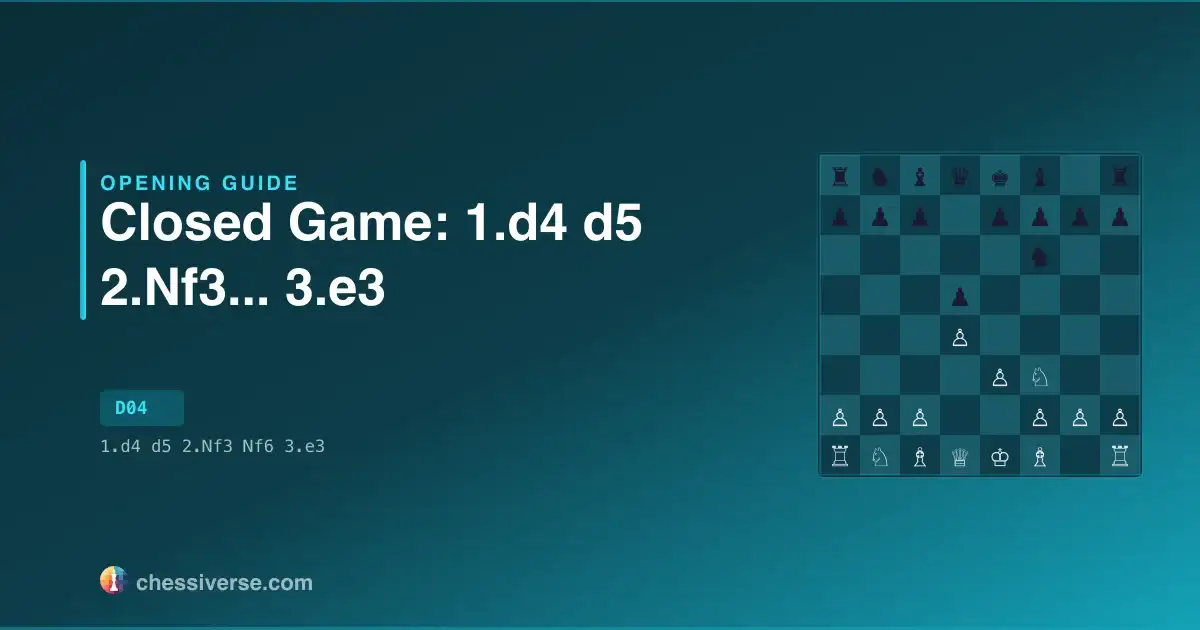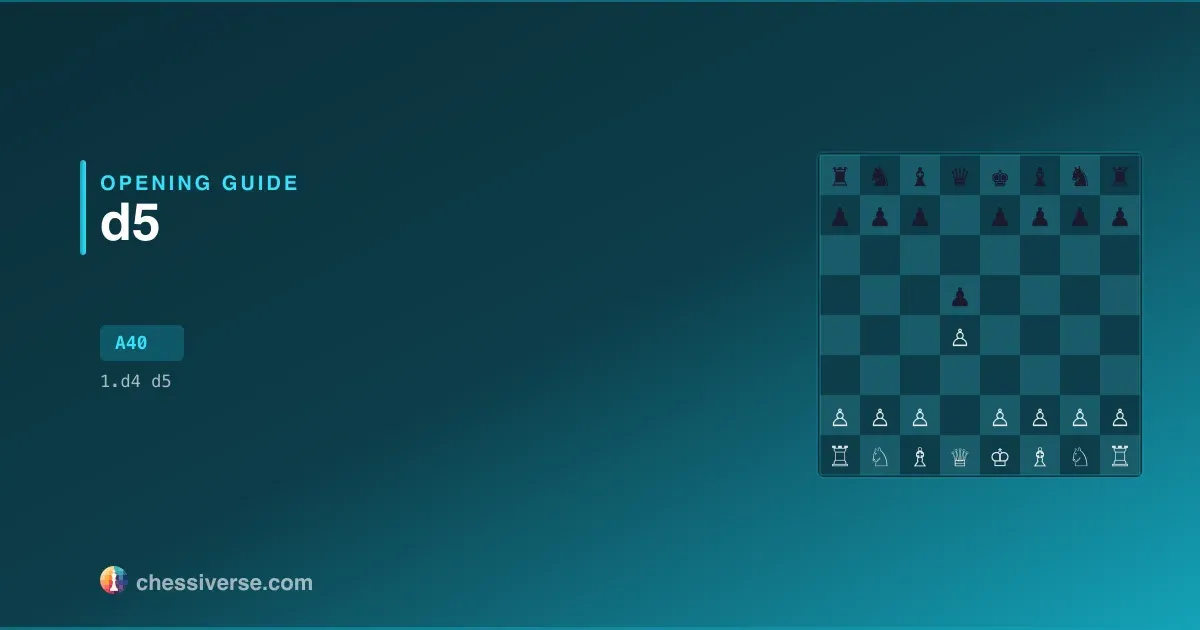
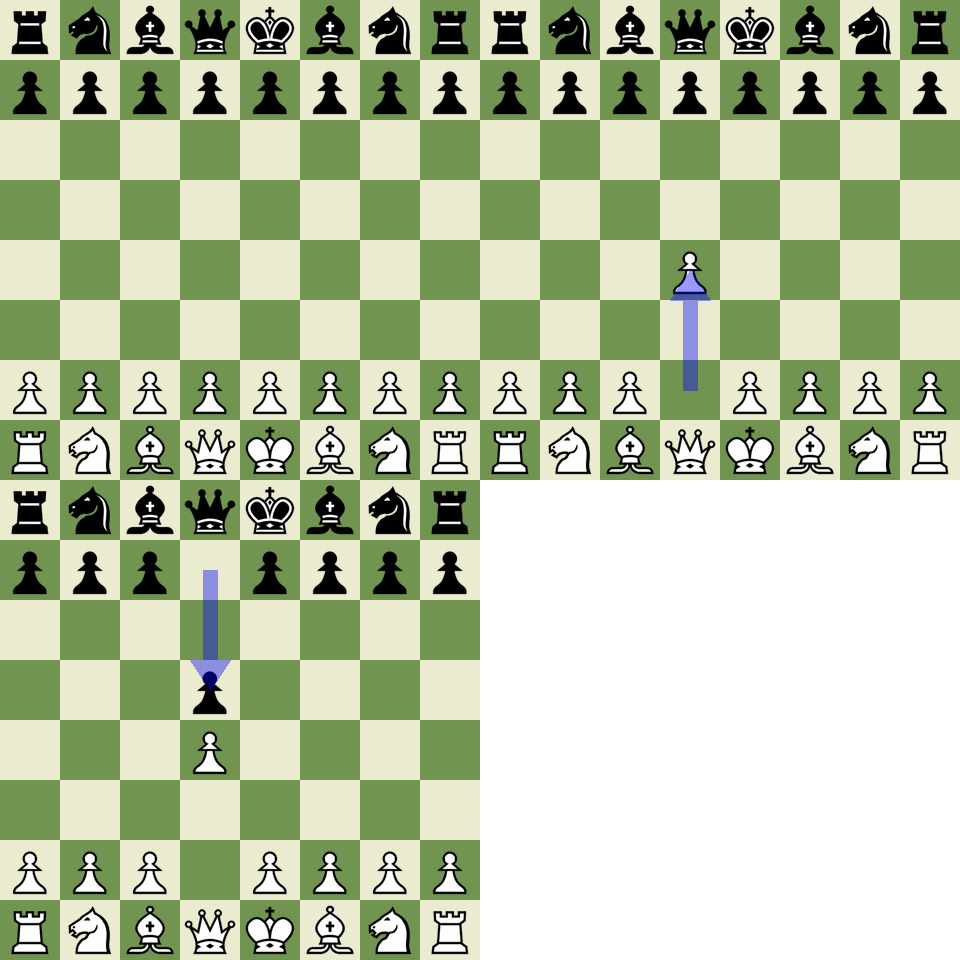
The Queen's Pawn Systems (1...d5) arises after 1.d4 d5 and falls under ECO code D00. The Queen's Pawn Opening begins with White seizing central territory: the d4 pawn directly covers c5 and e5, and the queen now surveys the d-file. It also opens a diagonal for the queenside bishop to enter the game later. As the second most popular first move after 1. e4, the Queen's Pawn opening produces games that are generally more closed and positional than the tactical battles common in King's Pawn openings, largely because the d4 pawn is already protected by the queen, making the early moves less forcing. White's strategic aim is less about rapid piece development and more about restraining Black's counterplay. Left unchecked, White would follow up with 2. e4 to establish a dominant two-pawn centre and enjoy comfortable development in the resulting space. Black's primary task, therefore, is to prevent this, and the most effective way to do so is to control the e4 square. With 523.3 million Lichess games across all rating levels, it is one of the most popular openings.
- Unlike the e-pawn after 1.e4, the d-pawn is guarded by the queen from move one, which steers play toward slower, more positional battles.
- White's main try is 2.c4, the Queen's Gambit, immediately creating pawn tension against the d5-pawn.
- White can instead avoid tension entirely with setup systems like the London, Colle or Stonewall, developing the same piece formation every game.
History and Notable Players
It arises from the Queen's Pawn Game. Among the most prolific practitioners on the White side are Ivan Farago (1797 games), Aleksey Dreev (1577 games), Loek Van Wely (1401 games). On the Black side, notable exponents include Viktor Korchnoi (841 games), Vassily Ivanchuk (751 games), Viswanathan Anand (730 games).
Meeting 1.d4 with 1...d5 is Black's traditional answer, and it was already hugely popular by the early 20th century as masters looked beyond 1.e4. Today it is still the second most common reply to 1.d4, edged out only by 1...Nf6 and the Indian defences.
Named after: Not a person: the label reflects the traditionally blocked, strategic positions these openings produce; it is also called the Double Queen's Pawn Opening.
Ding Liren beat Ian Nepomniachtchi with the London System in game six of the 2023 World Chess Championship.
Statistics
Based on 523.3 million Lichess games across all rating levels:
- White wins: 51.3%
- Black wins: 44%
- Draws: 4.6%
White holds a moderate edge statistically, though Black has good practical chances.
Main Lines and Variations
After 1.d4 d5, the main continuations include:
Each of these lines leads to distinct types of positions and requires its own understanding of the resulting pawn structures and piece placements.
Practice on Chessiverse
The best way to learn the Queen's Pawn Systems (1...d5) is through practice. On Chessiverse, you can play chess against computer opponents that specialize in this opening. Our AI bots range from beginner to grandmaster level, each with unique playing styles — from aggressive attackers to solid defenders. Choose a bot that matches your rating and work your way up as you master the opening's key ideas.
Performance Across Rating Levels
How well the Queen's Pawn Systems (1...d5) works depends on what level you're playing at. At 1200 Elo, the opening shows up in 11.83% of games (79,834,468 samples). White scores 51.6%, Black 44.4%, draws 4%. By 1800, popularity is 10.71% and White's score is 51.4% to Black's 43.5%. At 2500, 9.26% of games go into this opening; draws sit at 10.8% — the line is well-mapped at this level. White's edge erodes by 4.1pp from 1200 to 2500 Elo, suggesting Black's counterplay is easier to find with experience.
Time Control Patterns
Look at the same opening across time controls and rapid stands out. In bullet, it appears in 9.17% of games (243,760,537); White wins 52.4%. Blitz shows 11.01% adoption across 395,768,569 games, White scoring 51.4%. In rapid, the share rises to 11.52% — 127,493,614 games, White 51.1%.
Move Diversity and Theory Depth
Looking at move selection shows how forcing — or not — the position really is. At 1200 Elo (79,834,468 games), the top reply is c4, played 31.8% of the time. Four other moves each take at least 5% of games, and the top three moves account for 69.4% of games. Entropy: 2.62. By 2500 (1,263,318 games), c4 dominates at 56.3% of replies; only three other moves still reach 5% and the top three moves account for 89.7% of games. Entropy drops to 1.82. The narrowing is significant — strong players consolidate around a small set of best moves, while amateurs scatter across many plausible-looking options.