



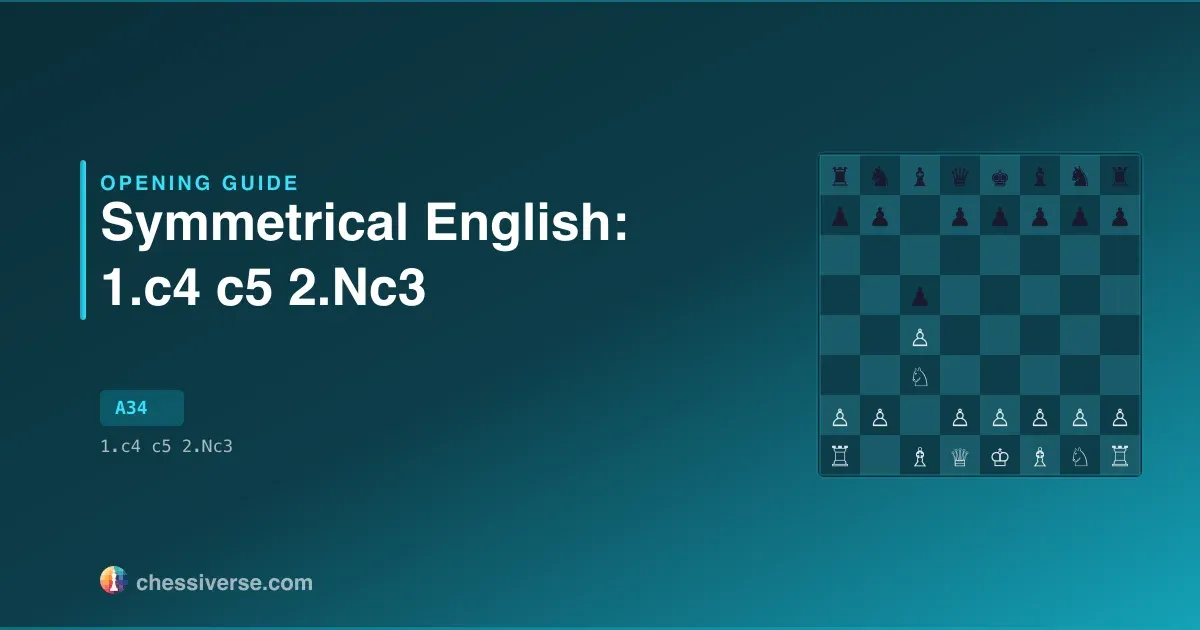
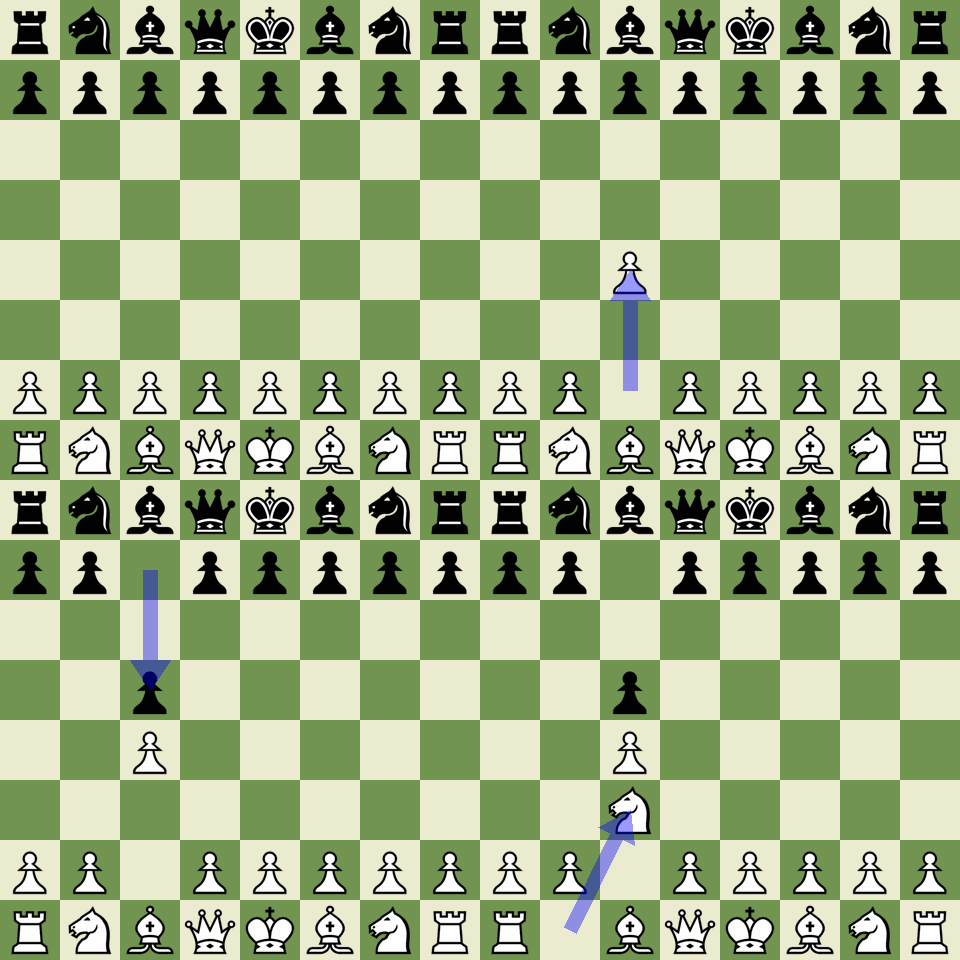
Starting from 1.c4 c5 2.Nc3, players enter the English Opening: Symmetrical Variation, Normal Variation — ECO A34. White takes the slow road — develop pieces first, break symmetry later. The Nc3 makes ...d5 harder for Black and signals long-term strategic play rather than quick tactical fireworks.
Strategic Overview
2.Nc3 in the Symmetrical English is the move for players who want to outmaneuver opponents rather than outprepare them. By piling on d5 immediately, White makes it harder for Black to play ...d5 in one move and forces Black into more committal setups. The most common Black reply is 2...g6, leading to a King's Indian-style fianchetto that equalizes cleanly. After 3.g3 Bg7 4.Bg2 Nc6 or 3.e3 Nf6 4.d4 Bg7, Black gets a solid structure with no real weaknesses. The other path is 3.e3 followed by d4, when Black can simply take with ...cxd4 and reach an equal position with the Bg7 pressuring along the long diagonal. White's best practical chances come from setups where Black plays less precisely. The middlegame in these lines is strategic — both sides need to find the right pawn break and the right moment to deviate from symmetry. White retains a small edge from the extra tempo but no concrete advantage. It's the kind of opening that suits patient positional players who want a quiet game where understanding eventually pays off over the long stretch.
Key Ideas
When players succeed in this line, they usually do so by leaning on the following themes:
- Pile on d5 to restrict Black's options — Two knights pressuring d5 stops Black from getting the ...d5 break in one move. Black has to either play ...g6 setups or commit to other structures.
- 2...g6 is the clean equalizer — King's Indian-style fianchetto setups give Black a solid structure regardless of which third move White picks. The Bg7 on the long diagonal balances the position.
- White's edge is small but real — The tempo advantage from playing first matters in symmetrical structures. White can usually get pawn breaks in one tempo earlier than Black, which adds up over the long game.
- Strategic patience over tactical sharpness — Don't expect early fireworks. The opening rewards understanding of pawn structure dynamics and the ability to outplay opponents in slow positions.
History and Notable Players
It arises from the Symmetrical English. On the White side, Normunds Miezis (97 games), Vladimir Sr Bukal (40 games), Karol Ruckschloss (30 games) top the database. Notable Black exponents: Gyozo V Forintos (23 games), Keith C Arkell (22 games), Normunds Miezis (21 games).
Performance Across Rating Levels
How well the English Opening: Symmetrical Variation, Normal Variation works depends on what level you're playing at. At 1200 Elo, the opening shows up in 0.11% of games (741,046 samples). White scores 52.4%, Black 43.8%, draws 3.8%. Move up to 1800 Elo and the share shifts to 0.29%, with White winning 50.6% versus Black's 44%. At 2500, 0.21% of games go into this opening; draws sit at 10.2% — the line is well-mapped at this level. White's edge erodes by 6.5pp from 1200 to 2500 Elo, suggesting Black's counterplay is easier to find with experience.
Time Control Patterns
Look at the same opening across time controls and bullet stands out. In bullet, it appears in 0.24% of games (6,450,104); White wins 51.5%. Blitz shows 0.22% adoption across 7,778,261 games, White scoring 50.8%. In rapid, the share rises to 0.15% — 1,661,957 games, White 51.2%.
Move Diversity and Theory Depth
What players actually play after the opening moves depends heavily on rating. At 1200 Elo (741,046 games), the top reply is Nc6, played 46.4% of the time. Four other moves each take at least 5% of games, and the top three moves account for 71.3% of games. Entropy: 2.47. By 2500 (28,300 games), Nc6 dominates at 51.5% of replies; only three other moves still reach 5% and the top three moves account for 90.1% of games. Entropy drops to 1.90. The narrowing is significant — strong players consolidate around a small set of best moves, while amateurs scatter across many plausible-looking options.
Historical Trends
Tracking the English Opening: Symmetrical Variation, Normal Variation year over year shows a clear story. Adoption peaked in 2020 at 0.24% (1,352,709 games). By 2025 it sits at 0.19%, 20% below the peak but still 27% above its 2013 level, so the line is up over the full period despite easing from the high.
Main Lines and Variations
From the position after 1.c4 c5 2.Nc3, the recognised continuations are:
Each branch leads to a different middlegame character — the resulting pawn structure decides what kind of game you get.
Common Mistakes
- Drifting away from main theory — At 400 Elo, the three most-played moves cover 64.1% of games, against 80.1% at 2000. The most popular deviation is d6 (played 15.1% of the time at 400, much less so up top). It looks fine but quietly hands the better-prepared side an edge.
- Neglecting development — Extra pawn moves in the opening are tempting, especially when you "know the moves". Developing a piece each turn is the simple correction.
- Playing without a plan — Each English Opening: Symmetrical Variation, Normal Variation middlegame demands a specific approach. Decide whether the position calls for attack, manoeuvre, or simplification before reaching for a move.
Practice on Chessiverse
Ready to try the English Opening: Symmetrical Variation, Normal Variation against a bot? Pick an opponent at your level and play a game.