

Colle System

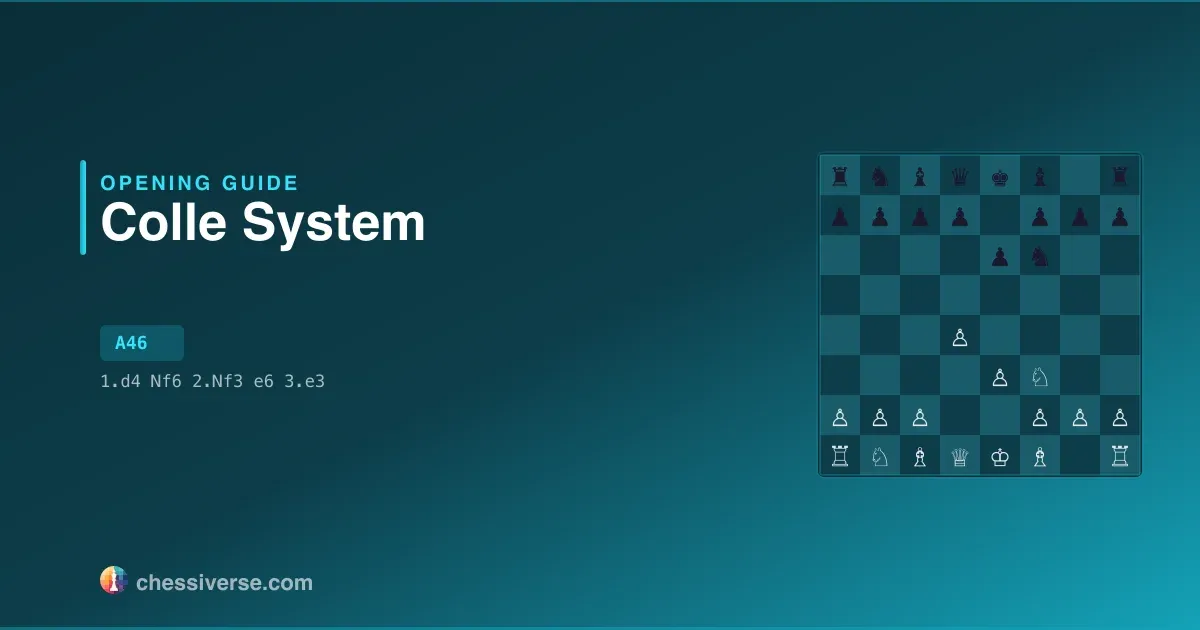
A461.d4 Nf6 2.Nf3 e6 3.e3
Updated Mar 27, 2026
Play this opening as...
TL;DR

The Colle is a system, not a line: 1.d4, Nf3, e3, c3 and Bd3 in flexible order, building a small pawn pyramid that aims to crack open with e3-e4 once developed. Less popular than the London today but still a workable surprise weapon below master level.

Reviewed by

IM John Bartholomew
IM John BartholomewCo-Founder & Chess Educator

International Master and chess educator. Co-founded Chessable and joined Chessiverse as co-founder. Best known for his "Climbing the Rating Ladder" YouTube series and structured opening courses.

Colle System: A Complete Guide
Colle System - Opening Moves
Summary

The Colle System arises after 1.d4 Nf6 2.Nf3 e6 3.e3 and falls under ECO code A46. With 3.9 million Lichess games across all rating levels, it is one of the most popular openings.

History and Notable Players

The opening is named after Edgard Colle. It arises from the Indian Defense Systems. Among the most prolific practitioners on the White side are Oleg M Romanishin (419 games), Mark L Hebden (400 games), Vladimir P Malaniuk (371 games). On the Black side, notable exponents include Mark L Hebden (139 games), Pia Cramling (131 games), Miso Cebalo (130 games).

Statistics

Based on 3.9 million Lichess games across all rating levels:

  • White wins: 49.4%
  • Black wins: 45.6%
  • Draws: 5%

The statistics show a roughly balanced opening where both sides have equal chances.

Practice on Chessiverse

The best way to learn the Colle System is through practice. On Chessiverse, you can play chess against computer opponents that specialize in this opening. Our AI bots range from beginner to grandmaster level, each with unique playing styles — from aggressive attackers to solid defenders. Choose a bot that matches your rating and work your way up as you master the opening's key ideas.

Performance Across Rating Levels

How well the Colle System works depends on what level you're playing at. The 1200 bracket has 324,604 games (0.05% of all games at that level); White wins 49.9%, Black 46.5%, 3.7% are drawn. Move up to 1800 Elo and the share shifts to 0.11%, with White winning 49.2% versus Black's 45.5%. Among 2500-rated players the line appears in 0.19% of games and draws spike to 10.5%, indicating tight preparation. Positions also become less sharp as level rises (sharpness 0.96 → 0.90).

Time Control Patterns

Time control matters here: bullet players reach for this opening more than others. In bullet, it appears in 0.13% of games (3,321,484); White wins 50.7%. Blitz shows 0.09% adoption across 3,225,943 games, White scoring 49.6%. In rapid, the share rises to 0.06% — 663,461 games, White 48%. White's score swings 2.7pp across formats, so time control isn't just a stylistic choice here — it shifts the actual results.

Move Diversity and Theory Depth

Looking at move selection shows how forcing — or not — the position really is. At 1200 Elo, the top reply is d5, played 40.6% of the time. There are 6 other moves seeing meaningful share, and 61.8% of games stick to established theory. Entropy: 2.81. By 2500, b6 dominates at 42.9% of replies; only 3 viable alternatives remain and 95.8% of moves are theory. Entropy drops to 1.82. That entropy collapse is the signature of a line where preparation pays off: at the top, players know the best move and play it.

Long-term, the trajectory of this opening is informative. Adoption peaked in 2015 at 0.10% (21,727 games). By 2025 it sits at 0.08% — a 5% shift overall, leaving the line flat.

Quick Facts

Main Line1.d4 Nf6 2.Nf3 e6 3.e3
FENrnbqkb1r/pppp1ppp/4pn2/8/3P4/4PN2/PPP2PPP/RNBQKB1R b KQkq - 0 3
ECO CodeD04-D05
DifficultyIntermediate
Named AfterEdgard Colle
Style

Solid Defender openings aim for a rock-solid pawn structure and safe piece placement. They resist aggression, minimize weaknesses, and seek to outplay the opponent in the long run.

3,889,404games on Lichess
49.4%
5%
45.6%
White wins Draws Black wins

Top Players

As White
As Black

Data from Lichess opening explorer (blitz & rapid)

Most Popular At2500
SharpnessSharp

Popularity by Rating

Percentage of all games at each rating bracket that feature this opening.

Data from Lichess opening explorer (blitz & rapid games)

Theory Adherence by Rating

How often players choose the single most popular move at this position. Higher = more predictable play.

Black to move after the opening line

Popularity Over Time

Share of all Lichess blitz + rapid games featuring this opening, by year.

Top Moves by Rating

Black to move after the opening line

RatingMost Popular2nd3rd
400d527.2%Nc617.4%Bb4+12.9%
1000d534.7%Nc613.8%Bb4+10.5%
1200d540.6%c511.8%Bb4+9.4%
1400d545.5%c515.2%b610.2%
1600d549.1%c518.6%b611.8%
1800d550.3%c521.3%b615.1%
2000d547.6%c522.8%b621.1%
2200d537.5%b632%c524.8%
2500b642.9%d528.3%c524.6%

Popularity by Time Control

Bullet
0.13%3.3M
Blitz
0.09%3.2M
Rapid
0.06%663K
2% more decisive in bullet
Raw data tables (Lichess blitz + rapid)
Colle System: popularity and win rates by player rating
Rating (Elo)Share %GamesWhite win %Black win %Draw %Sharpness
4000.0367,38149.046.84.20.958
10000.04149,64749.846.53.70.963
12000.05324,60449.946.53.70.963
14000.07596,67349.746.34.00.960
16000.09876,61049.945.64.50.955
18000.11915,73849.245.55.20.948
20000.14627,47148.945.06.10.939
22000.18305,40148.044.47.60.924
25000.1925,87947.941.610.50.895
Colle System: move-choice theory adherence by rating
Rating (Elo)Top moveTop move %Viable movesTheory %Entropy
400d527.2757.53.127
1000d534.7758.92.998
1200d540.6661.82.815
1400d545.5670.92.572
1600d549.1479.52.316
1800d550.3486.72.084
2000d547.6391.51.948
2200d537.5394.31.902
2500b642.9395.81.821
Colle System: popularity over time
YearShare %GamesWhite win %Black win %Draw %
20130.082,28449.246.34.6
20140.098,14646.748.54.7
20150.1021,72746.648.84.6
20160.1059,66446.648.64.8
20170.09105,01947.847.34.9
20180.09166,73348.546.65.0
20190.08229,43048.646.45.0
20200.08472,06348.246.35.5
20210.07545,51849.045.85.2
20220.09638,55449.945.34.8
20230.08664,89549.845.25.0
20240.08634,19050.144.95.0
20250.08620,30249.945.05.1
Colle System: popularity by time control
FormatShare %GamesWhite win %Black win %Draw %Sharpness
bullet0.133,321,48450.745.63.60.964
blitz0.093,225,94349.645.45.00.950
rapid0.06663,46148.046.75.30.947
Colle System: top candidate moves by rating bracket
Rating (Elo)1st move1st %2nd move2nd %3rd move3rd %
400d527.2Nc617.4Bb4+12.9
1000d534.7Nc613.8Bb4+10.5
1200d540.6c511.8Bb4+9.4
1400d545.5c515.2b610.2
1600d549.1c518.6b611.8
1800d550.3c521.3b615.1
2000d547.6c522.8b621.1
2200d537.5b632.0c524.8
2500b642.9d528.3c524.6
Colle System: top practitioners by side
SidePlayerGames
WhiteOleg M Romanishin419
WhiteMark L Hebden400
WhiteVladimir P Malaniuk371
BlackMark L Hebden139
BlackPia Cramling131
BlackMiso Cebalo130
Play this opening as...

Training Recommendations

Targeted drills using our bots' unique playstyles to sharpen your skills in this opening.

♟️

Opening Foundations in the Colle System

beginner

Rook Garrison, a versatile Mediator, plays the position on its merits, while defensive Guardian Igor Guardov likes to trade pieces and grind out long endings. A friendly entry point for picking up the structure and main ideas.

♟️

Learning the Patterns in the Colle System

novice

Paige Flipper is a flexible Hunter who tends to simplify when given the chance, while eileen Left is an all-round Mediator comfortable across position types. Good fit if the basic ideas are clear but the middlegame still surprises you.

Sharpening Your Play in the Colle System

intermediate

Attacking Hunter Morris Leander forces the position, then simplifies once the initiative bites. Use this matchup once you have a feel for the structure but want a real fight.

Testing Your Knowledge in the Colle System

skilled

Reed Pages plays patiently — a defensive Guardian who cuts down the position, while attacking Hunter Alek Sacrowicz forces the position, then simplifies once the initiative bites. A real opponent once preparation has gone past memorisation.

No-Quarter Sparring in the Colle System

advanced

Attacking Hunter Bishopla Fouré forces the position, then simplifies once the initiative bites, while steve Quipster plays patiently — a defensive Guardian who cuts down the position. Practice at the advanced level to face master-strength resistance.

Frequently Asked Questions

What is the Colle System?

The Colle System begins with 1.d4 Nf6 2.Nf3 e6 3.e3 and is classified under ECO code A46.

Is the Colle System good for beginners?

Yes, the Colle System is an excellent choice for beginners. The plans are relatively straightforward, and the key ideas are easy to understand. As you improve, you can explore deeper theoretical lines. Practice against our beginner-level bots to build confidence.

What are the win rates for the Colle System?

Across 3.9 million Lichess games, White wins 49.4% of the time, Black wins 45.6%, and 5% are drawn. Notable master practitioners on the White side include Oleg M Romanishin and Mark L Hebden. On the Black side, Mark L Hebden and Pia Cramling are among the most frequent practitioners.

How can I practice the Colle System?

On Chessiverse, you can practice the Colle System against AI bots specifically designed to play this opening. Our bots range from beginner (around 878 rating) to advanced (2538+ rating), so you can find the right challenge for your level.

Reviewed by

IM John Bartholomew
IM John BartholomewCo-Founder & Chess Educator

International Master and chess educator. Co-founded Chessable and joined Chessiverse as co-founder. Best known for his "Climbing the Rating Ladder" YouTube series and structured opening courses.

Practice This Opening on Chessiverse

Play against 1000+ AI bots with unique personalities and opening repertoires. From beginner-friendly to grandmaster-level opponents, find the perfect sparring partner for any opening.

Play Now

Not sure which opening fits you? Take the free chess personality test — your style determines which openings will work with you.

Back to Articles