

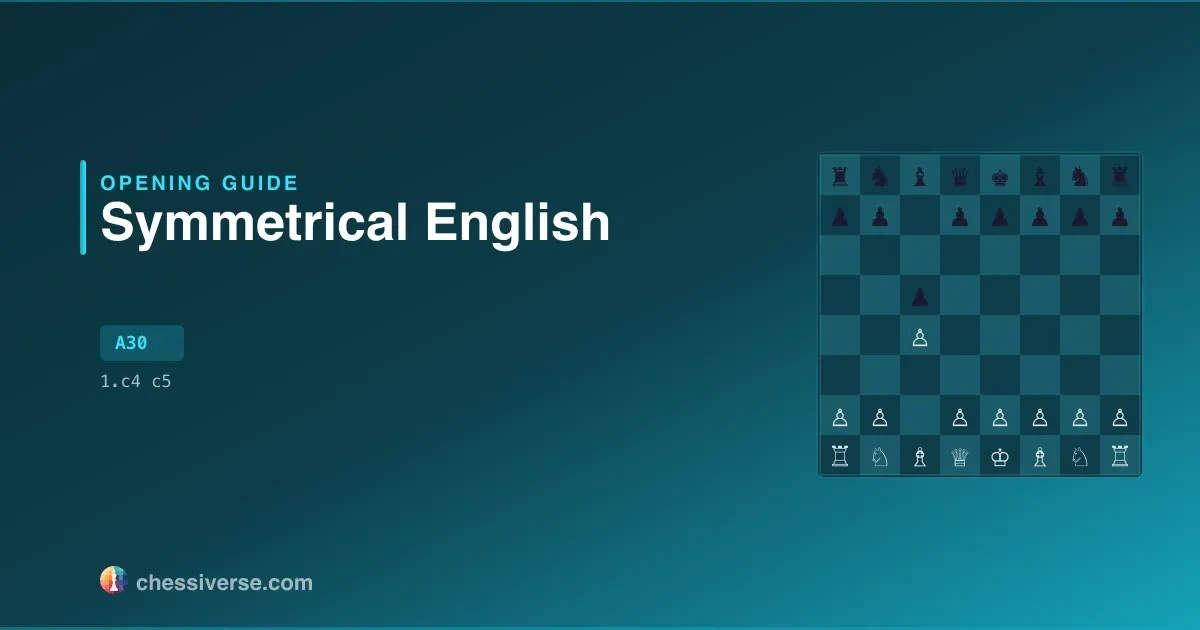
Starting from 1.c4 c5, players enter the Symmetrical English — ECO A30. Black mirrors White's flank pawn and dares them to break the symmetry first. The whole game now revolves around timing — who breaks the mirror, when, and on what terms.
Strategic Overview
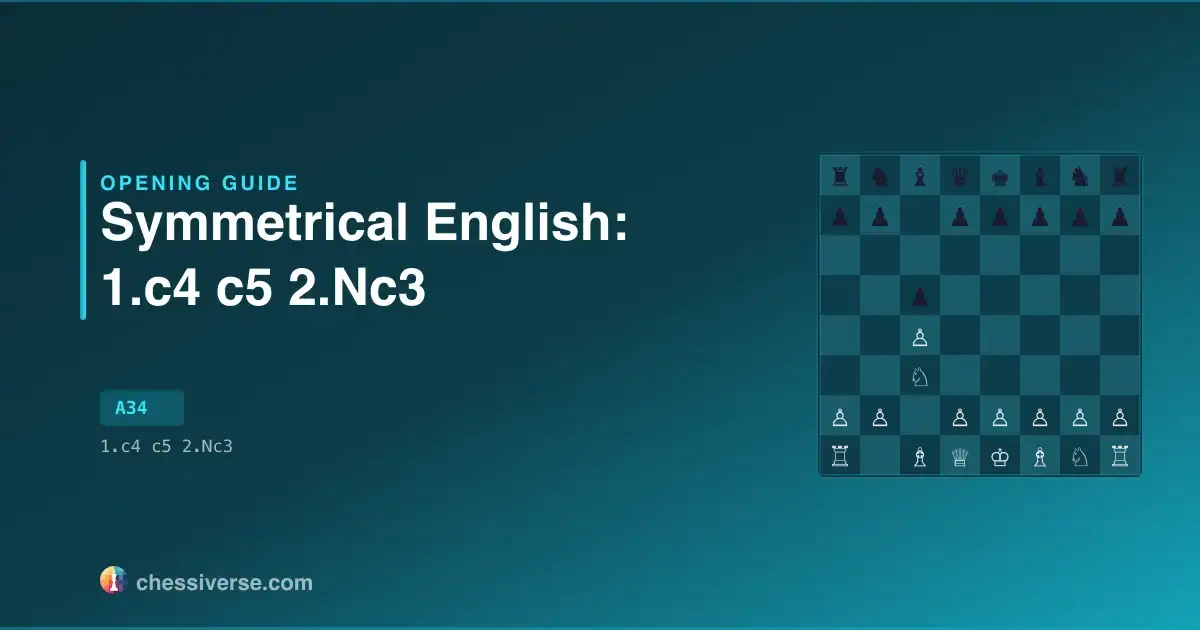
The Symmetrical English is built on tension. Both sides have identical pawn structures and any move that breaks the symmetry has to genuinely improve White's position, not just match Black's. The character of the middlegame depends enormously on White's second move. 2.Nf3 signals immediate plans for the d4 break, and Black often races to play their own ...d5 push before White can stabilize the center. 2.Nc3 is slower and more strategic — it discourages the early ...d5 break and signals that White wants to develop fully before breaking symmetry. From there, White typically goes for the Botvinnik System with g3, Bg2, e4, Nge2, d3, and 0-0, then choosing between f4, b4, or d4 as the decisive pawn break. The e3-then-d4 plan is another important option that can give White a strong central position once the knight is on e2. Black's job is to maintain the mirror until it stops favoring White, then break it on their own terms — usually with ...d5, ...e6 followed by ...d5, or ...b5 in some lines. The opening is more strategic than tactical and rewards players who can outmaneuver opponents in slow positions.
Key Ideas
A few ideas come up again and again in this opening:
- Whoever breaks symmetry first must justify it — The mirror is a feature, not a bug. Any move that breaks symmetry has to genuinely improve White's structure or piece activity, not just create a new asymmetric position.
- 2.Nf3 prepares the d4 break — If White plays this move order, the d4 break is coming soon. Black has to either contest it directly with ...d5 or accept a slightly more passive structure.
- 2.Nc3 signals slow buildup over fast breaks — This move order makes ...d5 harder and signals White's intention to develop pieces first. The Botvinnik System with g3, Bg2, e4, Nge2, d3, and 0-0 is the standard follow-up.
- f4, b4, or d4 — pick your pawn break — After the Botvinnik setup, White has three real breaks available. Which one happens depends on Black's piece placement and how the queenside has developed.
- Strategic patience over tactical aggression — Quick attacks rarely work in symmetrical structures. Both sides develop, both sides wait, and the side that better understands when to break the mirror wins.
History and Notable Players
It arises from the English Opening. Among the most prolific White practitioners are Wolfgang Uhlmann (170 games), Viktor Korchnoi (101 games), Normunds Miezis (98 games). Black-side regulars include Florin Gheorghiu (66 games), Peter Leko (61 games), Gyozo V Forintos (52 games).
Staunton played 1.c4 in his 1843 match against Saint-Amant and again at the first international tournament, London 1851, but the opening only caught on in the twentieth century. It became a world championship weapon for players from Botvinnik to Carlsen, and 1.c4 now ranks as White's fourth most popular first move.
Named after: The English is named for 19th-century English master Howard Staunton; the Symmetrical label comes from both sides pushing their c-pawns two squares.
Notable players: Howard Staunton, Mikhail Botvinnik, Garry Kasparov, Magnus Carlsen
Even Bobby Fischer, whose customary first move was 1.e4, switched to 1.c4 near the end of his career, including in his 1972 world championship match against Boris Spassky.
Performance Across Rating Levels
How well the Symmetrical English works depends on what level you're playing at. The 1200 bracket has 1,388,550 games (0.21% of all games at that level); White wins 51.6%, Black 44.5%, 3.9% are drawn. Move up to 1800 Elo and the share shifts to 0.48%, with White winning 50.6% versus Black's 44%. At the top end (2500+ Elo), popularity is 0.62% with 10.4% draws — a clear sign of how much theory rules the line at master level. White's edge erodes by 4.1pp from 1200 to 2500 Elo, suggesting Black's counterplay is easier to find with experience.
Time Control Patterns
The Symmetrical English skews toward bullet chess. In bullet, it appears in 0.41% of games (10,858,625); White wins 51.4%. Blitz shows 0.37% adoption across 13,358,394 games, White scoring 50.7%. In rapid, the share rises to 0.28% — 3,055,787 games, White 50.8%.
Move Diversity and Theory Depth
Looking at move selection shows how forcing — or not — the position really is. At 1200 Elo (1,388,550 games), the top reply is Nc3, played 54.1% of the time. Five other moves each take at least 5% of games, and the top three moves account for 75.4% of games. Entropy: 2.30. By 2500 (84,079 games), Nc3 is still the top reply, at 33.7%; only two other moves still reach 5% and the top three moves account for 96.6% of games. Entropy drops to 1.81.
Historical Trends
Tracking the Symmetrical English year over year shows a clear story. Adoption peaked in 2020 at 0.41% (2,381,103 games). By 2025 it sits at 0.33%, 21% below the peak but still 18% above its 2013 level, so the line is up over the full period despite easing from the high.
Main Lines and Variations
After 1.c4 c5, the established follow-ups are:
- English Opening: Symmetrical Variation, Normal Variation
- English Opening: Symmetrical Variation, Anti-Benoni Variation
Each branch leads to a different middlegame character — the resulting pawn structure decides what kind of game you get.
Common Mistakes
- Drifting away from main theory — At 400 Elo, the three most-played moves cover 61.6% of games, against 91.1% at 2000. The most popular deviation is e4 (played 9.8% of the time at 400, much less so up top). It looks fine but quietly hands the better-prepared side an edge.
- Neglecting development — It can feel productive to make extra pawn moves early, but falling behind in piece development is what loses most amateur games — especially in open positions where active pieces find squares fast.
- Playing without a plan — Each Symmetrical English middlegame demands a specific approach. Decide whether the position calls for attack, manoeuvre, or simplification before reaching for a move.
Practice on Chessiverse
Ready to try the Symmetrical English against a bot? Pick an opponent at your level and play a game.