



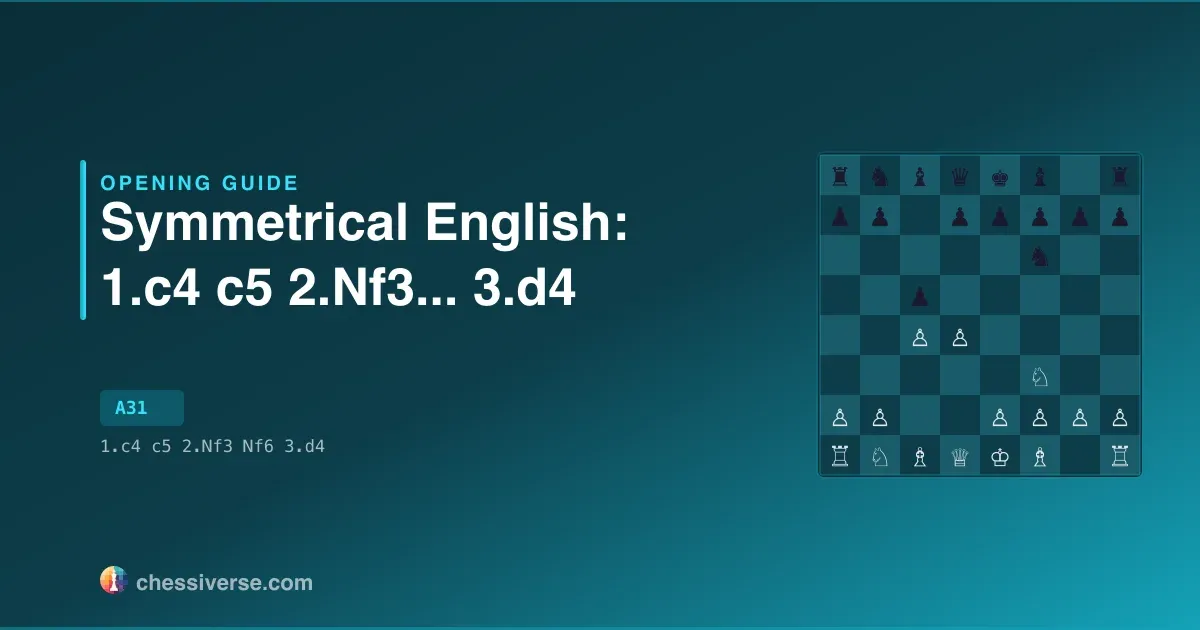
The English Opening: Symmetrical Variation, Anti-Benoni Variation begins with 1.c4 c5 2.Nf3 Nf6 3.d4 (ECO A31). White grabs the center on move three and forces Black to decide on a pawn structure immediately. This is the anti-Benoni move order — sharper than typical Symmetrical English play and demanding precise responses from Black.
Strategic Overview
3.d4 is the line White plays when they want to avoid the deep theoretical waters of the Benoni Defense. By committing to d4 before Black has played ...e6, White preempts the standard Benoni structures and steers the game toward Maroczy Bind setups instead. The main reply 3...cxd4 leads to a Sicilian-like structure where White's pawn on c4 replaces the standard Sicilian pawn on e4. Black often ends up in something resembling an Accelerated Dragon facing a Maroczy Bind — solid but cramped, with the c4 and e4 pawn duo (after a later e4) restricting Black's piece activity. The other main Black option is 3...e6, which gives White the choice between transposing back to a Benoni structure with d5 or playing e3 to keep the position more flexible. 3...d5 is also possible, leading to a symmetrical structure that should equalize cleanly. The middlegame character depends entirely on Black's choice. The Maroczy Bind lines are strategic battles where Black needs precise piece coordination to free the position; the Benoni transposition gives Black more counterplay but enters White's preparation; the symmetrical line gives both sides a balanced game.
Key Ideas
When players succeed in this line, they usually do so by leaning on the following themes:
- Avoid Benoni theory by committing to d4 early — Players who don't want to face the Benoni's deep theory use this move order. The early d4 prevents Black from getting the standard Benoni structure with ...e6 first.
- ...cxd4 leads to Maroczy Bind structures — After Black takes, White recaptures and aims for c4 plus a later e4, creating the classic Maroczy Bind. Black gets a solid but cramped position similar to an Accelerated Dragon.
- ...e6 lets White choose between Benoni and flexible setups — Pushing d5 transposes to the Benoni; playing e3 keeps the position more flexible. White picks based on what they want to play and what Black is prepared for.
- ...d5 is the cleanest equalizer — If Black wants a quiet symmetrical position, ...d5 gets it. The resulting structure is balanced and gives both sides equivalent chances.
History and Notable Players
It arises from the Symmetrical English. Among the most prolific White practitioners are Arturo Pomar Salamanca (27 games), Tomas Likavsky (26 games), Ivan Hausner (26 games). Black-side regulars include Juan Manuel Bellon Lopez (16 games), Jorge Szmetan (15 games), Milan Matulovic (14 games).
Performance Across Rating Levels
Popularity and results vary sharply by rating level. The 1200 bracket has 47,577 games (0.01% of all games at that level); White wins 48.7%, Black 47.8%, 3.5% are drawn. By 1800, popularity is 0.05% and White's score is 46.5% to Black's 48%. At 2500, 0.20% of games go into this opening; draws sit at 11% — the line is well-mapped at this level. Positions also become less sharp as level rises (sharpness 0.96 → 0.89).
Time Control Patterns
The English Opening: Symmetrical Variation, Anti-Benoni Variation skews toward blitz chess. In bullet, it appears in 0.04% of games (1,081,476); White wins 48.3%. Blitz shows 0.04% adoption across 1,479,235 games, White scoring 47.4%. In rapid, the share rises to 0.02% — 202,963 games, White 45.4%. White's score swings 2.9pp across formats, so time control isn't just a stylistic choice here — it shifts the actual results.
Move Diversity and Theory Depth
Looking at move selection shows how forcing — or not — the position really is. At 1200 Elo (47,577 games), the top reply is cxd4, played 43.3% of the time. Six other moves each take at least 5% of games, and the top three moves account for 70.4% of games. Entropy: 2.58. By 2500 (27,124 games), cxd4 dominates at 77.6% of replies; only two other moves still reach 5% and the top three moves account for 96.6% of games. Entropy drops to 1.16. That entropy collapse is the signature of a line where preparation pays off: at the top, players know the best move and play it.
Main Lines and Variations
After 1.c4 c5 2.Nf3 Nf6 3.d4, the established follow-ups are:
Each branch leads to a different middlegame character — the resulting pawn structure decides what kind of game you get.
Common Mistakes
- Drifting away from main theory — At 400 Elo, the three most-played moves cover 61.5% of games, against 94.5% at 2000. The most popular deviation is Nc6 (played 15.1% of the time at 400, much less so up top). It looks fine but quietly hands the better-prepared side an edge.
- Neglecting development — It can feel productive to make extra pawn moves early, but falling behind in piece development is what loses most amateur games — especially in open positions where active pieces find squares fast.
- Playing without a plan — Each English Opening: Symmetrical Variation, Anti-Benoni Variation middlegame demands a specific approach. Decide whether the position calls for attack, manoeuvre, or simplification before reaching for a move.
Practice on Chessiverse
Ready to try the English Opening: Symmetrical Variation, Anti-Benoni Variation against a bot? Pick an opponent at your level and play a game.