



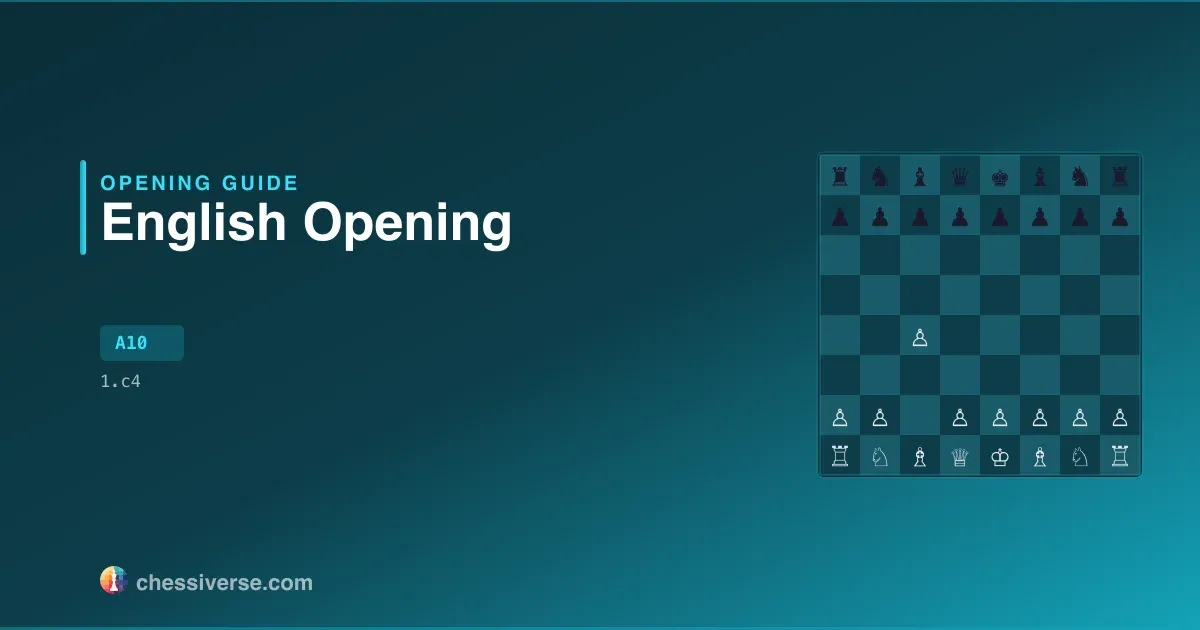
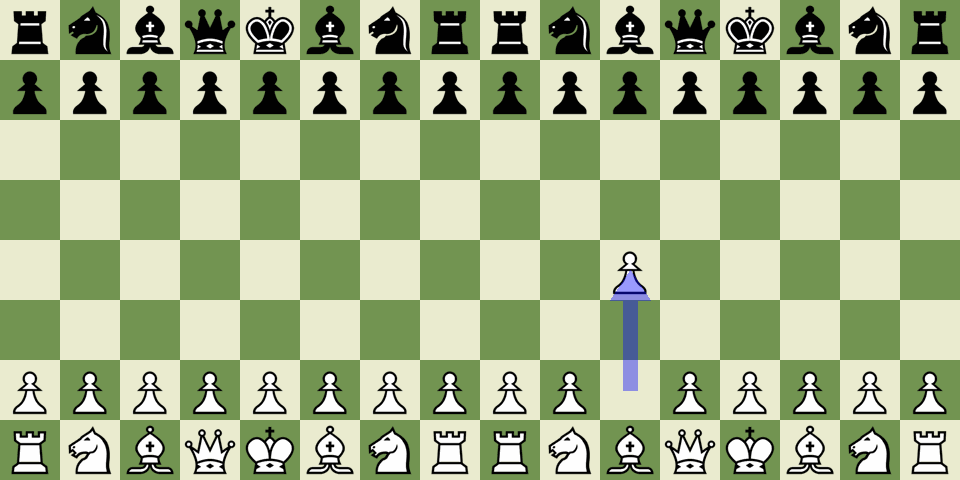
The English Opening arises after 1.c4 and falls under ECO code A10. The fourth most popular opening move in chess, 1.c4 gives the queen immediate freedom to enter the game and discourages Black from occupying the center with 1...d5. It also ensures the c-pawn will not get trapped behind a knight on c3 later. The positions that result tend to resemble 1.d4 structures more than 1.e4 ones, and White frequently follows up with d4 at some point. Although less immediately sharp than 1.e4 or 1.d4, the English is highly effective at controlling d5 and offers exceptional flexibility, making transpositions into other systems straightforward. This versatility is one of its greatest strengths: White can steer into Queen's Gambit or Indian Defense setups while avoiding specific variations they find undesirable against 1.d4. With 146.4 million Lichess games across all rating levels, it is one of the most popular openings.
- White fights for the centre from the wing in hypermodern style, using the c-pawn to control the key d5 square rather than occupying the centre at once.
- After 1...e5 White gets a Sicilian setup with an extra tempo, a family of positions known as the Reversed Sicilian.
- It is a flexible, transposition-friendly move order that can steer the game into Queen's Gambit, King's Indian or Catalan territory.
History and Notable Players
The earliest known analysis of this opening dates back to Staunton vs. Saint-Amant, 1843. The opening is named after Howard Staunton, English player and World Champion (unofficial). Among the most prolific practitioners on the White side are Wolfgang Uhlmann (1061 games), Normunds Miezis (964 games), Viktor Korchnoi (661 games). On the Black side, notable exponents include Wolfgang Uhlmann (182 games), Viktor Korchnoi (175 games), Ivan Farago (174 games).
Staunton introduced it in his 1843 match against Saint-Amant and played it at the first international tournament, London 1851, but it only caught on in the 20th century. World champions from Botvinnik to Carlsen adopted it, and Fischer famously turned to it against Spassky in their 1972 title match.
Named after: Named after Howard Staunton, England's leading 19th-century master, who played 1.c4 against Saint-Amant in their 1843 match and at the London 1851 tournament.
Notable players: Mikhail Botvinnik, Bobby Fischer, Garry Kasparov, Magnus Carlsen
Bobby Fischer created a stir by abandoning his customary 1.e4 for the English, playing it in his 1972 World Championship match with Boris Spassky; the opening also appears on screen in Sherlock Holmes: A Game of Shadows and Pawn Sacrifice.
Statistics
Based on 146.4 million Lichess games across all rating levels:
- White wins: 50.5%
- Black wins: 44.7%
- Draws: 4.8%
White holds a moderate edge statistically, though Black has good practical chances.
Main Lines and Variations
After 1.c4, the main continuations include:
- English Opening: Caro-Kann Defensive System
- English Opening: Agincourt Defense
- English Opening: Anglo-Indian Defense
- Reversed Sicilian
- Symmetrical English
Each of these lines leads to distinct types of positions and requires its own understanding of the resulting pawn structures and piece placements.
Practice on Chessiverse
The best way to learn the English Opening is through practice. On Chessiverse, you can play chess against computer opponents from any opening or custom position. Our AI bots range from beginner to grandmaster level, each with unique playing styles — from aggressive attackers to solid defenders. Choose a bot that matches your rating and work your way up as you master the opening's key ideas.
Performance Across Rating Levels
Popularity and results vary sharply by rating level. The 1200 bracket has 14,785,985 games (2.19% of all games at that level); White wins 51%, Black 45.2%, 3.8% are drawn. At 1800 the opening surfaces in 3.93% of games; White wins 50.5%, Black 44.6%, draws 5%. Among 2500-rated players the line appears in 5.71% of games and draws spike to 10%, indicating tight preparation. White's edge erodes by 3.4pp from 1200 to 2500 Elo, suggesting Black's counterplay is easier to find with experience.
Time Control Patterns
The English Opening skews toward bullet chess. In bullet, it appears in 3.51% of games (93,321,820); White wins 50.9%. Blitz shows 3.27% adoption across 117,610,500 games, White scoring 50.5%. In rapid, the share rises to 2.60% — 28,798,051 games, White 50.6%.
Move Diversity and Theory Depth
Move choice is far from uniform in the English Opening. At 1200 Elo (14,785,985 games), the top reply is e5, played 47% of the time. Four other moves each take at least 5% of games, and the top three moves account for 68.2% of games. Entropy: 2.60. By 2500 (778,465 games), Nf6 takes over as the top reply at 26.2%; five other moves reach 5% and the top three moves account for 65.1% of games. Entropy rises to 2.83. Even elite players don't fully agree on the best continuation here, which keeps the position dynamic.
Historical Trends
Long-term, the trajectory of this opening is informative. Adoption peaked in 2019 at 3.52% (10,077,834 games). By 2025 it sits at 3.04%, 14% below the peak but still 18% above its 2013 level, so the line is up over the full period despite easing from the high.