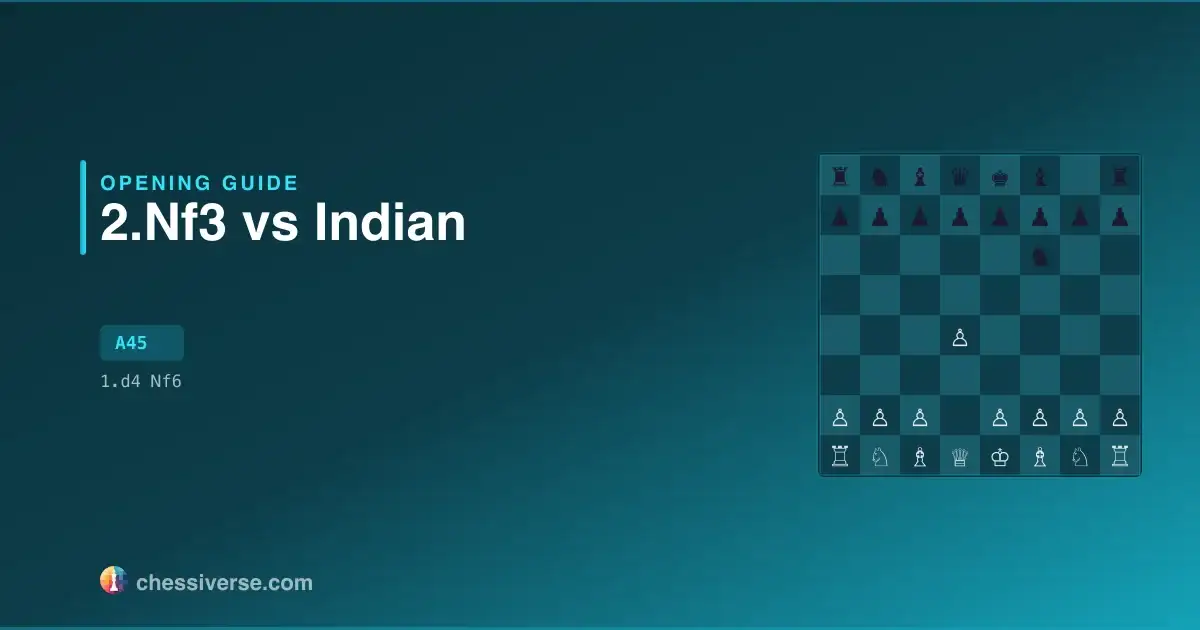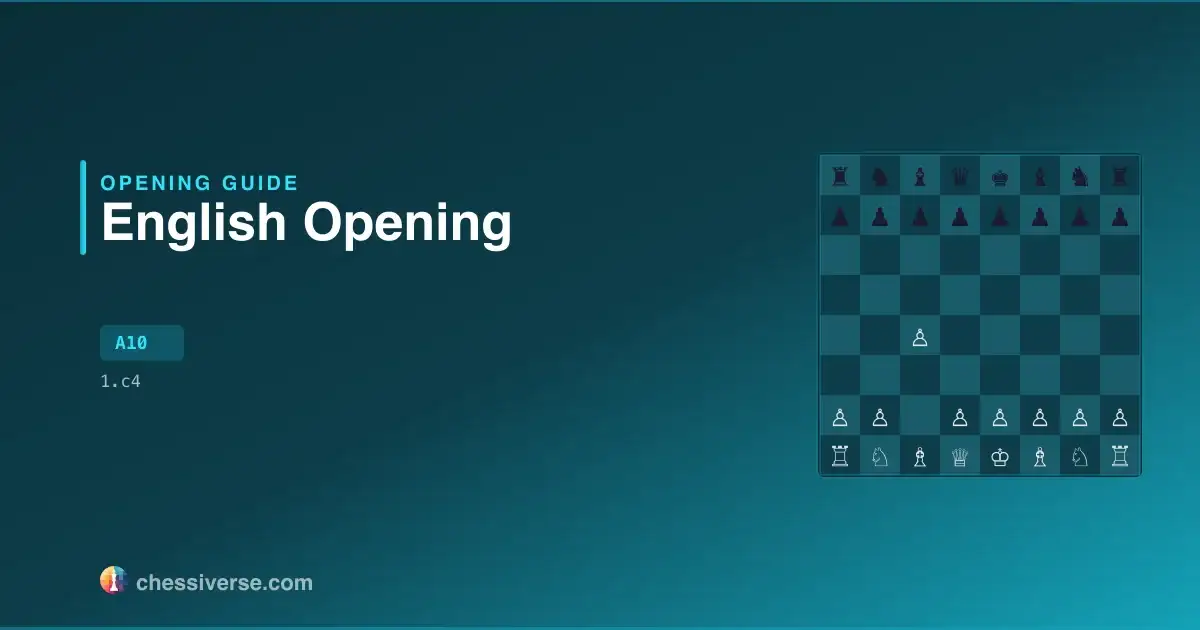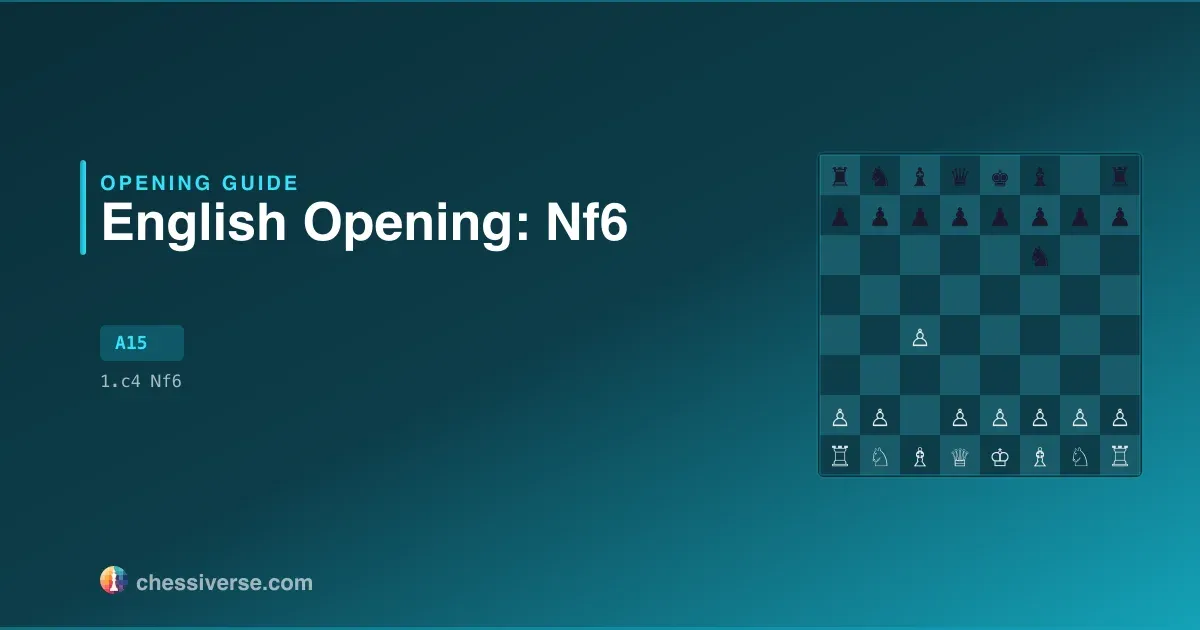
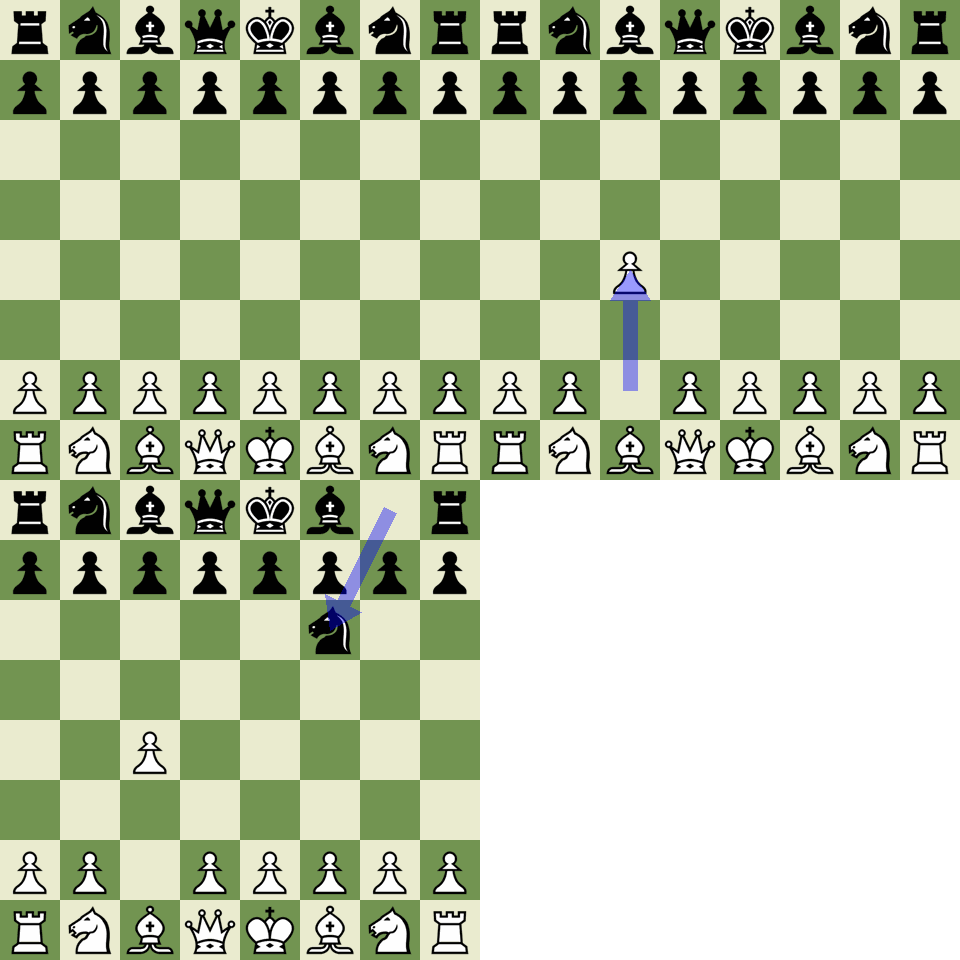
Starting from 1.c4 Nf6, players enter the English Opening: Anglo-Indian Defense — ECO A15. Black develops a piece, fights for e4, and stays uncommitted on pawn structure. If White ever plays d4, the game leaves the English entirely and becomes an Indian Defense.
Strategic Overview
1...Nf6 is the most flexible reply to 1.c4. The knight covers e4, prepares ...d5 or ...g6, and forces White to commit first. The defining feature of this move is its transposition potential: as soon as White plays d4, the game becomes some flavor of Indian Defense — King's Indian, Nimzo-Indian, Queen's Indian, or Grünfeld — depending on Black's follow-up. If White stays in the pure English with 2.Nc3 or 2.g3, Black can choose between ...e6 setups, ...g6 fianchetto plans, or ...e5 reversed Sicilians. The middlegame character therefore depends entirely on which structure both sides agree to. What 1...Nf6 promises is that Black never has to commit to a pawn skeleton before White does — and at high level, that flexibility is worth a lot. The cost is essentially zero: the knight on f6 is well-placed in basically every resulting structure. This is the move for Black players who want to react rather than dictate and who feel comfortable in multiple opening worlds.
Key Ideas
A few ideas come up again and again in this opening:
- Wait for White to commit before choosing a structure — By developing a piece first, Black avoids pinning down pawn structure. White has to show whether they want d4 (Indian Defense) or stay in the pure English.
- Indian Defense is always one move away — Any time White plays d4, the game transposes into an Indian system. That gives Black access to the entire Nimzo/Queen's/King's Indian family without committing early.
- The f6-knight fits every plan — Whether Black ends up with ...e6, ...g6, or ...e5, the knight on f6 is well-placed. There's no scenario where 1...Nf6 turns out to be the wrong move.
History and Notable Players
It arises from the English Opening. On the White side, Wolfgang Uhlmann (294 games), Viktor Korchnoi (238 games), Mihai Suba (197 games) top the database. Notable Black exponents: Ivan Farago (140 games), Wolfgang Uhlmann (97 games), Lev Gutman (89 games).
Performance Across Rating Levels
The picture changes a lot as you climb the rating ladder. At 1200 Elo, the opening shows up in 0.18% of games (1,220,429 samples). White scores 49.2%, Black 47.1%, draws 3.7%. By 1800, popularity is 0.81% and White's score is 49.1% to Black's 45.7%. Among 2500-rated players the line appears in 1.48% of games and draws spike to 9.8%, indicating tight preparation. Positions also become less sharp as level rises (sharpness 0.96 → 0.90).
Time Control Patterns
Time control matters here: blitz players reach for this opening more than others. In bullet, it appears in 0.54% of games (14,221,531); White wins 50.5%. Blitz shows 0.58% adoption across 20,917,036 games, White scoring 49.5%. In rapid, the share rises to 0.35% — 3,852,237 games, White 48.2%. White's score swings 2.3pp across formats, so time control isn't just a stylistic choice here — it shifts the actual results.
Move Diversity and Theory Depth
Move choice is far from uniform in the English Opening: Anglo-Indian Defense. At 1200 Elo (1,220,429 games), the top reply is Nc3, played 52.3% of the time. Three other moves each take at least 5% of games, and the top three moves account for 81.2% of games. Entropy: 2.20. By 2500 (202,452 games), Nc3 dominates at 55.3% of replies; only two other moves still reach 5% and the top three moves account for 95.9% of games. Entropy drops to 1.65. The narrowing is significant — strong players consolidate around a small set of best moves, while amateurs scatter across many plausible-looking options.
Historical Trends
Year-over-year data tells you whether this opening is a contemporary fixture or a fading one. Adoption peaked in 2020 at 0.63% (3,588,869 games). By 2025 it sits at 0.50%, 21% below the peak but still 51% above its 2013 level, so the line is up over the full period despite easing from the high.
Main Lines and Variations
After 1.c4 Nf6, the established follow-ups are:
Each branch leads to a different middlegame character — the resulting pawn structure decides what kind of game you get.
Common Mistakes
- Drifting away from main theory — At 400 Elo, the three most-played moves cover 70.7% of games, against 88% at 2000. The most popular deviation is d4 (played 18.3% of the time at 400, much less so up top). It looks fine but quietly hands the better-prepared side an edge.
- Neglecting development — Extra pawn moves in the opening are tempting, especially when you "know the moves". Developing a piece each turn is the simple correction.
- Playing without a plan — Each English Opening: Anglo-Indian Defense middlegame demands a specific approach. Decide whether the position calls for attack, manoeuvre, or simplification before reaching for a move.
Practice on Chessiverse
Ready to try the English Opening: Anglo-Indian Defense against a bot? Pick an opponent at your level and play a game.