

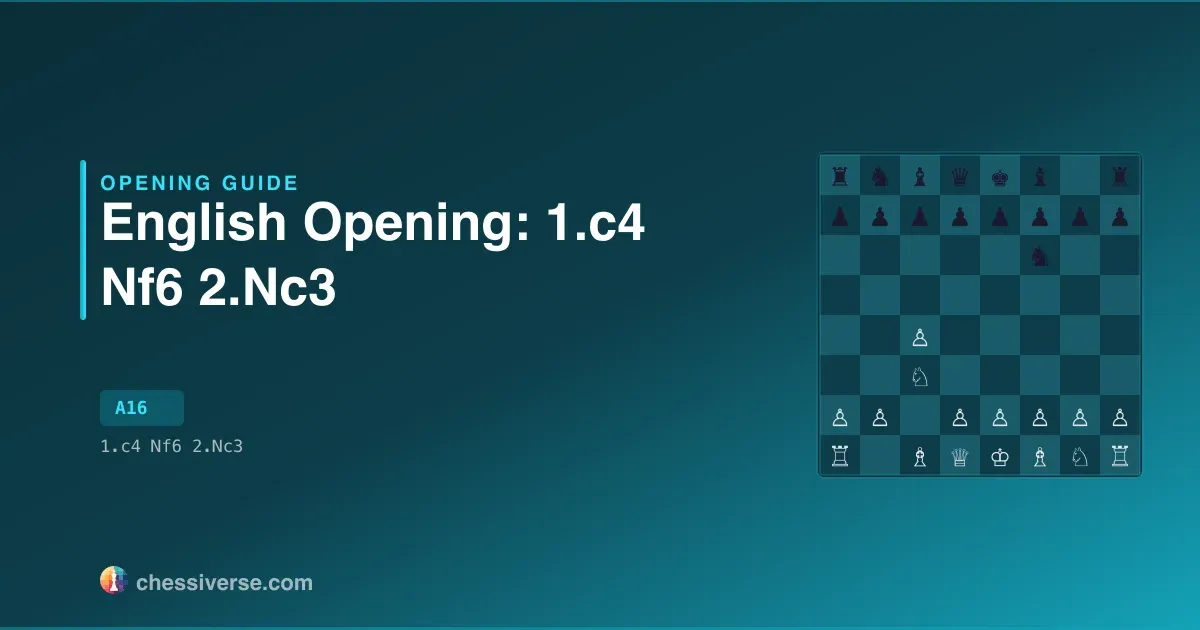
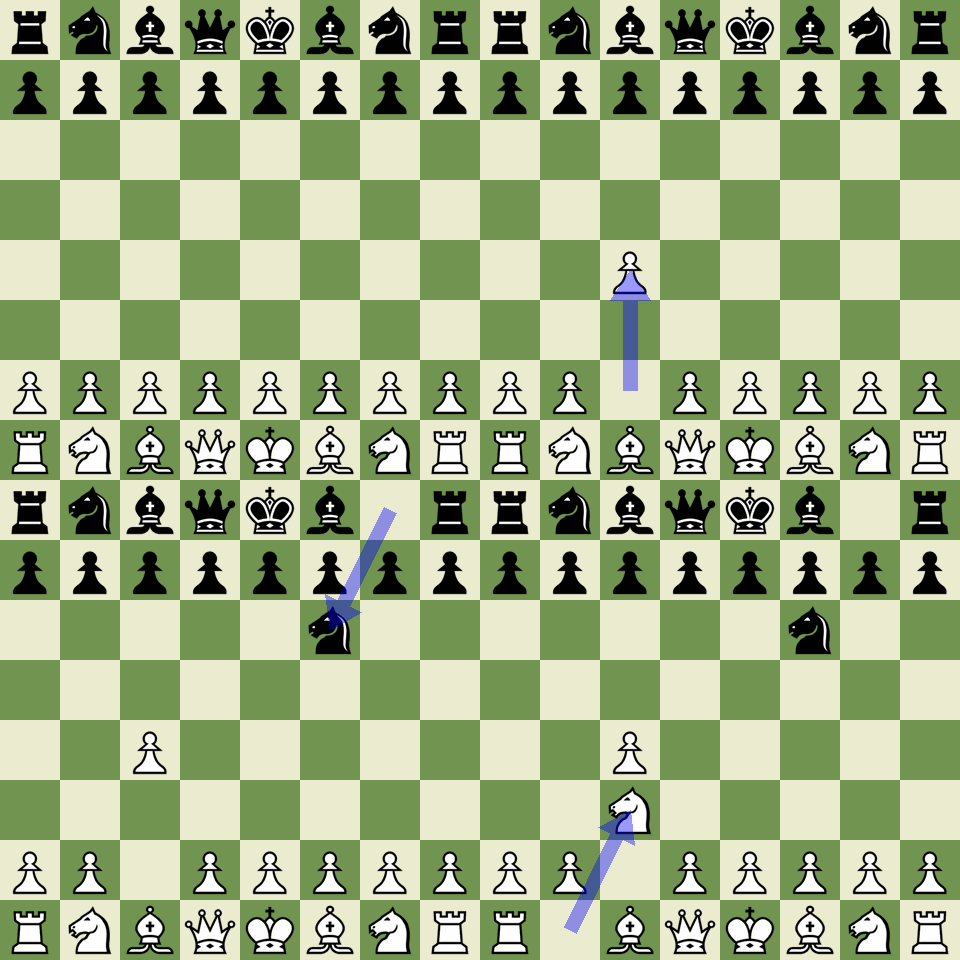
Starting from 1.c4 Nf6 2.Nc3, players enter the English Opening: Anglo-Indian Defense, Queen's Knight Variation — ECO A16. White piles a second piece onto d5 and keeps the d-pawn home, refusing to commit to a structure. Black now picks between a King's Indian, a Nimzo-style setup, or the sharp Reversed Sicilian.
Strategic Overview
2.Nc3 is the most principled English move order. Both knights aim at d5, the d-pawn stays flexible, and White waits to see what Black does before choosing between e4, g3, or d4 plans. Black's three serious replies define very different games. 2...g6 heads for a King's Indian structure with ...Bg7, ...0-0, and ...e5 or ...c5 to follow. 2...e6 prepares Nimzo-Indian and Queen's Indian setups, but warns: White can punt those plans with 3.e4, the Mikenas-Carls Variation, which goes tactical fast and demands serious preparation from Black. 2...e5 leads to the Reversed Sicilian and Bremen System, where the structure feels familiar but with an extra tempo for White. The unifying idea behind 2.Nc3 is that White doesn't want to over-commit before knowing Black's plan. The move keeps every option open — Botvinnik setups, fianchetto systems, even a quick d4 transposing into a Queen's Pawn game. It's the version of the English most grandmasters play because it forces Black to reveal intentions first.
Key Ideas
The recurring motifs below distinguish a confident handler of this opening from a beginner:
- Double up on d5 from move two — Two knights pressuring d5 makes it very hard for Black to push ...d5 in one move. That single restriction shapes the entire opening.
- 3.e4 against ...e6 is the sharpest weapon — The Mikenas-Carls Variation is what gives 2.Nc3 real bite. Black needs concrete knowledge or they get blown off the board in a structure they didn't expect.
- Stay flexible on the d-pawn — By keeping d2 free, White can play d3 for a Botvinnik setup, d4 to transpose into a Queen's Pawn game, or even just leave the pawn home indefinitely. Premature d-pawn commitment kills the flexibility advantage.
- Each Black reply demands a different White plan — Against 2...g6 White plays for e4 and central space. Against 2...e6 the choice is between sharp e4 lines and quieter g3 setups. Against 2...e5 the game becomes positional jousting. Know all three.
History and Notable Players
It arises from the English Opening: Anglo-Indian Defense. On the White side, Wolfgang Uhlmann (283 games), Viktor Korchnoi (188 games), Normunds Miezis (180 games) top the database. Notable Black exponents: Ivan Farago (79 games), Wolfgang Uhlmann (73 games), Anatoly Karpov (61 games).
Performance Across Rating Levels
How well the English Opening: Anglo-Indian Defense, Queen's Knight Variation works depends on what level you're playing at. Among 1200-rated players, it appears in 0.09% of games — 626,840 of them on record — with White winning 49.8% and Black 46.5%. Move up to 1800 Elo and the share shifts to 0.49%, with White winning 49.5% versus Black's 45.4%. At the top end (2500+ Elo), popularity is 0.82% with 9.5% draws — a clear sign of how much theory rules the line at master level. Positions also become less sharp as level rises (sharpness 0.96 → 0.91).
Time Control Patterns
Look at the same opening across time controls and blitz stands out. In bullet, it appears in 0.32% of games (8,599,954); White wins 50.7%. Blitz shows 0.35% adoption across 12,539,855 games, White scoring 49.8%. In rapid, the share rises to 0.19% — 2,110,897 games, White 48.6%. White's score swings 2.1pp across formats, so time control isn't just a stylistic choice here — it shifts the actual results.
Move Diversity and Theory Depth
Looking at move selection shows how forcing — or not — the position really is. At 1200 Elo (626,840 games), the top reply is g6, played 32.8% of the time. Four other moves each take at least 5% of games, and the top three moves account for 68.4% of games. Entropy: 2.73. By 2500 (111,932 games), g6 is still the top reply, at 37.8%; four other moves reach 5% and the top three moves account for 72.6% of games. Entropy drops to 2.47.
Historical Trends
Long-term, the trajectory of this opening is informative. Adoption peaked in 2020 at 0.37% (2,110,010 games). By 2025 it sits at 0.29%, 21% below the peak but still 47% above its 2013 level, so the line is up over the full period despite easing from the high.
Main Lines and Variations
The main branches off 1.c4 Nf6 2.Nc3 include:
Each branch leads to a different middlegame character — the resulting pawn structure decides what kind of game you get.
Common Mistakes
- Drifting away from main theory — At 400 Elo, the three most-played moves cover 62.8% of games, against 73.2% at 2000. The most popular deviation is e5 (played 18.9% of the time at 400, less so up top). It looks fine but quietly hands the better-prepared side an edge.
- Neglecting development — Extra pawn moves in the opening are tempting, especially when you "know the moves". Developing a piece each turn is the simple correction.
- Playing without a plan — Each English Opening: Anglo-Indian Defense, Queen's Knight Variation middlegame demands a specific approach. Decide whether the position calls for attack, manoeuvre, or simplification before reaching for a move.
Practice on Chessiverse
Ready to try the English Opening: Anglo-Indian Defense, Queen's Knight Variation against a bot? Pick an opponent at your level and play a game.