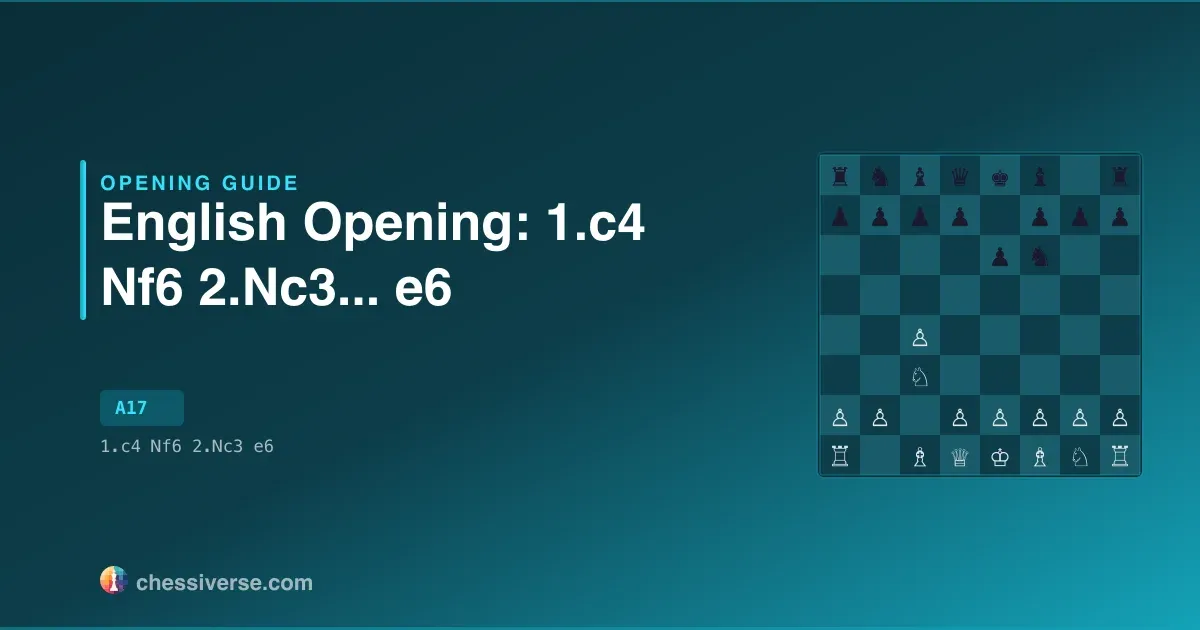
1.c4 Nf6 2.Nc3 e6 opens the English Opening: Anglo-Indian Defense, Hedgehog System, ECO A17. Black quietly threatens ...Bb4 to pin the c3-knight and crack open d5. White now decides between the razor-sharp 3.e4 Mikenas-Carls or a quieter route into Nimzo or Symmetrical structures.
Strategic Overview
2...e6 is a high-class waiting move that screens multiple plans behind one quiet pawn push. The threats are concrete: ...Bb4 pins the c3-knight, weakens White's grip on d5, and threatens doubled pawns if White ever recaptures with the b-pawn. Meanwhile, Black retains the option of ...d5 with a Queen's Gambit Declined structure, ...b6 and ...Bb7 for a Queen's Indian setup, or ...c5 transposing to a Symmetrical English. White has to make a real choice. 3.e4 is the most ambitious — the Mikenas-Carls Variation, where White grabs the center and dares Black to find precise defense in sharp tactical waters. 3.Nf3 keeps things calmer, often leading to Symmetrical English structures after 3...c5 with a battle over d4 and d5. 3.g3 prepares the fianchetto and aims for a slow positional squeeze. The character of the middlegame depends entirely on which path White chooses — and that choice is largely about taste. Aggressive players love 3.e4. Strategic players prefer 3.Nf3 or 3.g3.
Key Ideas
A few ideas come up again and again in this opening:
- The ...Bb4 pin is the immediate threat — Pinning the c3-knight weakens White's hold on d5 and threatens doubled pawns on the c-file. White has to factor this idea into every choice on move three.
- 3.e4 launches the Mikenas-Carls — The most aggressive try — White grabs the full center and the game turns sharp immediately. Black needs precise knowledge or the position collapses fast.
- 3.Nf3 c5 transposes to Symmetrical English — A calmer continuation leading to a positional battle over d4 and d5. This is the route for White players who want to outplay opponents rather than out-prepare them.
- Multiple defensive setups stay live — Behind ...e6, Black can still head into a Nimzo-Indian, Queen's Indian, QGD, or Symmetrical structure. That flexibility is the whole point of the move order.
History and Notable Players
It arises from the English Opening: Anglo-Indian Defense, Queen's Knight Variation. On the White side, Wolfgang Uhlmann (100 games), Viktor Korchnoi (97 games), Lajos Portisch (55 games) top the database. Notable Black exponents: Wolfgang Unzicker (31 games), Mikhail Tal (31 games), Aleksandar Matanovic (29 games).
Performance Across Rating Levels
Popularity and results vary sharply by rating level. At 1200 Elo, the opening shows up in 0.03% of games (196,012 samples). White scores 50.3%, Black 46.1%, draws 3.6%. By 1800, popularity is 0.18% and White's score is 49.9% to Black's 45%. At the top end (2500+ Elo), popularity is 0.20% with 9.8% draws — a clear sign of how much theory rules the line at master level. Positions also become less sharp as level rises (sharpness 0.96 → 0.90).
Time Control Patterns
Look at the same opening across time controls and bullet stands out. In bullet, it appears in 0.13% of games (3,349,726); White wins 50.8%. Blitz shows 0.12% adoption across 4,290,499 games, White scoring 50.2%. In rapid, the share rises to 0.07% — 719,630 games, White 49.1%.
Move Diversity and Theory Depth
Looking at move selection shows how forcing — or not — the position really is. At 1200 Elo (196,012 games), the top reply is g3, played 32.6% of the time. Five other moves each take at least 5% of games, and the top three moves account for 63.6% of games. Entropy: 2.71. By 2500 (27,614 games), e4 takes over as the top reply at 59.8%; only three other moves still reach 5% and the top three moves account for 89.3% of games. Entropy drops to 1.73. The narrowing is significant — strong players consolidate around a small set of best moves, while amateurs scatter across many plausible-looking options.
Historical Trends
Long-term, the trajectory of this opening is informative. Adoption peaked in 2020 at 0.12% (712,715 games). By 2025 it sits at 0.10%, 20% below the peak but still 22% above its 2013 level, so the line is up over the full period despite easing from the high.
Main Lines and Variations
After 1.c4 Nf6 2.Nc3 e6, the established follow-ups are:
Each branch leads to a different middlegame character — the resulting pawn structure decides what kind of game you get.
Common Mistakes
- Drifting away from main theory — At 400 Elo, the three most-played moves cover 63.3% of games, against 76.9% at 2000. The most popular deviation is Nf3 (played 17% of the time at 400, less so up top). It looks fine but quietly hands the better-prepared side an edge.
- Neglecting development — Extra pawn moves in the opening are tempting, especially when you "know the moves". Developing a piece each turn is the simple correction.
- Playing without a plan — Each English Opening: Anglo-Indian Defense, Hedgehog System middlegame demands a specific approach. Decide whether the position calls for attack, manoeuvre, or simplification before reaching for a move.
Practice on Chessiverse
Ready to try the English Opening: Anglo-Indian Defense, Hedgehog System against a bot? Pick an opponent at your level and play a game.