

English Opening: 1.c4 Nf6 2.Nc3...... 3.e4

+18%
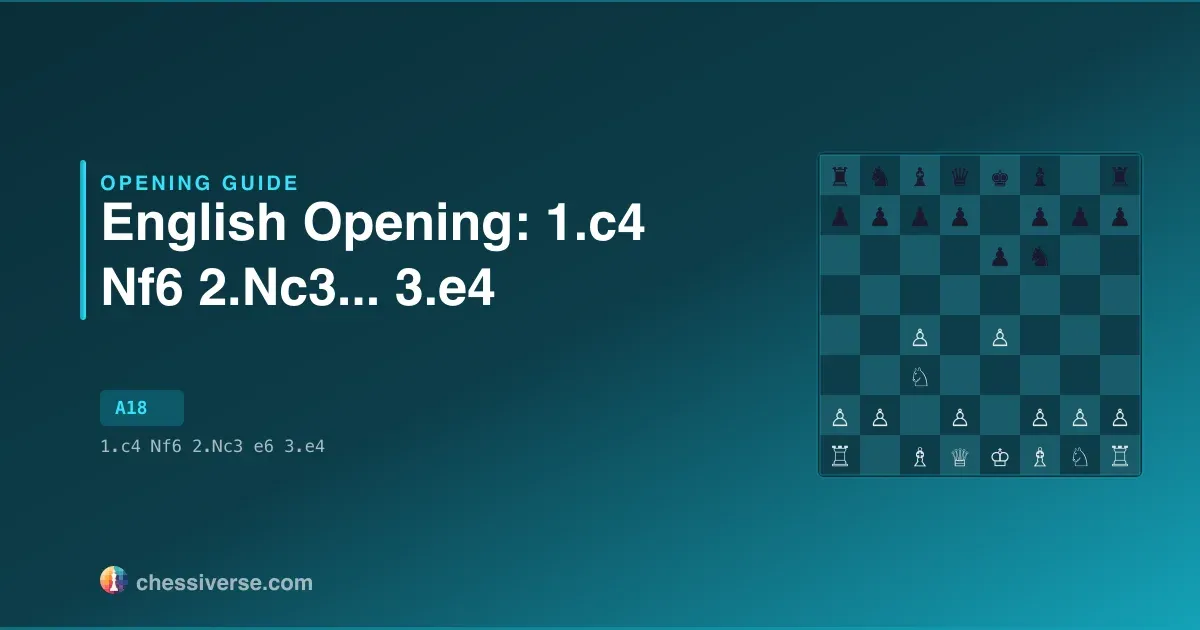
A181.c4 Nf6 2.Nc3 e6 3.e4
Sep 10, 2027
TL;DR

The Mikenas-Carls — White slams a pawn into the center to drag the English out of slow maneuvering and into sharp tactical waters. Main reply 3...c5 mimics a Sicilian; 3...d5 4.e5 sends the f6-knight to e4 in chaotic positions. Scores a hefty 53.5% for White.

Reviewed by

IM John Bartholomew
IM John BartholomewCo-Founder & Chess Educator

International Master and chess educator. Co-founded Chessable and joined Chessiverse as co-founder. Best known for his "Climbing the Rating Ladder" YouTube series and structured opening courses.

English Opening: 1.c4 Nf6 2.Nc3...... 3.e4: A Complete Guide
English Opening: 1.c4 Nf6 2.Nc3...... 3.e4 - Opening Moves
Summary

The English Opening: 1.c4 Nf6 2.Nc3... 3.e4 begins with 1.c4 Nf6 2.Nc3 e6 3.e4 (ECO A18). White slams a pawn into the center and refuses to let Black settle into a quiet Nimzo or Queen's Indian setup. The Mikenas-Carls is one of the sharpest English systems — concrete, forcing, and unforgiving.

Strategic Overview

3.e4 throws the English playbook in the bin. White says: I'm taking the center now, and you can either fight for it or watch me roll forward. The main reply is 3...c5, contesting d4 and offering a familiar Sicilian-like pawn break. Black can also try 3...d5, when White typically plays 4.e5 chasing the knight to e4 and entering chaotic tactical waters where every move matters. The character of the position is completely different from the rest of the English — instead of slow maneuvering around d5, the game becomes about central tension, piece activity, and direct pawn breaks. White's pieces come out fast: Nf3, d4, often Bd3 or g3 depending on Black's reply, and short castling. Black has to find concrete moves rather than relying on general principles. This is the variation that gives 2.Nc3 its real teeth — Black players who only know Nimzo or QID structures get caught flat-footed. The line rewards calculation over memorization, but you do need to know the main motifs before sitting down on either side.

Key Ideas

The recurring motifs below distinguish a confident handler of this opening from a beginner:

  • White grabs the center on move three — e4 turns the English into a sharp open game. Slow maneuvering is over — both sides have to find concrete moves immediately.
  • 3...c5 is Black's main equalizer — By striking back at d4, Black contests the center directly and gets familiar Sicilian-style structures. Without this break, White's center becomes overwhelming.
  • 3...d5 4.e5 leads to chaotic tactics — The knight gets chased to e4 and the resulting positions are extremely sharp. Both sides need precise calculation; general principles will get you punished.
  • Surprise weapon against quiet players — Black players who prepare for slow English structures often have no idea what to do here. The Mikenas-Carls is a way to drag opponents into territory they didn't study.

History and Notable Players

It arises from the English Opening: 1.c4 Nf6 2.Nc3... e6. On the White side, Normunds Miezis (31 games), Viktor Korchnoi (22 games), Davor Ramesa (17 games) top the database. Notable Black exponents: Hikaru Nakamura (14 games), Tomas Petrik (13 games), Eduardas Rozentalis (13 games).

Performance Across Rating Levels

How well the English Opening: 1.c4 Nf6 2.Nc3... 3.e4 works depends on what level you're playing at. At 1200 Elo, the opening shows up in 0.01% of games (42,722 samples). White scores 50.4%, Black 46.1%, draws 3.5%. Move up to 1800 Elo and the share shifts to 0.04%, with White winning 54.2% versus Black's 41.3%. At 2500, 0.12% of games go into this opening; draws sit at 9.5% — the line is well-mapped at this level. Positions also become less sharp as level rises (sharpness 0.96 → 0.91).

Time Control Patterns

The English Opening: 1.c4 Nf6 2.Nc3... 3.e4 skews toward blitz chess. In bullet, it appears in 0.03% of games (828,804); White wins 53.7%. Blitz shows 0.03% adoption across 1,195,999 games, White scoring 53.6%. In rapid, the share rises to 0.02% — 189,090 games, White 52.8%.

Move Diversity and Theory Depth

Move choice is far from uniform in the English Opening: 1.c4 Nf6 2.Nc3... 3.e4. At 1200 Elo, the top reply is Bb4, played 28.1% of the time. There are 7 other moves seeing meaningful share, and 55.1% of games stick to established theory. Entropy: 3.13. By 2500, d5 dominates at 65.1% of replies; only 3 viable alternatives remain and 91% of moves are theory. Entropy drops to 1.64. The narrowing is significant — strong players consolidate around a small set of best moves, while amateurs scatter across many plausible-looking options.

Year-over-year data tells you whether this opening is a contemporary fixture or a fading one. Adoption peaked in 2018 at 0.03% (64,235 games). By 2025 it sits at 0.03% — a 18% shift overall, leaving the line on the rise.

Main Lines and Variations

After 1.c4 Nf6 2.Nc3 e6 3.e4, the established follow-ups are:

Each branch leads to a different middlegame character — the resulting pawn structure decides what kind of game you get.

Common Mistakes

  • Drifting away from main theory — At 400 Elo, theory adherence sits at 52.9% — versus 71.3% at 2000. The most popular deviation is Nc6 (played 16.3% of the time at 400, much less so up top). It looks fine but quietly hands the better-prepared side an edge.
  • Neglecting development — Extra pawn moves in the opening are tempting, especially when you "know the moves". Developing a piece each turn is the simple correction.
  • Playing without a plan — Each English Opening: 1.c4 Nf6 2.Nc3... 3.e4 middlegame demands a specific approach. Decide whether the position calls for attack, manoeuvre, or simplification before reaching for a move.

Practice on Chessiverse

Ready to try the English Opening: 1.c4 Nf6 2.Nc3... 3.e4 against a bot? Pick an opponent at your level and play a game.

Quick Facts

Main Line1.c4 Nf6 2.Nc3 e6 3.e4
DifficultyIntermediate
Style

Hypermodern openings let the opponent occupy the center with pawns, then attack it from the flanks with pieces and fianchettoed bishops. Control is exerted from a distance rather than by direct occupation.

1,385,089games on Lichess
53.5%
5.1%
41.4%
White wins Draws Black wins

Top Players

As White
As Black

Data from Lichess opening explorer (blitz & rapid)

Most Popular At2200
SharpnessSharp

Popularity by Rating

Percentage of all games at each rating bracket that feature this opening.

Data from Lichess opening explorer (blitz & rapid games)

Theory Adherence by Rating

How often players choose the single most popular move at this position. Higher = more predictable play.

Black to move after the opening line

Popularity Over Time

Share of all Lichess blitz + rapid games featuring this opening, by year.

Top Moves by Rating

Black to move after the opening line

RatingMost Popular2nd3rd
400d522%Nc616.3%Bb414.7%
1000Bb421.4%d517.7%Nc613.7%
1200Bb428.1%d515.9%Nc611.1%
1400Bb429.4%d517.7%d610.2%
1600Bb425.3%d523.1%d612.8%
1800d531.2%Bb419.3%d615.2%
2000d541.3%d616.9%Bb413.1%
2200d554.7%d615.2%c514%
2500d565.1%c517.6%d68.3%

Popularity by Time Control

Bullet
0.03%829K
Blitz
0.03%1.2M
Rapid
0.02%189K
2% more decisive in bullet
Raw data tables (Lichess blitz + rapid)
English Opening: 1.c4 Nf6 2.Nc3...... 3.e4: popularity and win rates by player rating
Rating (Elo)Share %GamesWhite win %Black win %Draw %Sharpness
4000.005,48051.245.13.60.964
10000.0017,12450.945.53.60.964
12000.0142,72250.446.13.50.965
14000.0191,82751.045.33.70.963
16000.02197,28453.142.94.00.960
18000.04365,20454.241.34.50.955
20000.09407,75254.540.15.40.946
22000.14241,16553.139.97.00.930
25000.1216,53152.138.49.50.905
English Opening: 1.c4 Nf6 2.Nc3...... 3.e4: move-choice theory adherence by rating
Rating (Elo)Top moveTop move %Viable movesTheory %Entropy
400d522.0552.93.186
1000Bb421.4652.83.212
1200Bb428.1755.13.135
1400Bb429.4757.33.073
1600Bb425.3761.23.020
1800d531.2565.72.879
2000d541.3471.32.602
2200d554.7483.82.110
2500d565.1391.01.639
English Opening: 1.c4 Nf6 2.Nc3...... 3.e4: popularity over time
YearShare %GamesWhite win %Black win %Draw %
20130.0268851.744.53.8
20140.022,00153.243.23.6
20150.036,38754.541.04.5
20160.0318,15554.341.24.6
20170.0335,77254.840.64.6
20180.0364,23554.441.04.6
20190.0395,19854.041.24.8
20200.03187,43153.741.05.4
20210.03220,38053.141.65.3
20220.03216,70353.541.55.1
20230.03222,22853.441.55.1
20240.03209,93653.341.75.0
20250.03208,17253.441.55.1
English Opening: 1.c4 Nf6 2.Nc3...... 3.e4: popularity by time control
FormatShare %GamesWhite win %Black win %Draw %Sharpness
bullet0.03828,80453.742.93.40.966
blitz0.031,195,99953.641.35.00.950
rapid0.02189,09052.841.75.60.944
English Opening: 1.c4 Nf6 2.Nc3...... 3.e4: top candidate moves by rating bracket
Rating (Elo)1st move1st %2nd move2nd %3rd move3rd %
400d522.0Nc616.3Bb414.7
1000Bb421.4d517.7Nc613.7
1200Bb428.1d515.9Nc611.1
1400Bb429.4d517.7d610.2
1600Bb425.3d523.1d612.8
1800d531.2Bb419.3d615.2
2000d541.3d616.9Bb413.1
2200d554.7d615.2c514.0
2500d565.1c517.6d68.3
English Opening: 1.c4 Nf6 2.Nc3...... 3.e4: top practitioners by side
SidePlayerGames
WhiteNormunds Miezis31
WhiteViktor Korchnoi22
WhiteDavor Ramesa17
BlackHikaru Nakamura14
BlackTomas Petrik13
BlackEduardas Rozentalis13

Frequently Asked Questions

What is the English Opening: 1.c4 Nf6 2.Nc3... 3.e4?

The English Opening: 1.c4 Nf6 2.Nc3... 3.e4 begins with 1.c4 Nf6 2.Nc3 e6 3.e4 and is classified under ECO code A18.

Is the English Opening: 1.c4 Nf6 2.Nc3... 3.e4 good for beginners?

The English Opening: 1.c4 Nf6 2.Nc3... 3.e4 can be played at any level. Beginners should focus on understanding the key strategic ideas rather than memorizing long theoretical lines. Our AI bots at various rating levels provide a great way to practice the opening concepts.

What are the main variations of the English Opening: 1.c4 Nf6 2.Nc3... 3.e4?

The main continuations include: English Opening: 1.c4 Nf6 2.Nc3... c5. Each variation leads to distinct types of positions with their own strategic themes.

What are the win rates for the English Opening: 1.c4 Nf6 2.Nc3... 3.e4?

In a database of 1,385,089 master games, White wins 53.5% of the time, Black wins 41.4%, and 5.1% are drawn. Notable players on the White side include Normunds Miezis and Viktor Korchnoi. On the Black side, Hikaru Nakamura and Tomas Petrik are among the most frequent practitioners.

Reviewed by

IM John Bartholomew
IM John BartholomewCo-Founder & Chess Educator

International Master and chess educator. Co-founded Chessable and joined Chessiverse as co-founder. Best known for his "Climbing the Rating Ladder" YouTube series and structured opening courses.

Practice This Opening on Chessiverse

Play against 1000+ AI bots with unique personalities and opening repertoires. From beginner-friendly to grandmaster-level opponents, find the perfect sparring partner for any opening.

Play Now

Not sure which opening fits you? Take the free chess personality test — your style determines which openings will work with you.

Back to Articles