



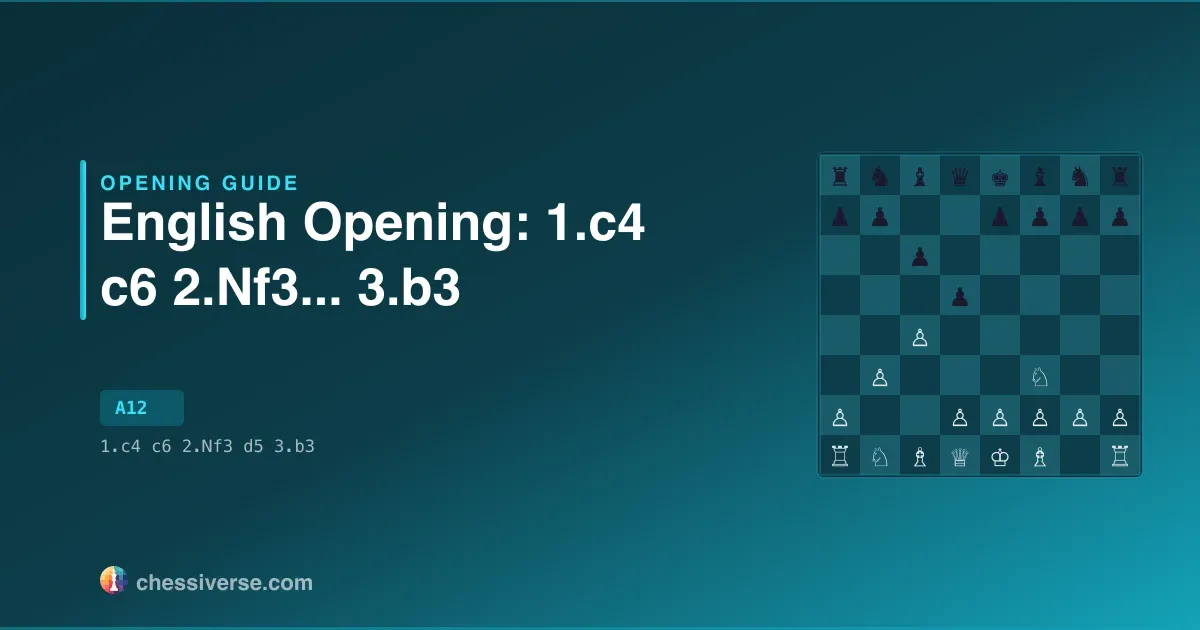
Starting from 1.c4 c6 2.Nf3 d5 3.b3, players enter the Réti Opening: Anglo-Slav Variation, Bogoljubow Variation — ECO A12. White finally tips a hand — b3 prepares Bb2 and treats this as a true Reti hybrid rather than a transposition to the Slav. The fight for the d4- and e5-squares starts now.
Strategic Overview
By committing to b3 instead of d4, White renounces the central pawn duo and plays for piece pressure on Black's center. The plan is clean: Bb2 finishes the queenside development, g3 and Bg2 fianchetto the other bishop, and White builds a battery aimed at d5 and e5 from a distance. Black's c6-d5 structure is solid but slightly passive — the c8-bishop has to find a square before ...e6 locks it in, and the c6-pawn restricts Black's own knight from its natural square. The middlegame typically revolves around two ideas: White's cxd5 break (opening the c-file and giving the b2-bishop a clear sight to the long diagonal) and Black's ability to free the position with ...e5 or ...c5. If White can keep the tension on c4-d5 long enough, the bishops on b2 and g2 will start to matter more and more. This is a positional opening that rewards patience and punishes overextension; the side that grabs space too early usually ends up defending a weakened structure.
Key Ideas
When players succeed in this line, they usually do so by leaning on the following themes:
- Double fianchetto pressures the center from distance — Bb2 and Bg2 form a battery that targets e5 and d5 without ever pushing a central pawn. White doesn't need to occupy the center to dominate it.
- The cxd5 break is White's main lever — Opening the c-file gives the rook and the b2-bishop real scope. Timing matters — too early and Black gets free piece play; too late and Black equalizes with ...e5.
- Black's c8-bishop is the problem piece — Behind the c6-d5 chain, this bishop has no good square unless Black develops it before ...e6. Solving its development is Black's main early task.
History and Notable Players
It arises from the English Opening: Caro-Kann Defensive System. On the White side, Leonardo Valdes (15 games), Evgeny Matorin (15 games), Nikola Spiridonov (12 games) top the database. Notable Black exponents: Frank Roeder (10 games), Jonny Hector (9 games), Arturo Pomar Salamanca (9 games).
Performance Across Rating Levels
Popularity and results vary sharply by rating level. Among 1200-rated players, it appears in 0.00% of games — 6,722 of them on record — with White winning 50.2% and Black 46.3%. Move up to 1800 Elo and the share shifts to 0.01%, with White winning 52.2% versus Black's 42.3%. Among 2500-rated players the line appears in 0.03% of games and draws spike to 10.1%, indicating tight preparation. White's edge erodes by 4.1pp from 1200 to 2500 Elo, suggesting Black's counterplay is easier to find with experience.
Move Diversity and Theory Depth
Looking at move selection shows how forcing — or not — the position really is. At 1200 Elo (6,722 games), the top reply is Nf6, played 32.8% of the time. Four other moves each take at least 5% of games, and the top three moves account for 69.1% of games. Entropy: 2.76. By 2500 (4,627 games), Nf6 dominates at 73.9% of replies; only two other moves still reach 5% and the top three moves account for 92.2% of games. Entropy drops to 1.44. The narrowing is significant — strong players consolidate around a small set of best moves, while amateurs scatter across many plausible-looking options.
Historical Trends
Tracking the Réti Opening: Anglo-Slav Variation, Bogoljubow Variation year over year shows a clear story. Adoption peaked in 2014 at 0.010% (913 games). By 2025 it sits at 0.006%, 38% below the peak but still 37% above its 2013 level, so the line is up over the full period despite easing from the high.
Common Mistakes
- Drifting away from main theory — At 400 Elo, the three most-played moves cover 58% of games, against 83.3% at 2000. The most popular deviation is Bf5 (played 17.3% of the time at 400, less so up top). It looks fine but quietly hands the better-prepared side an edge.
- Neglecting development — Extra pawn moves in the opening are tempting, especially when you "know the moves". Developing a piece each turn is the simple correction.
- Playing without a plan — Each Réti Opening: Anglo-Slav Variation, Bogoljubow Variation middlegame demands a specific approach. Decide whether the position calls for attack, manoeuvre, or simplification before reaching for a move.
Practice on Chessiverse
Ready to try the Réti Opening: Anglo-Slav Variation, Bogoljubow Variation against a bot? Pick an opponent at your level and play a game.