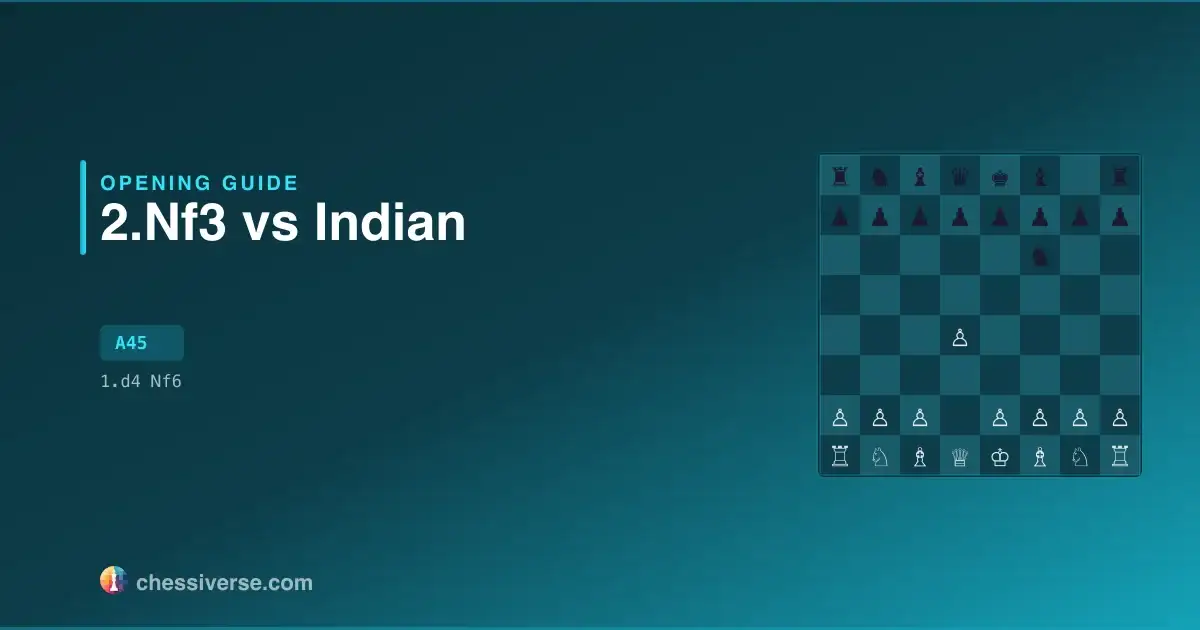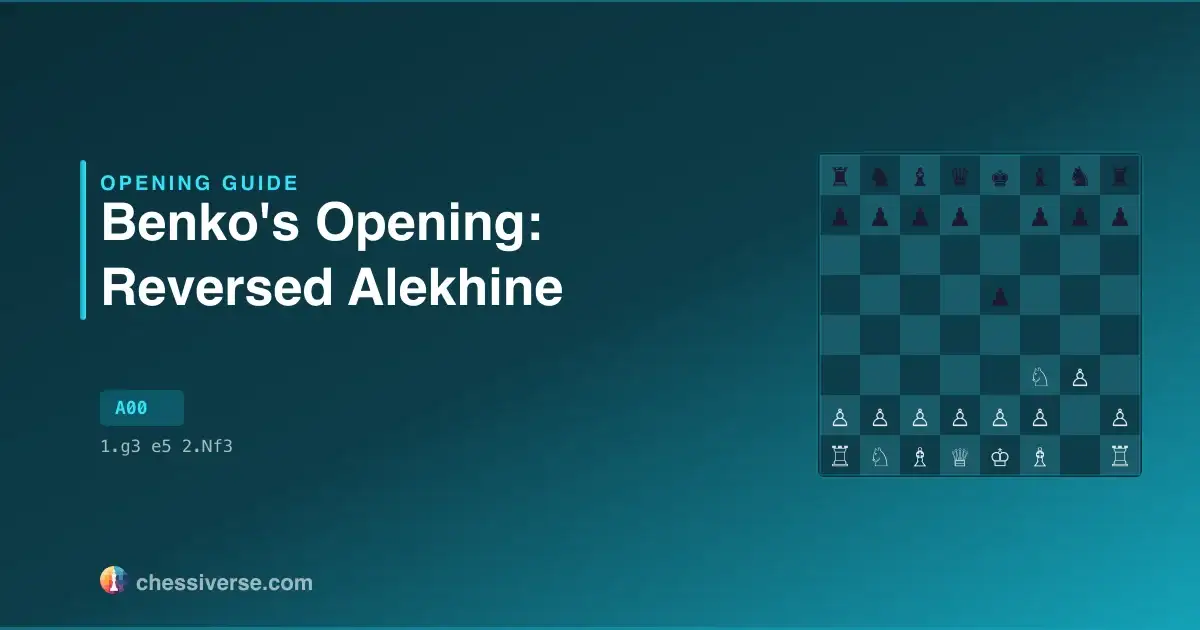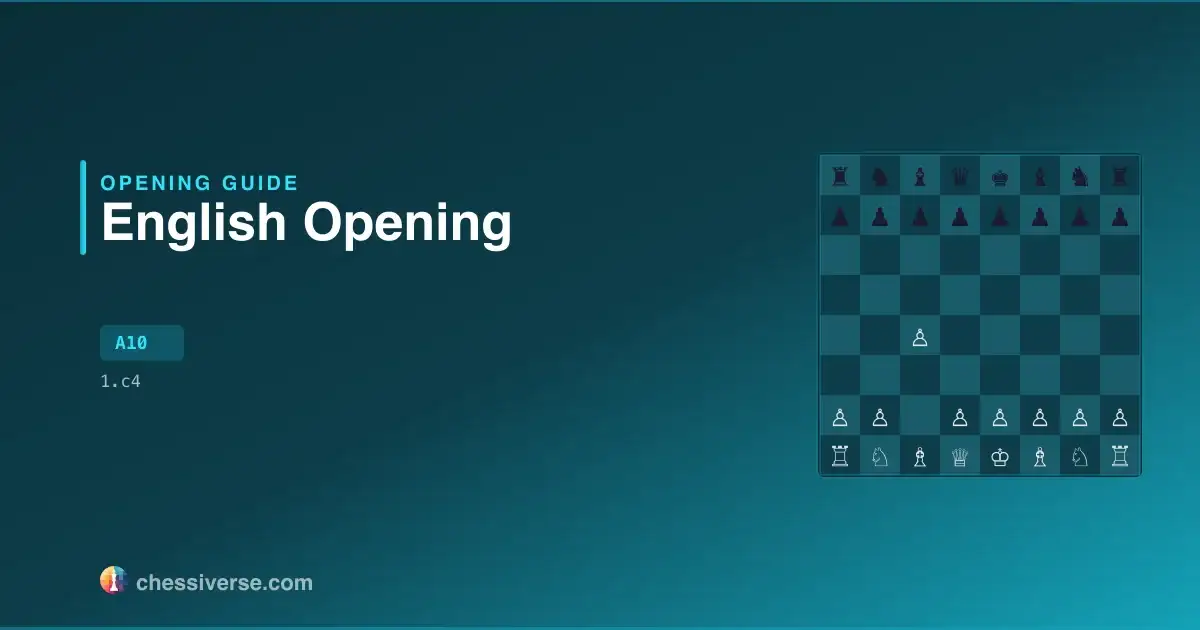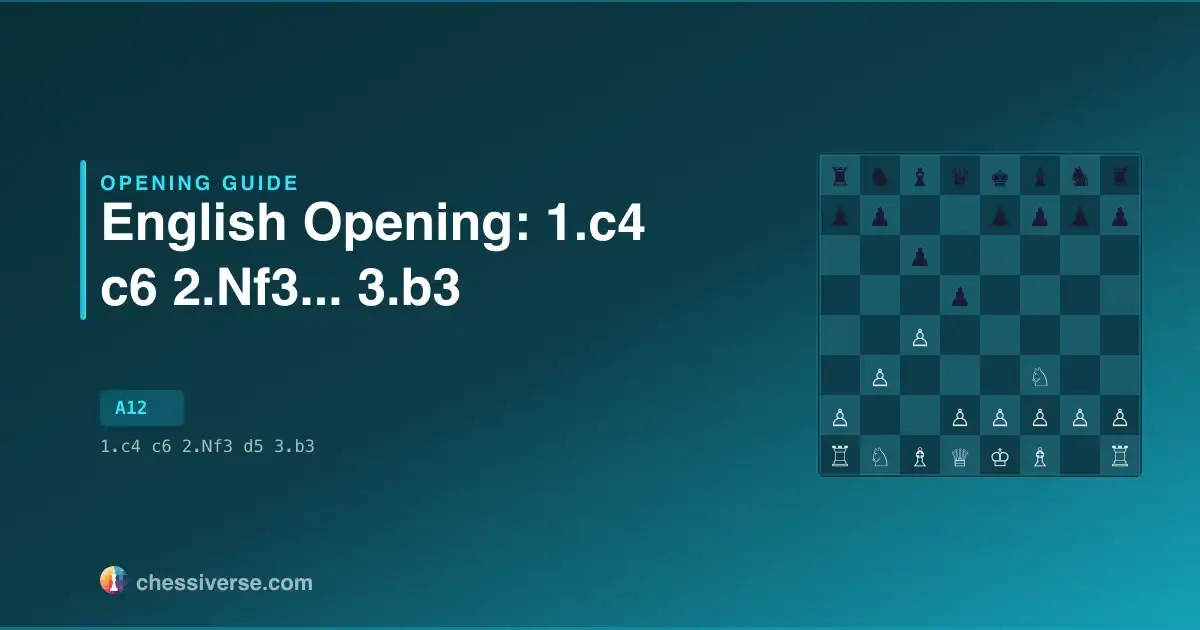




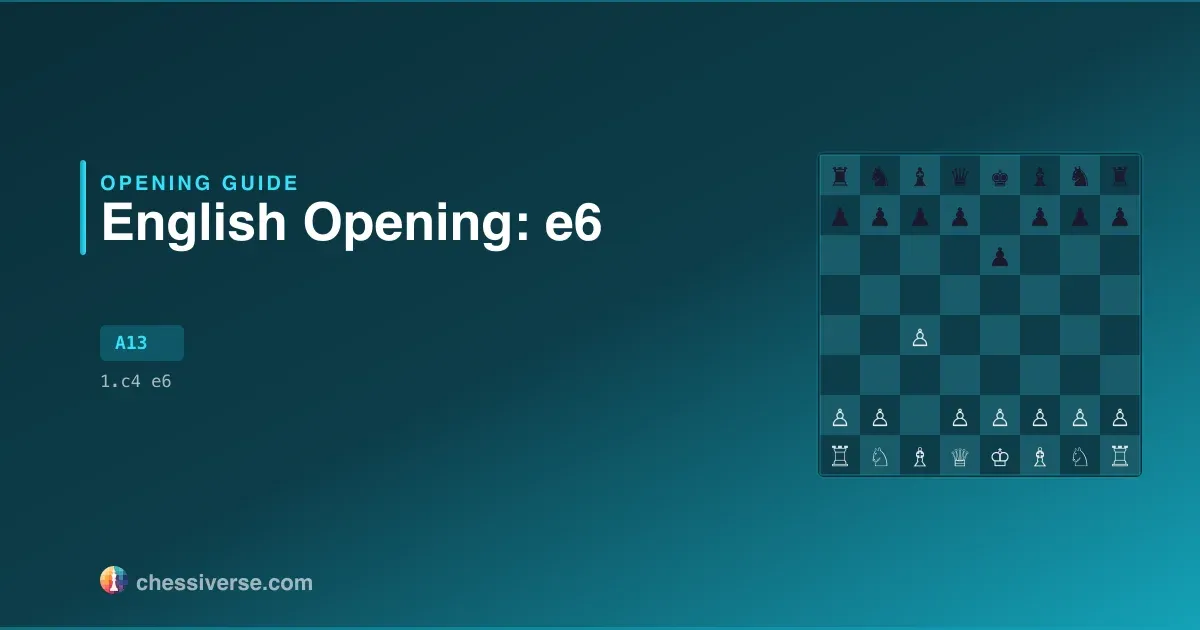
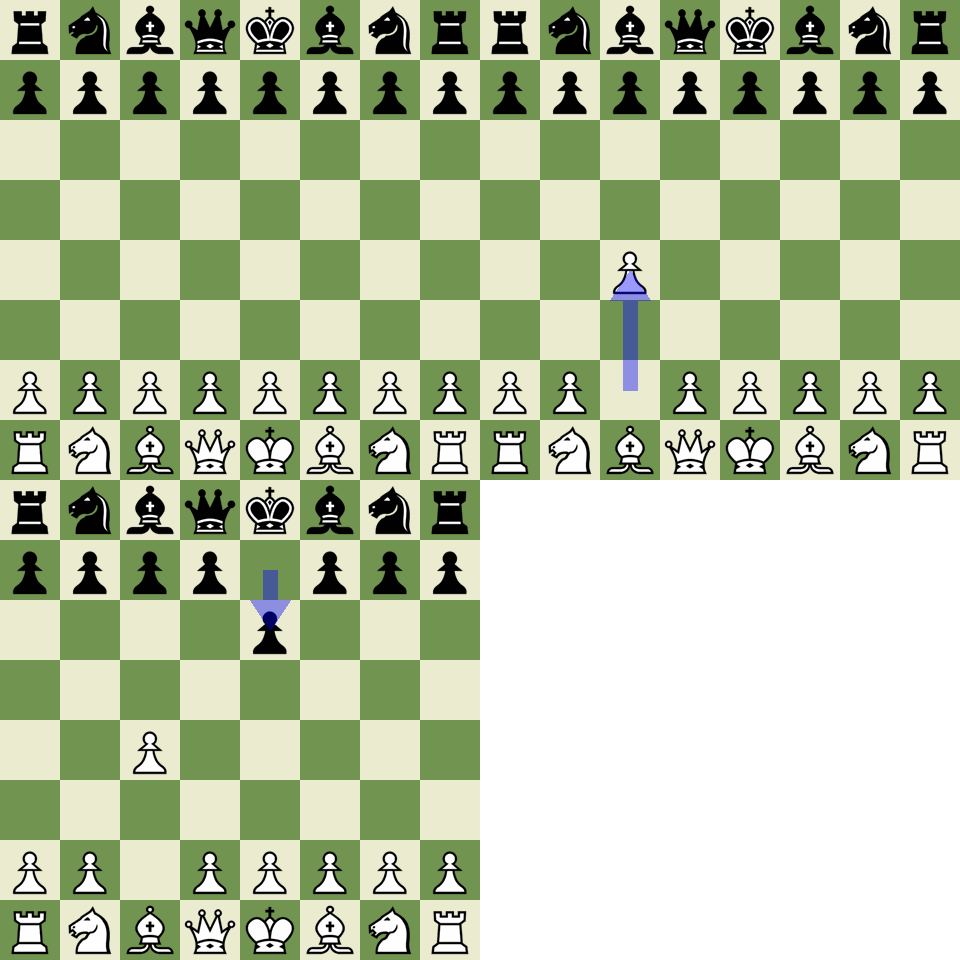
1.c4 e6 opens the English Opening: Agincourt Defense, ECO A13. Black plants the e-pawn one square forward and quietly stakes a claim on d5. Known as the Agincourt Defense, this is a transposition magnet — Queen's Gambit, Catalan, and Nimzo structures are all one move away.
Strategic Overview
1...e6 is the most transposition-prone reply to the English. The point is simple: prepare ...d5 with full support, while keeping the option of ...Nf6 and ...Bb4 lines open. After 2.Nf3 d5, the game can drift into Reti or Catalan territory. After 2.Nc3 d5, the symmetrical structure echoes a Queen's Gambit Declined. After 2.g3 d5, it's a Catalan unless White declines to push d4. The unifying idea is that Black wants to plant a pawn on d5 and develop pieces behind it, much like a Queen's Gambit Declined played a tempo down for White. The downside is exactly what you'd expect: the c8-bishop is locked in until Black plays ...b6 or accepts a passive piece. The upside is that this structure is hard to break down — Black has no weaknesses and a clear plan around ...c5 or ...e5 breaks once development is complete. It's the Agincourt because solid, patient defense wins the day, not because anything sharp happens early.
Key Ideas
A few ideas come up again and again in this opening:
- Prepare ...d5 with full pawn support — The whole purpose of 1...e6 is to follow with ...d5 and own that square. White can't easily play d4 and e4 to bulldoze the center anymore.
- Transposition is a feature, not a bug — Depending on White's choice between 2.Nf3, 2.Nc3, and 2.g3, the game heads into Catalan, QGD, or Reti structures. Black's job is to know which transposition they want and steer accordingly.
- The c8-bishop needs a plan — This bishop gets stuck behind the e6-d5 pawn chain. Either prepare ...b6 and ...Bb7 to fianchetto it, or accept that it will sit on c8 or d7 for a while until ...e5 frees the diagonal.
History and Notable Players
It arises from the English Opening. Among the most prolific White practitioners are Normunds Miezis (245 games), Wolfgang Uhlmann (133 games), Viktor Korchnoi (127 games). Black-side regulars include Glenn C Flear (115 games), Evgeny Sveshnikov (108 games), Eduardas Rozentalis (92 games).
Performance Across Rating Levels
Popularity and results vary sharply by rating level. Among 1200-rated players, it appears in 0.17% of games — 1,153,968 of them on record — with White winning 51% and Black 45.3%. At 1800 the opening surfaces in 0.43% of games; White wins 49.7%, Black 45.2%, draws 5.1%. At 2500, 0.99% of games go into this opening; draws sit at 10.8% — the line is well-mapped at this level. White's edge erodes by 4.8pp from 1200 to 2500 Elo, suggesting Black's counterplay is easier to find with experience.
Time Control Patterns
Time control matters here: bullet players reach for this opening more than others. In bullet, it appears in 0.43% of games (11,547,216); White wins 50.4%. Blitz shows 0.34% adoption across 12,231,598 games, White scoring 49.9%. In rapid, the share rises to 0.22% — 2,443,433 games, White 50.2%.
Move Diversity and Theory Depth
Move choice is far from uniform in the English Opening: Agincourt Defense. At 1200 Elo (1,153,968 games), the top reply is Nc3, played 47.4% of the time. Four other moves each take at least 5% of games, and the top three moves account for 75.4% of games. Entropy: 2.43. By 2500 (135,628 games), Nc3 is still the top reply, at 33.4%; only two other moves still reach 5% and the top three moves account for 90.3% of games. Entropy drops to 2.08.
Main Lines and Variations
The main branches off 1.c4 e6 include:
Each branch leads to a different middlegame character — the resulting pawn structure decides what kind of game you get.
Common Mistakes
- Drifting away from main theory — At 400 Elo, the three most-played moves cover 67.1% of games, against 79.5% at 2000. The most popular deviation is d4 (played 18.1% of the time at 400, less so up top). It looks fine but quietly hands the better-prepared side an edge.
- Neglecting development — It can feel productive to make extra pawn moves early, but falling behind in piece development is what loses most amateur games — especially in open positions where active pieces find squares fast.
- Playing without a plan — Each English Opening: Agincourt Defense middlegame demands a specific approach. Decide whether the position calls for attack, manoeuvre, or simplification before reaching for a move.
Practice on Chessiverse
Ready to try the English Opening: Agincourt Defense against a bot? Pick an opponent at your level and play a game.