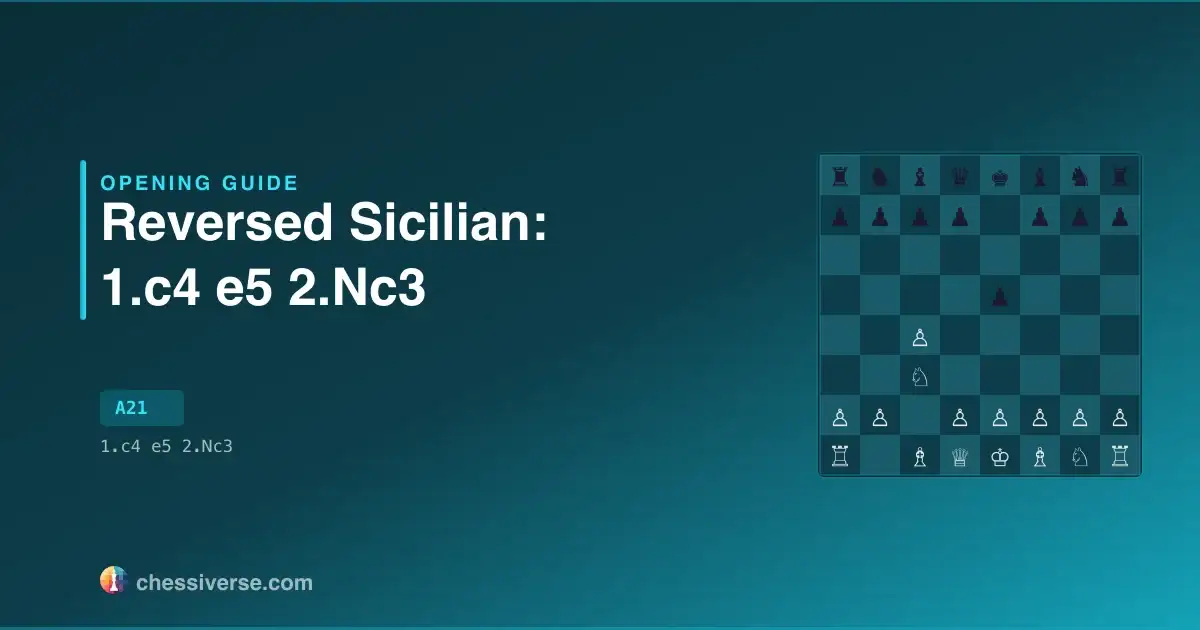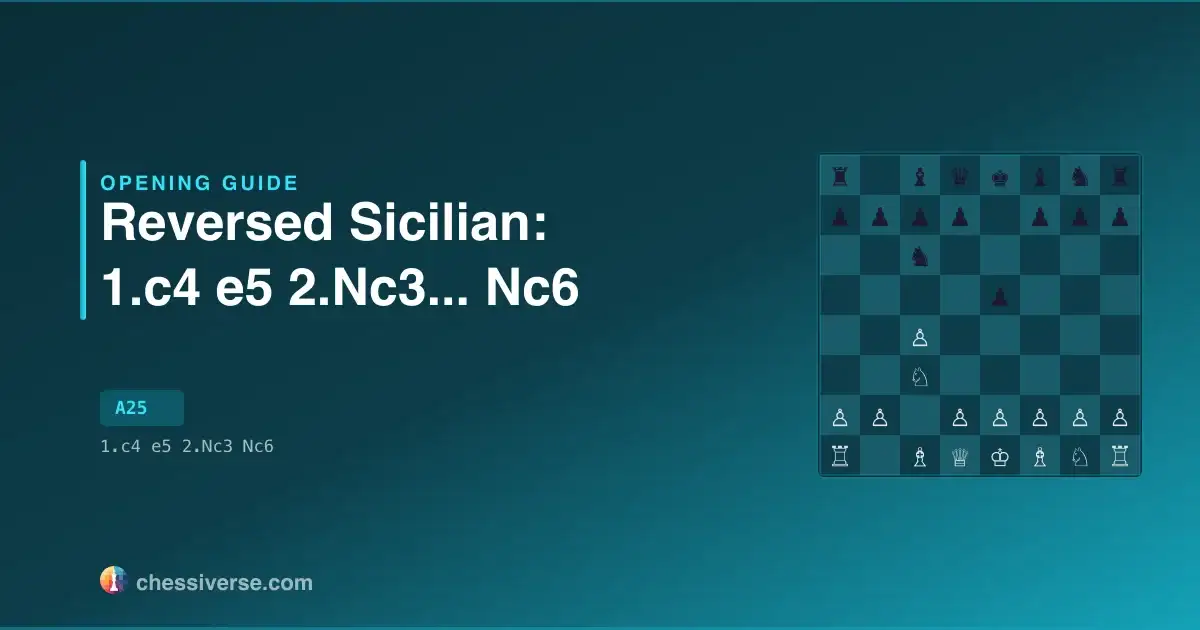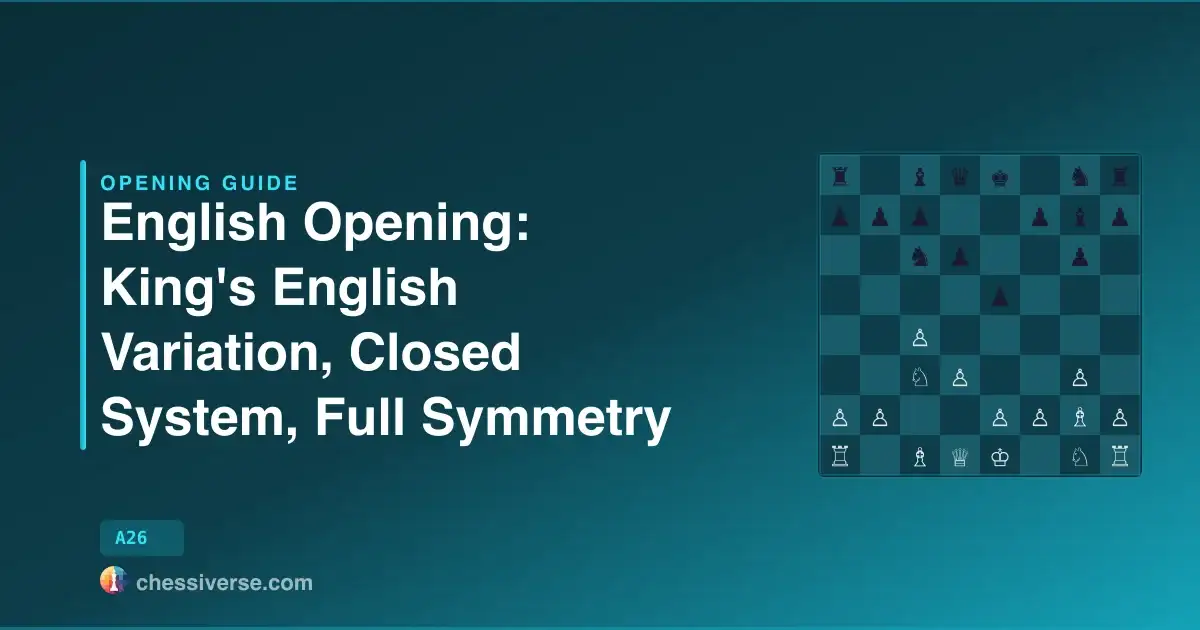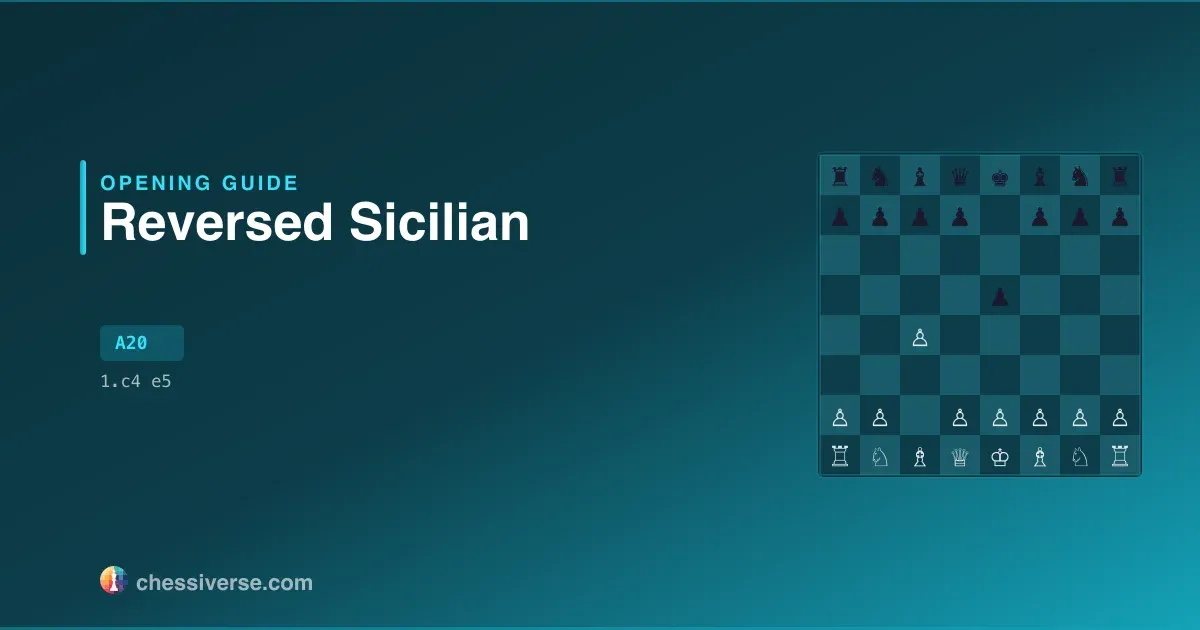
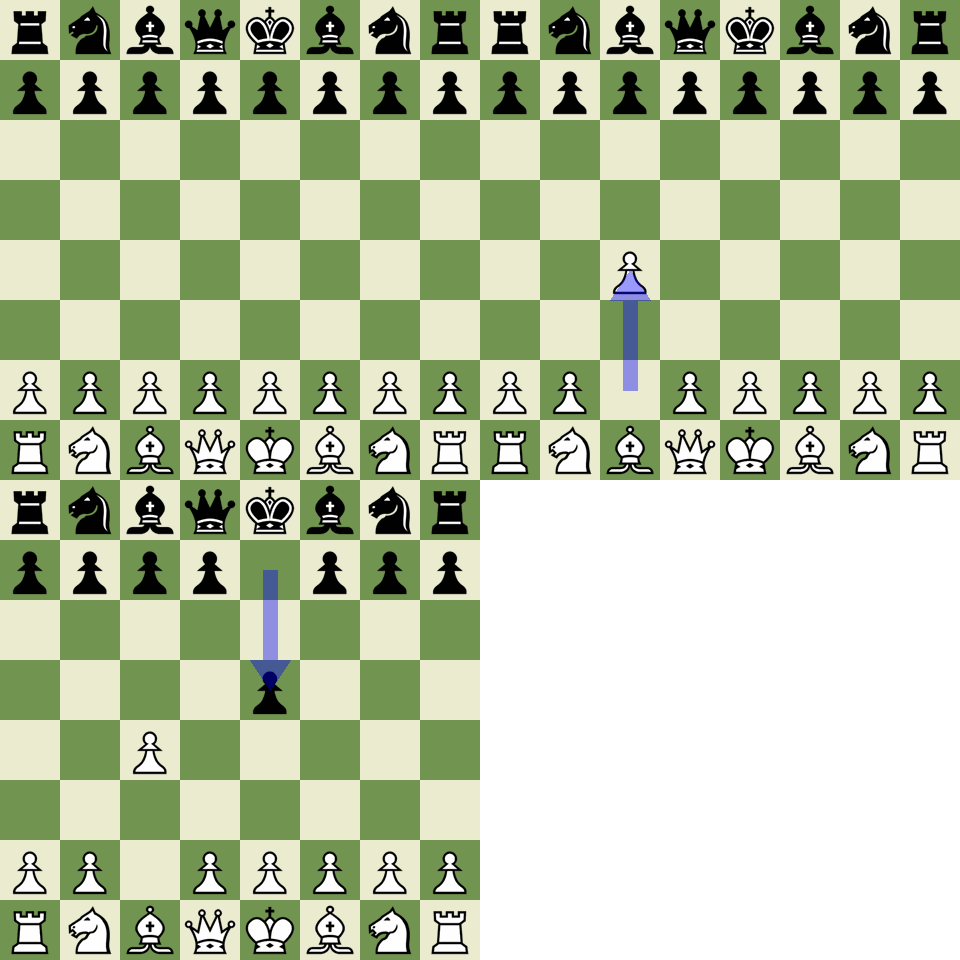
1.c4 e5 opens the Reversed Sicilian, ECO A20. Black plays the Sicilian — but on the other side, and a tempo down. That extra move sounds like nothing until you realize how often the Sicilian itself relies on Black's precise move order to make a thing of it.
Strategic Overview
The Reversed Sicilian flips the colors of a Sicilian Defense, with the extra wrinkle that White is now the side with the half-open file and ...c5 break. The structural ideas are the same — flank pawn pressure, the long diagonal, fight for d5 — but the tempo advantage changes which lines actually work. White's main choices on move two are 2.Nc3 (the standard plan, reinforcing d5), 2.g3 (preparing a fianchetto and keeping transpositions wide open), and 2.Nf3 (which can lead to a reversed Alekhine if Black plays ...e4, with the cxd5 trick available if Black tries ...d5). Pushing 2.d4 throws the advantage away — White gives up the structural asymmetry that justifies the opening in the first place. Black's setup has to acknowledge that this isn't the Sicilian — defensive resources that work for Black there don't always work for White here, because the extra tempo can be the difference between a comfortable Najdorf-style position and one where White just has more space. The middlegame revolves around the d5-square, the c-file, and whether White can convert tempo into real initiative.
Key Ideas
The recurring motifs below distinguish a confident handler of this opening from a beginner:
- 2.Nc3 is the principled main move — The standard plan: reinforce the attack on d5 and keep flexibility on the d-pawn. From here White can choose between Nf3, g3 (Bremen System), or e3 setups depending on Black's reply.
- 2.g3 keeps transpositions wide open — Fianchetto first, decide later. The Bg2 will matter in basically every resulting structure, and White retains the option of Ne2 or Nf3 depending on Black's setup.
- 2.Nf3 invites a reversed Alekhine — If Black plays ...e4 chasing the knight, the position becomes a reversed Alekhine where White has an extra tempo. If Black tries ...d5 instead, cxd5 is a clean equalizing trick.
- Don't play 2.d4 — it gives up the asymmetry — Pushing d4 turns the position into something resembling a Queen's Gambit but with the wrong move order. White throws away the structural advantage of having played c4 first.
History and Notable Players
It arises from the English Opening. Among the most prolific White practitioners are Normunds Miezis (226 games), Wolfgang Uhlmann (198 games), Colin Anderson McNab (123 games). Black-side regulars include Oleg M Romanishin (80 games), Viswanathan Anand (80 games), Ivan Sokolov (76 games).
It arises from the English Opening, pioneered by Howard Staunton in his 1843 match against Saint-Amant and at London 1851, though 1.c4 only really caught on in the twentieth century. It has since featured in world championship play from Botvinnik and Petrosian through Kasparov to Carlsen and Ding Liren.
Named after: Named for its mirrored structure: after 1.c4 e5, White has the Black side of a Sicilian Defence but with an extra tempo.
There is a famous catch, noted by Bruce Leverett: it feels natural to play it like a Sicilian with an extra move, yet the Sicilian's biggest main lines turn out to correspond to obscure byways here - and vice versa.
Performance Across Rating Levels
Popularity and results vary sharply by rating level. Among 1200-rated players, it appears in 1.02% of games — 6,869,641 of them on record — with White winning 51% and Black 45.3%. Move up to 1800 Elo and the share shifts to 1.10%, with White winning 51.7% versus Black's 43.6%. Among 2500-rated players the line appears in 1.22% of games and draws spike to 9.4%, indicating tight preparation. White's edge erodes by 4.1pp from 1200 to 2500 Elo, suggesting Black's counterplay is easier to find with experience.
Time Control Patterns
Time control matters here: rapid players reach for this opening more than others. In bullet, it appears in 0.77% of games (20,523,082); White wins 52.3%. Blitz shows 1.04% adoption across 37,366,590 games, White scoring 51.3%. In rapid, the share rises to 1.11% — 12,232,013 games, White 50.9%.
Move Diversity and Theory Depth
What players actually play after the opening moves depends heavily on rating. At 1200 Elo (6,869,641 games), the top reply is Nc3, played 54.5% of the time. Four other moves each take at least 5% of games, and the top three moves account for 75.5% of games. Entropy: 2.28. By 2500 (165,975 games), Nc3 dominates at 57% of replies; only one other move still reaches 5% and the top three moves account for 94.4% of games. Entropy drops to 1.54. The narrowing is significant — strong players consolidate around a small set of best moves, while amateurs scatter across many plausible-looking options.
Main Lines and Variations
The main branches off 1.c4 e5 include:
Each branch leads to a different middlegame character — the resulting pawn structure decides what kind of game you get.
Common Mistakes
- Drifting away from main theory — At 400 Elo, the three most-played moves cover 65.1% of games, against 91.4% at 2000. The most popular deviation is e4 (played 13.6% of the time at 400, much less so up top). It looks fine but quietly hands the better-prepared side an edge.
- Neglecting development — It can feel productive to make extra pawn moves early, but falling behind in piece development is what loses most amateur games — especially in open positions where active pieces find squares fast.
- Ignoring the kingside attack — In sharp Sicilian lines, White typically castles long and pushes the h-pawn. Without your own counterplay on the queenside or in the centre, White's attack lands first.
Practice on Chessiverse
Ready to try the Reversed Sicilian against a bot? Pick an opponent at your level and play a game.