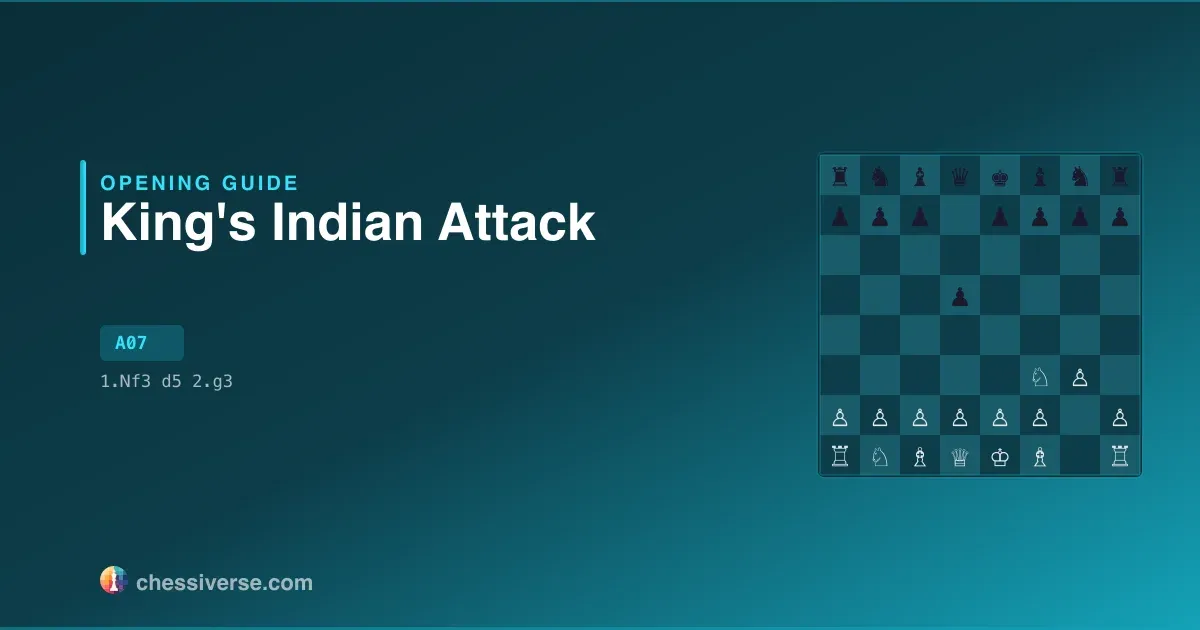
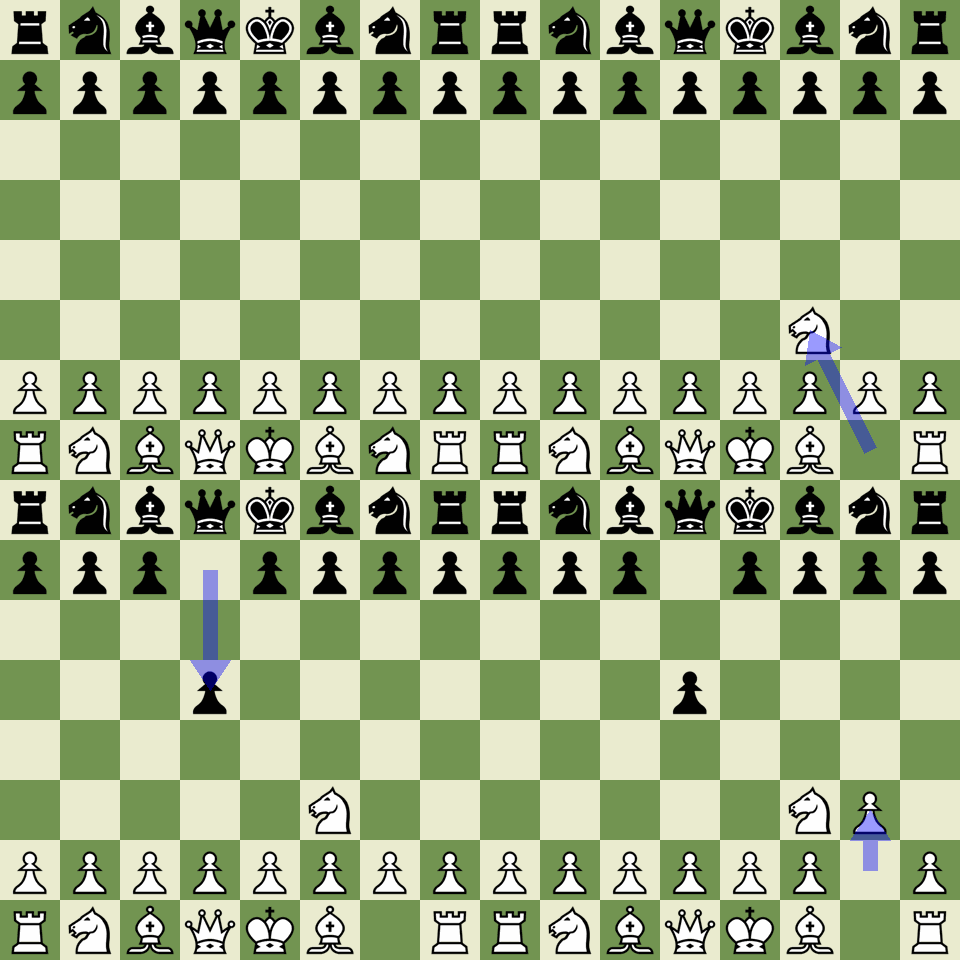
The King's Indian Attack arises after 1.Nf3 d5 2.g3 and falls under ECO code A07. With 2.g3, White prepares to fianchetto the king's bishop and adopt a setup that mirrors the King's Indian Defense, but from the white side. Having the extra tempo allows White to pursue this system more aggressively than Black typically can, pressing for an initiative while maintaining the same structural and strategic ideas that characterize the King's Indian. With 11.1 million Lichess games across all rating levels, it is a well-established opening choice.
History and Notable Players
Among the most prolific practitioners on the White side are Tomasz Markowski (184 games), Lev Gutman (161 games), Valery A Loginov (146 games). On the Black side, notable exponents include Aleksey Dreev (65 games), Evgeny Sveshnikov (55 games), Jonny Hector (54 games).
Statistics
Based on 11.1 million Lichess games across all rating levels:
- White wins: 51.4%
- Black wins: 43.2%
- Draws: 5.4%
White holds a moderate edge statistically, though Black has good practical chances.
Main Lines and Variations
After 1.Nf3 d5 2.g3, the main continuations include:
Each of these lines leads to distinct types of positions and requires its own understanding of the resulting pawn structures and piece placements.
Common Mistakes to Avoid
- Allowing White to build an overwhelming center: Hypermodern openings allow White space in the center, but you need to strike back at the right moment. Delaying the counterattack too long can leave you without active play.
Practice on Chessiverse
The best way to learn the King's Indian Attack is through practice. On Chessiverse, you can play chess against computer opponents that specialize in this opening. Our AI bots range from beginner to grandmaster level, each with unique playing styles — from aggressive attackers to solid defenders. Choose a bot that matches your rating and work your way up as you master the opening's key ideas.
Performance Across Rating Levels
Popularity and results vary sharply by rating level. The 1200 bracket has 1,103,693 games (0.16% of all games at that level); White wins 49.8%, Black 46%, 4.3% are drawn. By 1800, popularity is 0.25% and White's score is 52.9% to Black's 42.1%. At the top end (2500+ Elo), popularity is 1.40% with 11% draws — a clear sign of how much theory rules the line at master level.
Time Control Patterns
Time control matters here: bullet players reach for this opening more than others. In bullet, it appears in 0.36% of games (9,543,772); White wins 53.3%. Blitz shows 0.25% adoption across 9,048,505 games, White scoring 51.5%. In rapid, the share rises to 0.19% — 2,060,560 games, White 50.9%. White's score swings 2.4pp across formats, so time control isn't just a stylistic choice here — it shifts the actual results.
Move Diversity and Theory Depth
Looking at move selection shows how forcing — or not — the position really is. At 1200 Elo (1,103,693 games), the top reply is Nc6, played 35.1% of the time. Five other moves each take at least 5% of games, and the top three moves account for 61.8% of games. Entropy: 2.91. By 2500 (191,313 games), Nf6 takes over as the top reply at 34.9%; six other moves reach 5% and the top three moves account for 63.5% of games. Entropy drops to 2.79.
Historical Trends
Long-term, the trajectory of this opening is informative. Adoption peaked in 2020 at 0.25% (1,429,551 games). By 2025 it sits at 0.24%, 2% below the peak but still 66% above its 2013 level, so the line is up over the full period despite easing from the high.