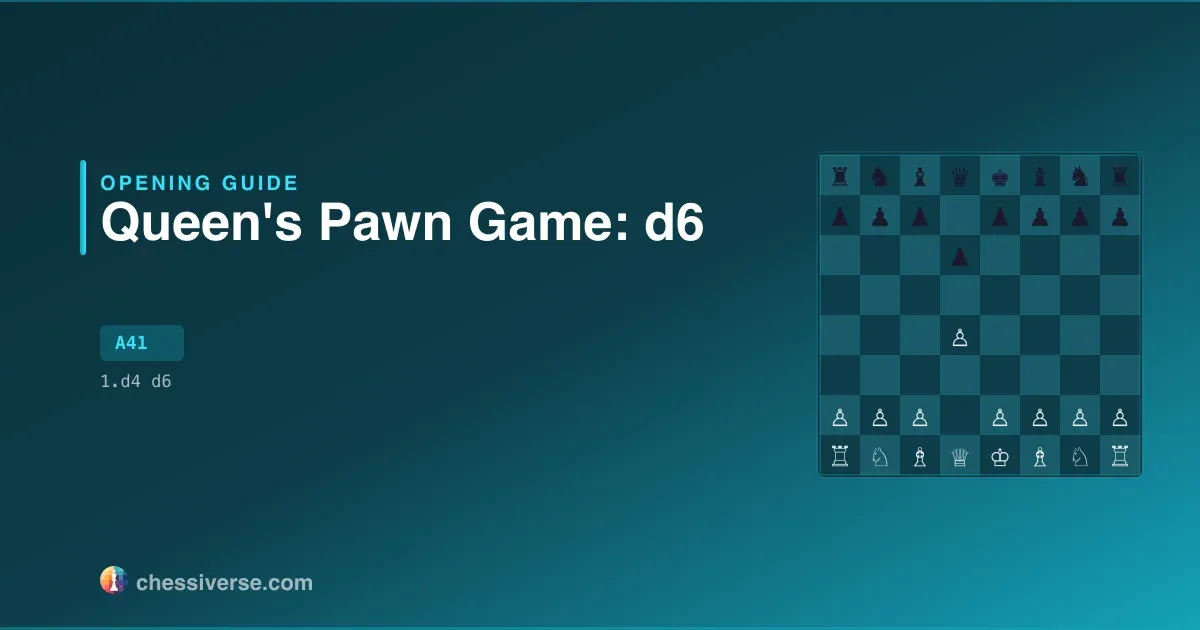
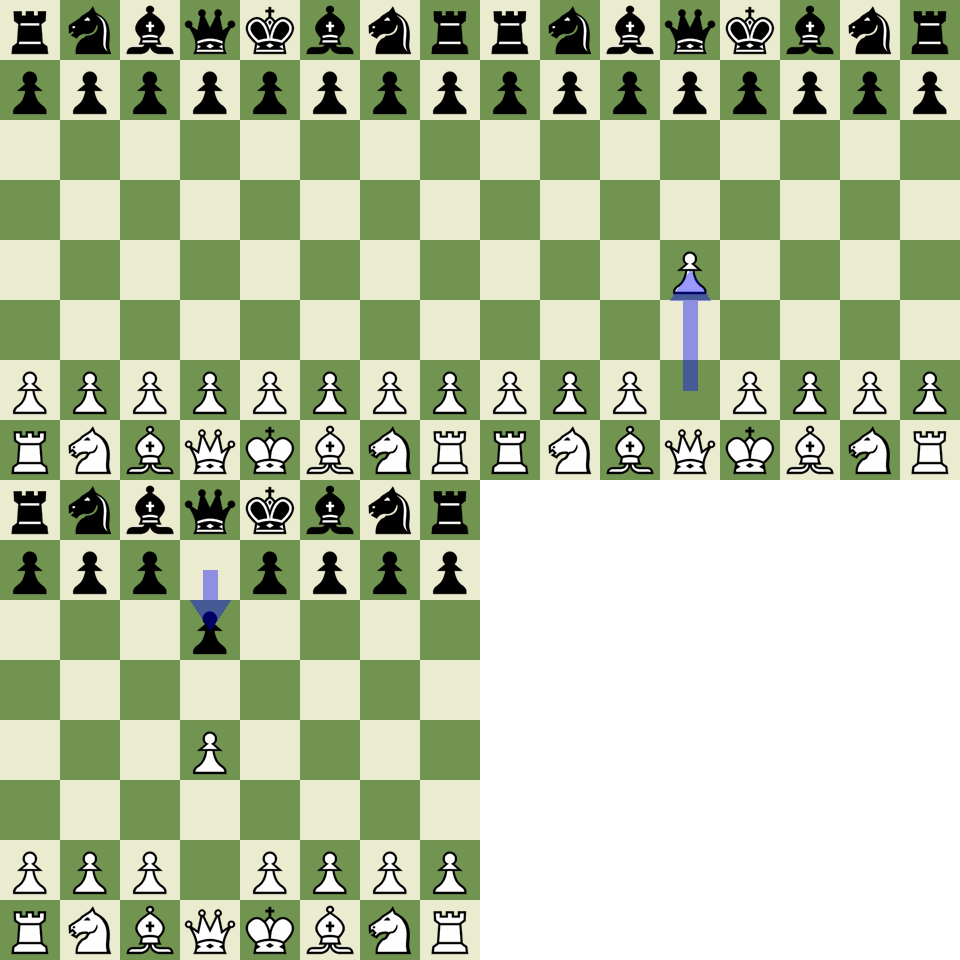
Starting from 1.d4 d6, players enter the Queen's Pawn Game: d6 — ECO A41. Black plays a flexible waiting move that almost always transposes into something more familiar. The interesting question is which structure both sides agree to enter.
Strategic Overview
1...d6 is rarely a destination — it's a route. The move is solid enough but commits Black to defenses that have to be played eventually anyway: Pirc, Modern, King's Indian, or a Queen's Pawn game with a delayed ...e5. White's main choices on move two define the character of the game. 2.e4 turns the position into a Pirc or Modern setup, which is fine if Black wanted that — but if Black avoided 1.e4 specifically to dodge those defenses, this transposition is awkward. 2.c4 lets Black grab the center with 2...e5, threatening to claim equal space and head into King's Indian or Old Indian structures. 2.Nf3 is the most flexible — White keeps options open, controls e5, and can transpose into many systems depending on Black's reply. The strategic theme across all these continuations is that Black plays a hypermodern defense: let White build a center, then attack it. The minor pieces find natural squares on f6 and g7 (or e7) and the pawn breaks ...e5 and ...c5 challenge White's center at the right moment. It's an opening for players who don't mind giving White space early in exchange for active piece play later.
Key Ideas
A few ideas come up again and again in this opening:
- Almost always transposes — pick your destination — 1...d6 is a waiting move. Where you end up — Pirc, Modern, King's Indian, or Old Indian — depends on White's reply and your own preparation. Know which transpositions you want.
- 2.e4 forces a Pirc/Modern transposition — If White plays e4, the game becomes a Pirc or Modern setup. Black has to be comfortable in those defenses or this move order isn't the right choice.
- 2.c4 allows ...e5 immediately — Against c4, Black can grab the center with ...e5. This often heads toward King's Indian or Old Indian structures with a more balanced position than the Pirc lines.
- Hypermodern philosophy across all variations — The unifying theme is: let White build a center, then attack it with pieces and pawn breaks. ...e5 and ...c5 are the standard breaks; ...Nf6 and ...Bg7 are the standard piece setups.
History and Notable Players
It arises from the Queen's Pawn Game. On the White side, Ivan Farago (72 games), Miso Cebalo (51 games), Aleksey Dreev (50 games) top the database. Notable Black exponents: Colin Anderson McNab (275 games), Zurab Azmaiparashvili (199 games), Aleksa Strikovic (172 games).
Performance Across Rating Levels
The picture changes a lot as you climb the rating ladder. Among 1200-rated players, it appears in 0.72% of games — 4,868,771 of them on record — with White winning 50.5% and Black 45.3%. By 1800, popularity is 0.88% and White's score is 48.6% to Black's 46.6%. Among 2500-rated players the line appears in 1.30% of games and draws spike to 10%, indicating tight preparation. White's edge erodes by 3.3pp from 1200 to 2500 Elo, suggesting Black's counterplay is easier to find with experience.
Time Control Patterns
The Queen's Pawn Game: d6 skews toward bullet chess. In bullet, it appears in 1.25% of games (33,194,160); White wins 48.9%. Blitz shows 0.87% adoption across 31,191,275 games, White scoring 49.2%. In rapid, the share rises to 0.67% — 7,372,987 games, White 50.3%.
Move Diversity and Theory Depth
Looking at move selection shows how forcing — or not — the position really is. At 1200 Elo (4,868,771 games), the top reply is c4, played 24.2% of the time. Five other moves each take at least 5% of games, and the top three moves account for 64.6% of games. Entropy: 2.80. By 2500 (176,789 games), Nf3 takes over as the top reply at 33.9%; only three other moves still reach 5% and the top three moves account for 85.9% of games. Entropy drops to 2.25. The narrowing is significant — strong players consolidate around a small set of best moves, while amateurs scatter across many plausible-looking options.
Historical Trends
Tracking the Queen's Pawn Game: d6 year over year shows a clear story. Adoption peaked in 2025 at 0.86% (6,386,234 games). 2025 marks the high — the opening is rising, currently at 0.86%.
Main Lines and Variations
From the position after 1.d4 d6, the recognised continuations are:
Each branch leads to a different middlegame character — the resulting pawn structure decides what kind of game you get.
Common Mistakes
- Drifting away from main theory — At 400 Elo, the three most-played moves cover 55.6% of games, against 76.6% at 2000. The most popular deviation is Bf4 (played 17.2% of the time at 400, less so up top). It looks fine but quietly hands the better-prepared side an edge.
- Neglecting development — Extra pawn moves in the opening are tempting, especially when you "know the moves". Developing a piece each turn is the simple correction.
- Playing without a plan — Each Queen's Pawn Game: d6 middlegame demands a specific approach. Decide whether the position calls for attack, manoeuvre, or simplification before reaching for a move.
Practice on Chessiverse
Ready to try the Queen's Pawn Game: d6 against a bot? Pick an opponent at your level and play a game.