



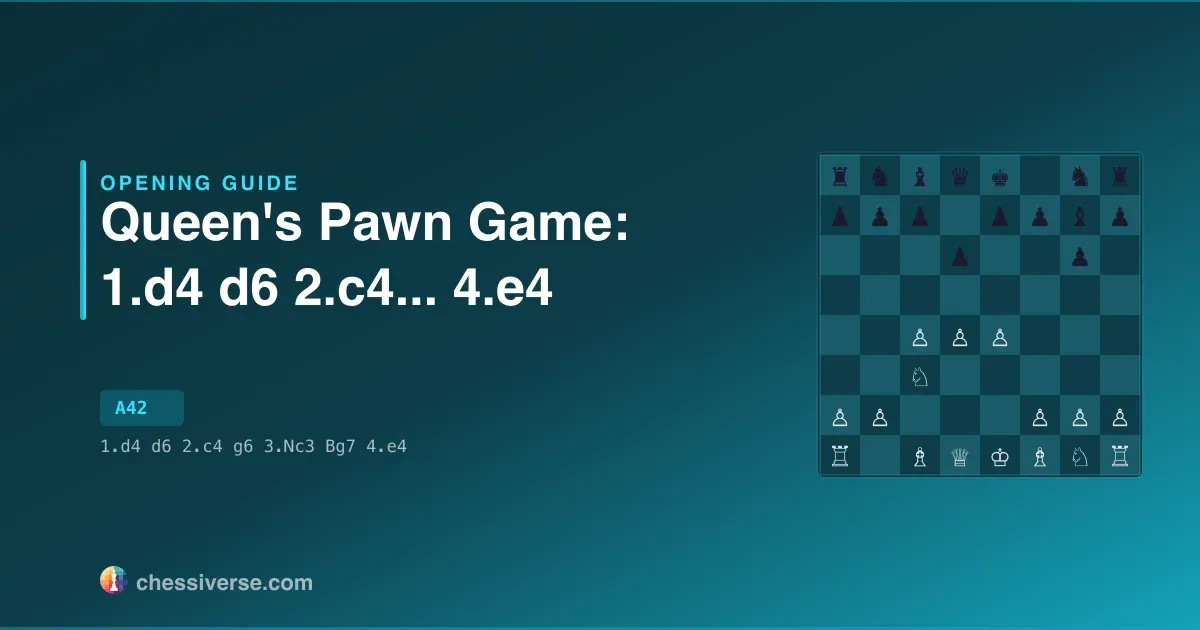
Starting from 1.d4 d6 2.c4 g6 3.Nc3 Bg7 4.e4, players enter the Modern Defense: Averbakh System — ECO A42. Across rating levels it shows up in 4,482,875 recorded games — enough data to map exactly where it succeeds and where it stalls.
History and Notable Players
It arises from the Queen's Pawn Game: d6. Among the most prolific White practitioners are Wolfgang Uhlmann (69 games), Miso Cebalo (33 games), Ivan Farago (32 games). Black-side regulars include Miodrag Todorcevic (88 games), Carsten Hoi (47 games), Borislav Ivkov (40 games).
Performance Across Rating Levels
The picture changes a lot as you climb the rating ladder. At 1200 Elo, the opening shows up in 0.02% of games (120,984 samples). White scores 50%, Black 46.6%, draws 3.4%. At 1800 the opening surfaces in 0.17% of games; White wins 49.3%, Black 46.2%, draws 4.5%. At the top end (2500+ Elo), popularity is 0.25% with 9.4% draws — a clear sign of how much theory rules the line at master level. Positions also become less sharp as level rises (sharpness 0.97 → 0.91).
Time Control Patterns
Look at the same opening across time controls and blitz stands out. In bullet, it appears in 0.11% of games (2,896,540); White wins 48.1%. Blitz shows 0.11% adoption across 3,943,352 games, White scoring 48.8%. In rapid, the share rises to 0.05% — 539,523 games, White 50.5%. White's score swings 2.4pp across formats, so time control isn't just a stylistic choice here — it shifts the actual results.
Move Diversity and Theory Depth
Looking at move selection shows how forcing — or not — the position really is. At 1200 Elo (120,984 games), the top reply is Nf6, played 47.1% of the time. Five other moves each take at least 5% of games, and the top three moves account for 67.7% of games. Entropy: 2.62. By 2500 (34,349 games), Nf6 is still the top reply, at 29.8%; only three other moves still reach 5% and the top three moves account for 80.9% of games. Entropy drops to 2.41.
Common Mistakes
- Drifting away from main theory — At 400 Elo, the three most-played moves cover 70.5% of games, against 77.3% at 2000. The most popular deviation is e5 (played 13% of the time at 400, much less so up top). It looks fine but quietly hands the better-prepared side an edge.
- Neglecting development — It can feel productive to make extra pawn moves early, but falling behind in piece development is what loses most amateur games — especially in open positions where active pieces find squares fast.
- Playing without a plan — Each Modern Defense: Averbakh System middlegame demands a specific approach. Decide whether the position calls for attack, manoeuvre, or simplification before reaching for a move.
Practice on Chessiverse
Ready to try the Modern Defense: Averbakh System against a bot? Pick an opponent at your level and play a game.