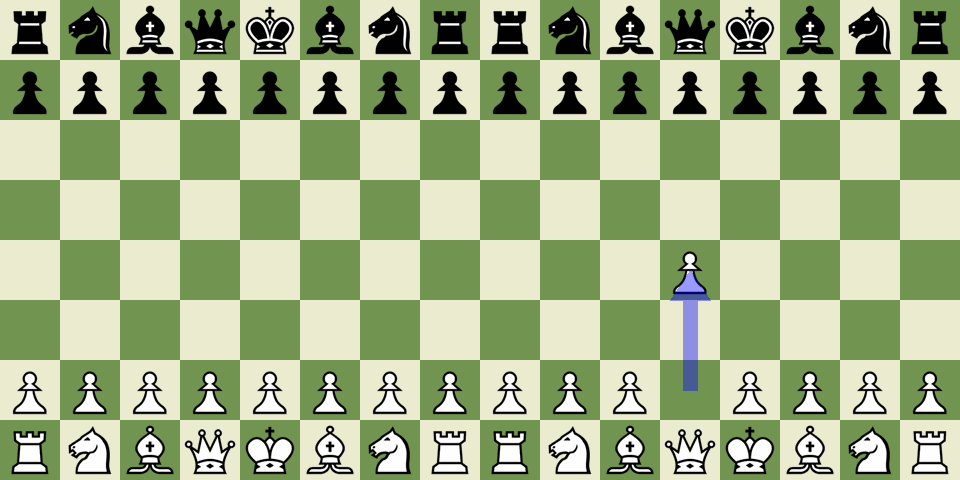
The Queen's Pawn Game arises after 1.d4 and falls under ECO code A40. With this move, White stakes a claim in the centre, directly controlling the c5 and e5 squares while the queen gains a clear view down the d-file. It also opens a path for the queenside bishop to develop later. As the second most played opening move after 1. e4, Queen's Pawn games tend to unfold in a less forcing manner than King's Pawn games because the d4 pawn is already defended by the queen, leading to positions that are typically more closed and strategic. White's approach focuses on restraining Black's activity rather than rushing piece development. If Black does nothing to prevent it, White can follow up with 2. e4, establishing a commanding two-pawn centre with ample room for comfortable development. Black's most important early priority, therefore, is to control the e4 square and deny White that ideal setup. With 1152.6 million Lichess games across all rating levels, it is one of the most popular openings.
- Both main replies, 1...Nf6 and 1...d5, stop White from grabbing the full centre with an early e4.
- White can head for the Queen's Gambit with 2.c4, or choose another 1.d4 opening such as the London, Colle, Torre or Trompowsky.
- Move orders are very flexible: games constantly transpose between 1.d4 openings depending on when each side commits pawns and pieces.
History and Notable Players
Among the most prolific practitioners on the White side are Ivan Farago (1797 games), Aleksey Dreev (1577 games), Loek Van Wely (1401 games). On the Black side, notable exponents include Viktor Korchnoi (841 games), Vassily Ivanchuk (751 games), Viswanathan Anand (730 games).
In the 1800s and early 1900s, 1.e4 ruled and the unusual 1.d4 openings were lumped together as the Queen's Pawn Game. As 1.d4 was explored, the Queen's Gambit grew more popular than all other 1.d4 openings combined, and the hypermodern school later made the Indian defences fashionable, so the label kept narrowing.
Named after: Named for the queen's pawn, the d-pawn that White pushes two squares with 1.d4.
1.d4 is the second most popular first move after 1.e4, yet the name Queen's Pawn Game kept shrinking: it once meant every 1.d4 opening, then everything except the Queen's Gambit, then even less once the Indian defences earned their own names.
Statistics
Based on 1152.6 million Lichess games across all rating levels:
- White wins: 50.2%
- Black wins: 45.1%
- Draws: 4.7%
White holds a moderate edge statistically, though Black has good practical chances.
Main Lines and Variations
After 1.d4, the main continuations include:
Each of these lines leads to distinct types of positions and requires its own understanding of the resulting pawn structures and piece placements.
Practice on Chessiverse
The best way to learn the Queen's Pawn Game is through practice. On Chessiverse, you can play chess against computer opponents that specialize in this opening. Our AI bots range from beginner to grandmaster level, each with unique playing styles — from aggressive attackers to solid defenders. Choose a bot that matches your rating and work your way up as you master the opening's key ideas.
Performance Across Rating Levels
Popularity and results vary sharply by rating level. The 1200 bracket has 147,900,600 games (21.92% of all games at that level); White wins 50.8%, Black 45.3%, 3.9% are drawn. At 1800 the opening surfaces in 26.65% of games; White wins 50%, Black 45.1%, draws 4.9%. Among 2500-rated players the line appears in 34.49% of games and draws spike to 10.1%, indicating tight preparation. White's edge erodes by 3.4pp from 1200 to 2500 Elo, suggesting Black's counterplay is easier to find with experience.
Time Control Patterns
The Queen's Pawn Game skews toward bullet chess. In bullet, it appears in 26.31% of games (699,306,809); White wins 50.6%. Blitz shows 25.18% adoption across 905,227,504 games, White scoring 50.2%. In rapid, the share rises to 22.35% — 247,333,023 games, White 50.2%.
Move Diversity and Theory Depth
Move choice is far from uniform in the Queen's Pawn Game. At 1200 Elo (147,900,600 games), the top reply is d5, played 54.6% of the time. Three other moves each take at least 5% of games, and the top three moves account for 75.7% of games. Entropy: 2.34. By 2500 (4,703,789 games), Nf6 takes over as the top reply at 53.2%; only one other move still reaches 5% and the top three moves account for 84.6% of games. Entropy drops to 2.02.
Historical Trends
Year-over-year data tells you whether this opening is a contemporary fixture or a fading one. Adoption peaked in 2022 at 24.86% (183,765,460 games). By 2025 it sits at 24.71%, 1% below the peak and roughly back to its 2013 level, leaving the line flat over the full period.