

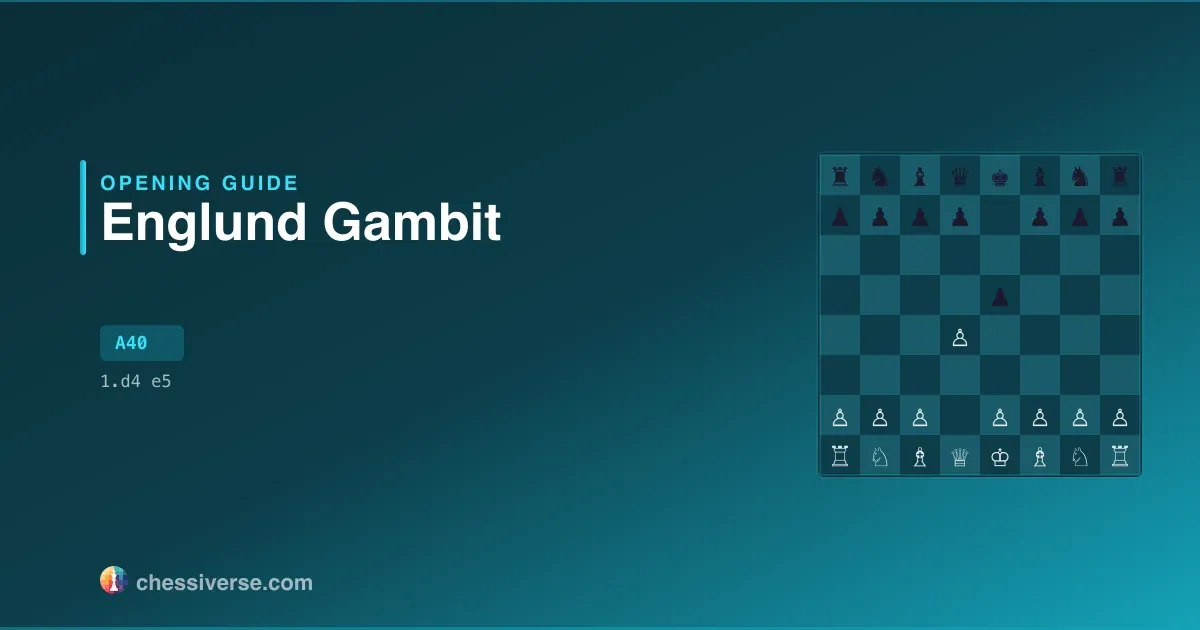
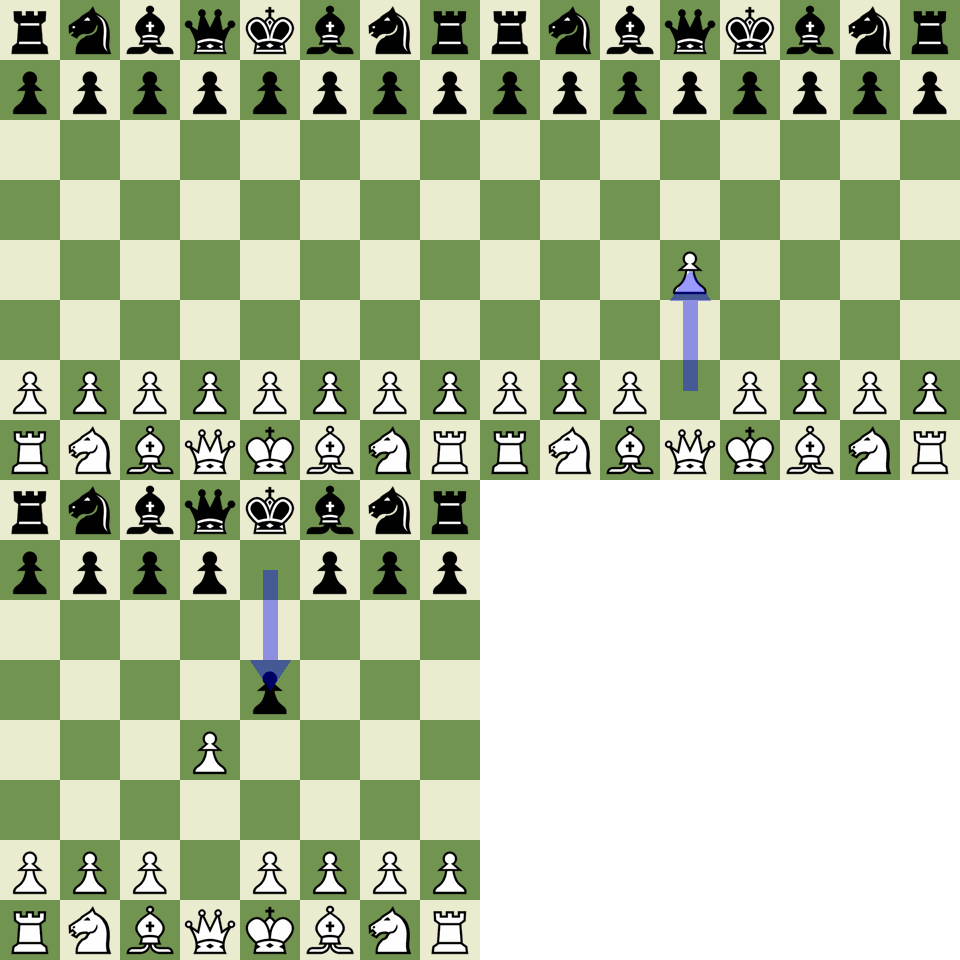
The Englund Gambit arises after 1.d4 e5 and falls under ECO code A40. Black immediately offers the e-pawn, but this gambit is generally considered unsound: with accurate play, White obtains an advantage that Black cannot fully compensate for. Consequently, it is seldom seen in serious tournament play, though it appears regularly in amateur games where Black is seeking an open, tactical struggle with trappy possibilities. Accepting with 2. dxe5 is the most principled response, putting the burden on Black to demonstrate compensation. The main line runs 2...Nc6 3. Nf3 Qe7 4. Bf4, where Black hopes for the queen manoeuvre ...Qb4+ followed by ...Qxb2, but careful play from White renders this harmless. The alternative 2...d6 concedes the pawn in exchange for an open centre and faster development. White can also decline: 2. e3!? exd4 leads to a reversed French structure, 2. d5!? keeps things closed, 2. Nf3!? enters a reversed Alekhine where 2...e4 kicks the knight, and 2. e4 transposes directly into the Centre Game (1. e4 e5 2. d4). With 63.9 million Lichess games across all rating levels, it is one of the most popular openings.
- Black gives up a pawn at once to drag a 1.d4 player into open, tactical play far from quiet queen's-pawn territory.
- In the main line Black's queen swings to e7 and then b4, harassing White's queenside and setting well-known traps.
- Sound play leaves White with an edge thanks to a lead in development, but one careless bishop move can even allow a quick mate on c1.
History and Notable Players
It arises from the Queen's Pawn Systems (1...d5). Among the most prolific practitioners on the White side are Ivan Farago (1797 games), Aleksey Dreev (1577 games), Loek Van Wely (1401 games). On the Black side, notable exponents include Viktor Korchnoi (841 games), Vassily Ivanchuk (751 games), Viswanathan Anand (730 games).
Australian champion Henry Charlick tried 1.d4 e5 ideas as early as the 1890s, and Karlis Betins, who also established the Latvian Gambit, worked out the main line with 2...Nc6 and 3...Qe7. The name stuck after Fritz Englund funded a thematic tournament on the gambit in 1932-33.
Named after: Named for Fritz Englund (1871-1933), a Swedish player who sponsored a 1932-33 thematic tournament in which every game began from the gambit's key position.
Notable players: Paul Keres, Henri Grob, Kamran Shirazi
Its most famous trap punishes the natural-looking 6.Bc3: after 6...Bb4 one line ends with Black's queen delivering mate on c1 as early as move 8. IM Kamran Shirazi has played the gambit over 1,400 times in blitz and bullet.
Statistics
Based on 63.9 million Lichess games across all rating levels:
- White wins: 49.2%
- Black wins: 46.9%
- Draws: 3.9%
The statistics show a roughly balanced opening where both sides have equal chances.
Common Mistakes to Avoid
- Overextending without backup: When playing a gambit, each attacking move should have a purpose. Random checks and threats without coordination can leave your own position exposed once the initiative fades.
Practice on Chessiverse
The best way to learn the Englund Gambit is through practice. On Chessiverse, you can play chess against computer opponents that specialize in this opening. Our AI bots range from beginner to grandmaster level, each with unique playing styles — from aggressive attackers to solid defenders. Choose a bot that matches your rating and work your way up as you master the opening's key ideas.
Performance Across Rating Levels
Popularity and results vary sharply by rating level. At 1200 Elo, the opening shows up in 1.59% of games (10,703,246 samples). White scores 49.2%, Black 47.2%, draws 3.6%. Move up to 1800 Elo and the share shifts to 1.18%, with White winning 48.8% versus Black's 47%. At 2500, 0.16% of games go into this opening; draws sit at 8.1% — the line is well-mapped at this level.
Time Control Patterns
Time control matters here: bullet players reach for this opening more than others. In bullet, it appears in 2.04% of games (54,161,108); White wins 49.3%. Blitz shows 1.40% adoption across 50,402,324 games, White scoring 49%. In rapid, the share rises to 1.22% — 13,498,633 games, White 50%.
Move Diversity and Theory Depth
Looking at move selection shows how forcing — or not — the position really is. At 1200 Elo (10,703,246 games), the top reply is dxe5, played 59.9% of the time. Four other moves each take at least 5% of games, and the top three moves account for 76.9% of games. Entropy: 2.12. By 2500 (21,362 games), dxe5 dominates at 79.7% of replies; only two other moves still reach 5% and the top three moves account for 91.3% of games. Entropy drops to 1.26. The narrowing is significant — strong players consolidate around a small set of best moves, while amateurs scatter across many plausible-looking options.
Historical Trends
Tracking the Englund Gambit year over year shows a clear story. Adoption peaked in 2025 at 1.61% (11,929,809 games). 2025 marks the high — the opening is rising, currently at 1.61%.