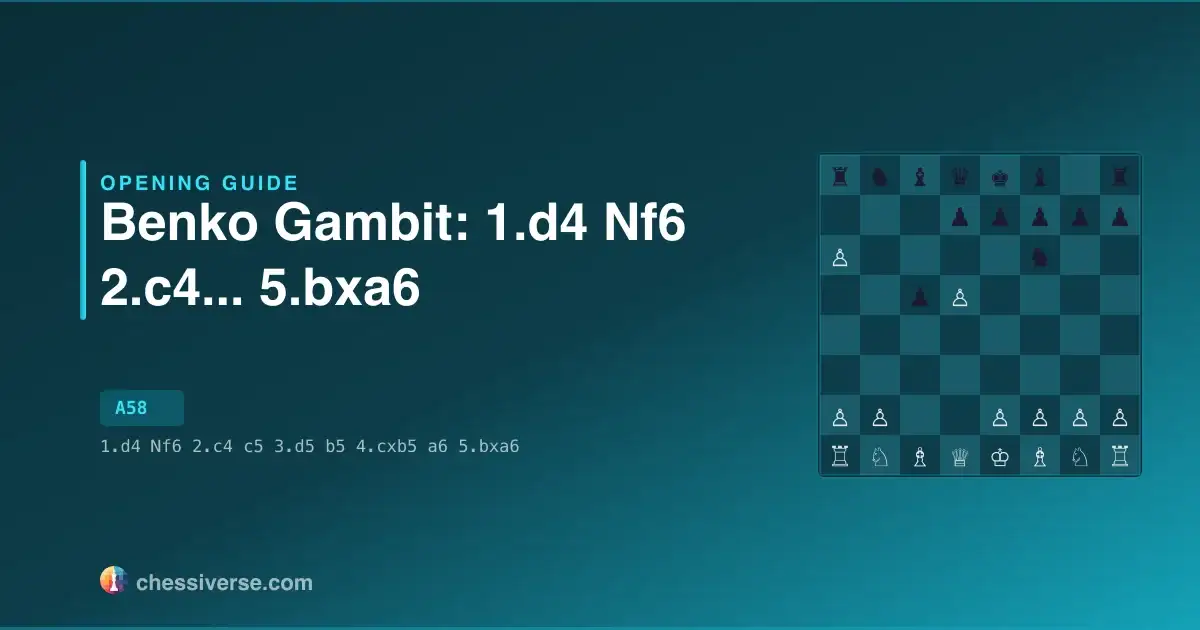




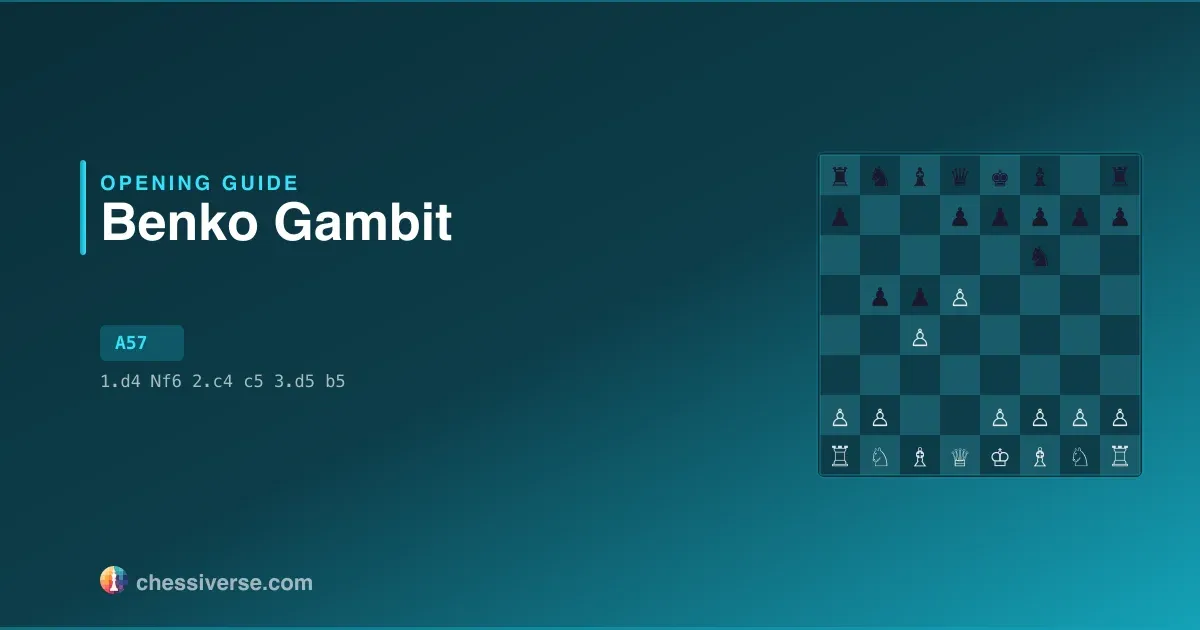
The Benko Gambit arises after 1.d4 Nf6 2.c4 c5 3.d5 b5 and falls under ECO code A57. With 3...b5, Black sacrifices a pawn on the queenside, and since declining tends to be unfavorable, White usually accepts with 4. cxb5. Black then follows up with 4...a6, offering a second pawn. If White takes with 5. bxa6, the compensation for being down material (Black can recapture on a6 at a convenient moment) comes in the form of powerful queenside pressure along two half-open files, a strong long diagonal for the fianchettoed bishop on g7, and a healthy pawn structure. White can opt to accept the first pawn but decline the second, for example with 5. b6, to avoid the most theoretically demanding lines. Declining the gambit entirely on move four is also possible but generally considered suboptimal, as it allows Black to advance with ...b4!, seizing queenside space and clamping down on a3 and c3, squares where White's knight would naturally develop. In practice, Black frequently maintains the tension between the b- and c-pawns, waiting to see whether White will eventually transpose back into a Benko Gambit accepted. With 4.3 million Lichess games across all rating levels, it is a well-established opening choice.
- Black gives up a pawn for long-term queenside pressure down the half-open a- and b-files, backed by a fianchettoed bishop on the long diagonal.
- Unusually for a gambit, Black is happy to swap queens - the positional pressure keeps paying off deep into the endgame.
- White's extra pawn comes at a price: the a- and b-pawns become targets while Black develops quickly and plays for a win.
History and Notable Players
It arises from the Indian Defense Systems. Among the most prolific practitioners on the White side are Ivan Farago (54 games), Ivan Sokolov (37 games), Loek Van Wely (35 games). On the Black side, notable exponents include Juan Manuel Bellon Lopez (67 games), Jan Plachetka (66 games), Natalija Pogonina (64 games).
The ...b5 pawn sacrifice was employed repeatedly by Karel Opocensky in the late 1930s, and a 1953 Taimanov-Bronstein game at the Zurich Candidates brought it wider attention. Pal Benko then refined and promoted it from the late 1960s, publishing The Benko Gambit in 1974. In Eastern Europe it is known as the Volga Gambit, after a 1946 Russian magazine article.
Named after: Hungarian-American grandmaster Pal Benko, who championed the gambit from the late 1960s and published a book on it in 1974.
Notable players: Pal Benko, Garry Kasparov, Viswanathan Anand, Veselin Topalov
In Eastern Europe the opening goes by a different name entirely - the Volga Gambit, from a 1946 article in the Soviet magazine Shakhmaty v SSSR - and many sources now hedge with Volga-Benko.
Statistics
Based on 4.3 million Lichess games across all rating levels:
- White wins: 44.3%
- Black wins: 50.2%
- Draws: 5.4%
Interestingly, Black scores well in this opening, suggesting it offers strong counterplay.
Main Lines and Variations
After 1.d4 Nf6 2.c4 c5 3.d5 b5, the main continuations include:
Each of these lines leads to distinct types of positions and requires its own understanding of the resulting pawn structures and piece placements.
Common Mistakes to Avoid
- Overextending without backup: When playing a gambit, each attacking move should have a purpose. Random checks and threats without coordination can leave your own position exposed once the initiative fades.
Practice on Chessiverse
The best way to learn the Benko Gambit is through practice. On Chessiverse, you can play chess against computer opponents that specialize in this opening. Our AI bots range from beginner to grandmaster level, each with unique playing styles — from aggressive attackers to solid defenders. Choose a bot that matches your rating and work your way up as you master the opening's key ideas.
Performance Across Rating Levels
The picture changes a lot as you climb the rating ladder. Among 1200-rated players, it appears in 0.01% of games — 40,695 of them on record — with White winning 48.3% and Black 48.9%. Move up to 1800 Elo and the share shifts to 0.14%, with White winning 42.3% versus Black's 53%. At 2500, 0.57% of games go into this opening; draws sit at 9.4% — the line is well-mapped at this level.
Time Control Patterns
The Benko Gambit skews toward blitz chess. In bullet, it appears in 0.06% of games (1,486,734); White wins 45.8%. Blitz shows 0.10% adoption across 3,774,280 games, White scoring 44.5%. In rapid, the share rises to 0.04% — 490,842 games, White 42.8%. White's score swings 3.0pp across formats, so time control isn't just a stylistic choice here — it shifts the actual results.
Move Diversity and Theory Depth
Move choice is far from uniform in the Benko Gambit. At 1200 Elo (40,695 games), the top reply is b3, played 41.6% of the time. Three other moves each take at least 5% of games, and the top three moves account for 78.2% of games. Entropy: 2.34. By 2500 (77,760 games), cxb5 takes over as the top reply at 76.6%; only two other moves still reach 5% and the top three moves account for 90.9% of games. Entropy drops to 1.39. The narrowing is significant — strong players consolidate around a small set of best moves, while amateurs scatter across many plausible-looking options.
Historical Trends
Tracking the Benko Gambit year over year shows a clear story. Adoption peaked in 2015 at 0.14% (31,895 games). By 2025 it sits at 0.08%, 44% below the peak but still 38% above its 2013 level, so the line is up over the full period despite easing from the high.