Benko Gambit: 1.d4 Nf6 2.c4...... 7.e4

+137%
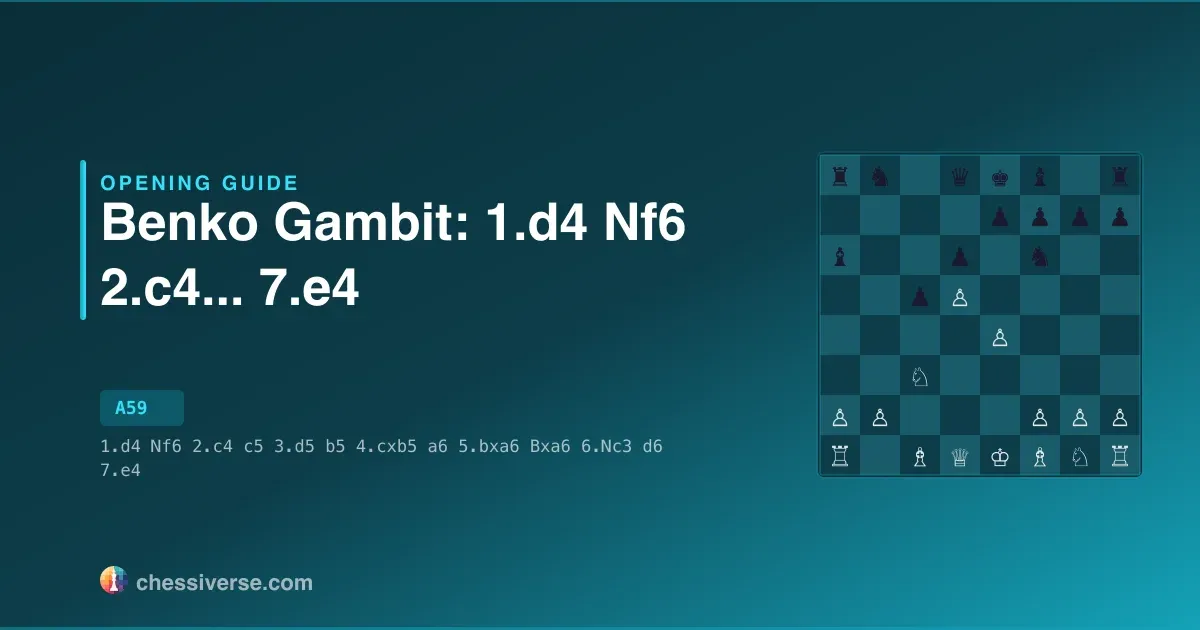
A591.d4 Nf6 2.c4 c5 3.d5 b5 4.cxb5 a6 5.bxa6 Bxa6 6.Nc3 d6 7.e4
Oct 13, 2027
TL;DR

The fully accepted Benko mainline with 7.e4 — White claims the full center while Black's a6-bishop, g7-fianchetto, and half-open a/b-files generate textbook compensation. Famous Kxf1 king-walk defenses appear here, and Black actually outscores White 47.5% to 45.5%.

Reviewed by

IM John Bartholomew
IM John BartholomewCo-Founder & Chess Educator

International Master and chess educator. Co-founded Chessable and joined Chessiverse as co-founder. Best known for his "Climbing the Rating Ladder" YouTube series and structured opening courses.

Benko Gambit: 1.d4 Nf6 2.c4...... 7.e4: A Complete Guide
Benko Gambit: 1.d4 Nf6 2.c4...... 7.e4 - Opening Moves
Summary

The Benko Gambit: 1.d4 Nf6 2.c4... 7.e4 begins with 1.d4 Nf6 2.c4 c5 3.d5 b5 4.cxb5 a6 5.bxa6 Bxa6 6.Nc3 d6 7.e4 (ECO A59). Lichess records 202,437 games in this line, which gives us a reliable view of how it actually performs in practice.

History and Notable Players

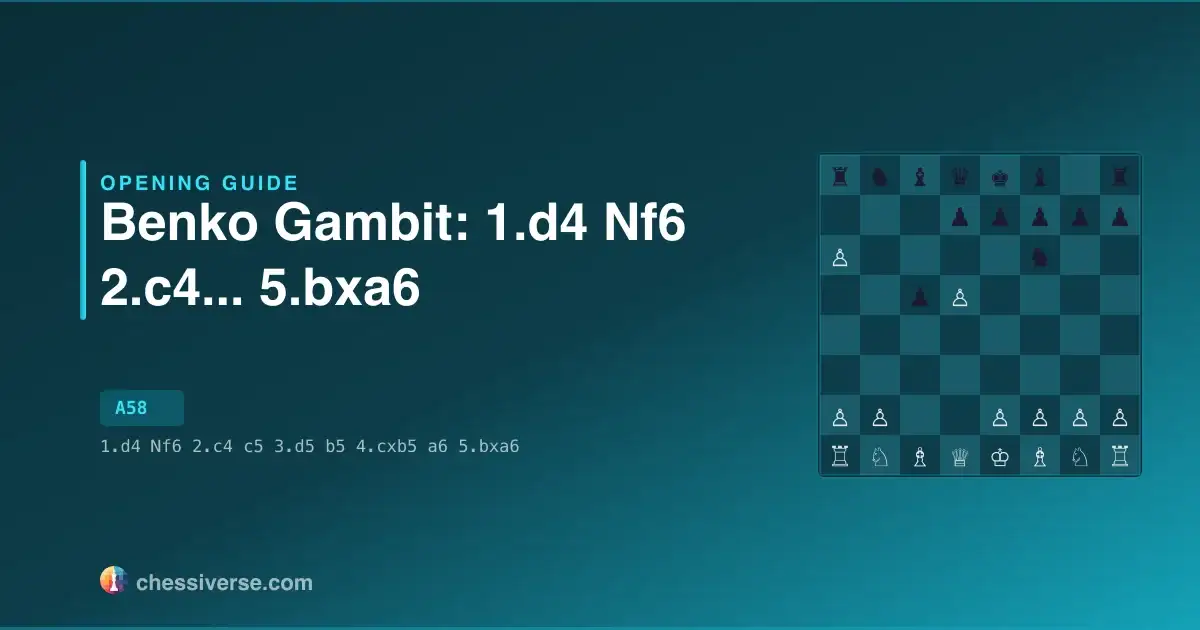
It arises from the Benko Gambit: 1.d4 Nf6 2.c4... 5.bxa6. Among the most prolific White practitioners are Kristof Koczo (6 games), David Bekker Jensen (4 games), Laszlo Pacsay (4 games). Black-side regulars include Misa Pap (7 games), Robert Hardarson (5 games), Kiril Georgiev (4 games).

Performance Across Rating Levels

How well the Benko Gambit: 1.d4 Nf6 2.c4... 7.e4 works depends on what level you're playing at. The 1200 bracket has 220 games (0.00% of all games at that level); White wins 52.7%, Black 45%, 2.3% are drawn. Move up to 1800 Elo and the share shifts to 0.01%, with White winning 43.6% versus Black's 50.7%. At the top end (2500+ Elo), popularity is 0.03% with 10.4% draws — a clear sign of how much theory rules the line at master level. White's edge erodes by 3.4pp from 1200 to 2500 Elo, suggesting Black's counterplay is easier to find with experience.

Move Diversity and Theory Depth

What players actually play after the opening moves depends heavily on rating. At 1200 Elo, the top reply is Bxf1, played 61.4% of the time. There are 3 other moves seeing meaningful share, and 93.6% of games stick to established theory. Entropy: 1.62. By 2500, Bxf1 dominates at 92.9% of replies; only 1 viable alternatives remain and 98.7% of moves are theory. Entropy drops to 0.48. That entropy collapse is the signature of a line where preparation pays off: at the top, players know the best move and play it.

Common Mistakes

  • Neglecting development — It can feel productive to make extra pawn moves early, but falling behind in piece development is what loses most amateur games — especially in open positions where active pieces find squares fast.
  • Overextending the attack — Gambits look like permission to throw everything forward. They aren't — every attacking move should improve a piece. Random checks and threats burn the initiative once they fail to coordinate.

Practice on Chessiverse

Ready to try the Benko Gambit: 1.d4 Nf6 2.c4... 7.e4 against a bot? Pick an opponent at your level and play a game.

Quick Facts

Main Line1.d4 Nf6 2.c4 c5 3.d5 b5 4.cxb5 a6 5.bxa6 Bxa6 6.Nc3 d6 7.e4
DifficultyAdvanced
Style

Gambiteers sacrifice material early for rapid development and initiative. These openings often lead to sharp, tactical positions where the attacking side must strike quickly before the opponent consolidates.

202,437games on Lichess
45.5%
7%
47.5%
White wins Draws Black wins

Top Players

As Black

Data from Lichess opening explorer (blitz & rapid)

Most Popular At2200
SharpnessCalm

Popularity by Rating

Percentage of all games at each rating bracket that feature this opening.

Data from Lichess opening explorer (blitz & rapid games)

Theory Adherence by Rating

How often players choose the single most popular move at this position. Higher = more predictable play.

Black to move after the opening line

Popularity Over Time

Share of all Lichess blitz + rapid games featuring this opening, by year.

Top Moves by Rating

Black to move after the opening line

RatingMost Popular2nd3rd
400Bxf150%g633.3%Qa516.7%
1000Bxf143.2%g635.1%Nbd710.8%
1200Bxf161.4%g620.9%Nbd711.4%
1400Bxf162.8%g623.4%Nbd79.1%
1600Bxf172.4%g617.2%Nbd77.8%
1800Bxf180.3%g613%Nbd75.5%
2000Bxf186.6%g69.4%Nbd73.2%
2200Bxf190.1%g67%Nbd71.8%
2500Bxf192.9%g64%Qa51.8%

Popularity by Time Control

Bullet
<0.01%85K
Blitz
<0.01%187K
Rapid
<0.01%16K
3% more decisive in bullet
Raw data tables (Lichess blitz + rapid)
Benko Gambit: 1.d4 Nf6 2.c4...... 7.e4: popularity and win rates by player rating
Rating (Elo)Share %GamesWhite win %Black win %Draw %Sharpness
4000.00633.366.70.01.000
10000.003756.837.85.40.946
12000.0022052.745.02.30.977
14000.001,58046.749.73.60.964
16000.0010,44144.351.54.30.957
18000.0144,91343.650.75.70.943
20000.0281,81644.748.36.90.931
22000.0459,84247.843.78.50.915
25000.033,58249.340.310.40.896
Benko Gambit: 1.d4 Nf6 2.c4...... 7.e4: move-choice theory adherence by rating
Rating (Elo)Top moveTop move %Viable movesTheory %Entropy
400Bxf150.03100.01.459
1000Bxf143.2489.21.835
1200Bxf161.4393.61.616
1400Bxf162.8395.41.522
1600Bxf172.4397.41.244
1800Bxf180.3398.70.972
2000Bxf186.6299.20.730
2200Bxf190.1298.90.594
2500Bxf192.9198.70.480
Benko Gambit: 1.d4 Nf6 2.c4...... 7.e4: popularity over time
YearShare %GamesWhite win %Black win %Draw %
20130.004734.055.310.6
20140.0028540.751.97.4
20150.011,14943.549.37.1
20160.013,35145.548.16.4
20170.016,43245.448.46.1
20180.019,51245.848.16.1
20190.0012,24546.647.36.1
20200.0028,35945.747.07.3
20210.0033,23846.046.67.5
20220.0032,99145.447.96.7
20230.0031,43745.247.87.0
20240.0029,13245.247.67.3
20250.0028,32645.347.67.1
Benko Gambit: 1.d4 Nf6 2.c4...... 7.e4: popularity by time control
FormatShare %GamesWhite win %Black win %Draw %Sharpness
bullet0.0084,64446.149.04.90.951
blitz0.01186,60745.547.66.90.931
rapid0.0015,83045.046.68.40.916
Benko Gambit: 1.d4 Nf6 2.c4...... 7.e4: top candidate moves by rating bracket
Rating (Elo)1st move1st %2nd move2nd %3rd move3rd %
400Bxf150.0g633.3Qa516.7
1000Bxf143.2g635.1Nbd710.8
1200Bxf161.4g620.9Nbd711.4
1400Bxf162.8g623.4Nbd79.1
1600Bxf172.4g617.2Nbd77.8
1800Bxf180.3g613.0Nbd75.5
2000Bxf186.6g69.4Nbd73.2
2200Bxf190.1g67.0Nbd71.8
2500Bxf192.9g64.0Qa51.8
Benko Gambit: 1.d4 Nf6 2.c4...... 7.e4: top practitioners by side
SidePlayerGames
WhiteKristof Koczo6
WhiteDavid Bekker Jensen4
WhiteLaszlo Pacsay4
BlackMisa Pap7
BlackRobert Hardarson5
BlackKiril Georgiev4

Frequently Asked Questions

What is the Benko Gambit: 1.d4 Nf6 2.c4... 7.e4?

The Benko Gambit: 1.d4 Nf6 2.c4... 7.e4 begins with 1.d4 Nf6 2.c4 c5 3.d5 b5 4.cxb5 a6 5.bxa6 Bxa6 6.Nc3 d6 7.e4 and is classified under ECO code A59.

Is the Benko Gambit: 1.d4 Nf6 2.c4... 7.e4 good for beginners?

The Benko Gambit: 1.d4 Nf6 2.c4... 7.e4 can be played at any level. Beginners should focus on understanding the key strategic ideas rather than memorizing long theoretical lines. Our AI bots at various rating levels provide a great way to practice the opening concepts.

What are the win rates for the Benko Gambit: 1.d4 Nf6 2.c4... 7.e4?

In a database of 202,437 master games, White wins 45.5% of the time, Black wins 47.5%, and 7% are drawn. Notable players on the White side include Kristof Koczo and David Bekker Jensen. On the Black side, Misa Pap and Robert Hardarson are among the most frequent practitioners.

How can I practice the Benko Gambit: 1.d4 Nf6 2.c4... 7.e4?

On Chessiverse, you can practice the Benko Gambit: 1.d4 Nf6 2.c4... 7.e4 by playing against our 600+ AI bots. Each bot has a unique playing style and opening repertoire, so you can find the perfect sparring partner for any level.

Reviewed by

IM John Bartholomew
IM John BartholomewCo-Founder & Chess Educator

International Master and chess educator. Co-founded Chessable and joined Chessiverse as co-founder. Best known for his "Climbing the Rating Ladder" YouTube series and structured opening courses.

Practice This Opening on Chessiverse

Play against 1000+ AI bots with unique personalities and opening repertoires. From beginner-friendly to grandmaster-level opponents, find the perfect sparring partner for any opening.

Play Now

Not sure which opening fits you? Take the free chess personality test — your style determines which openings will work with you.

Back to Articles