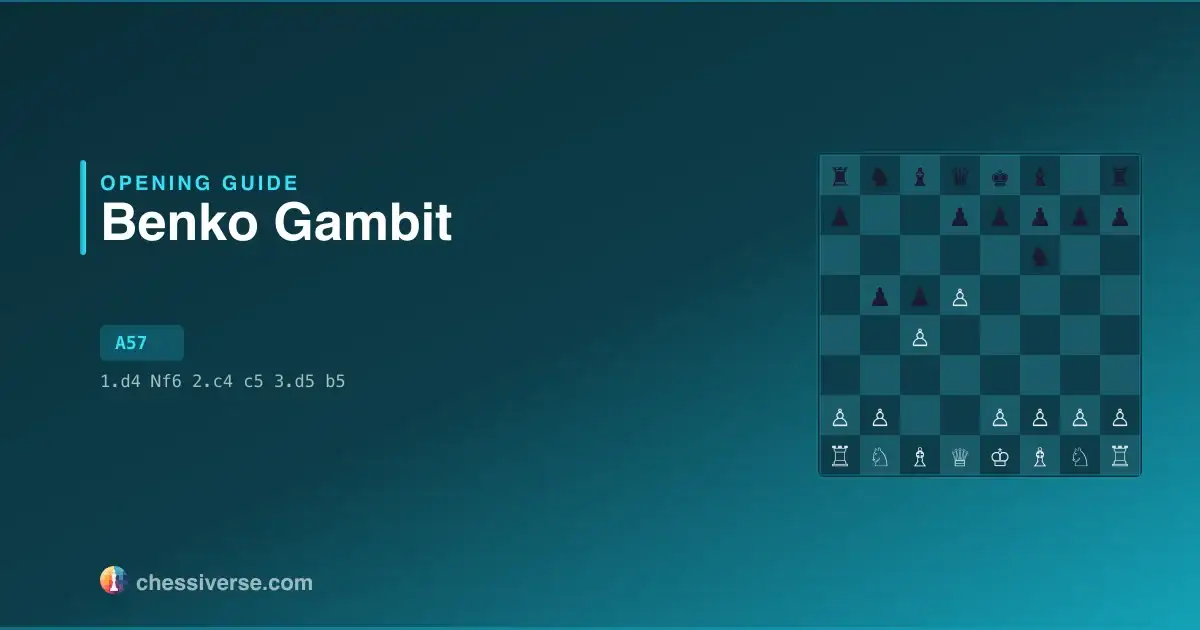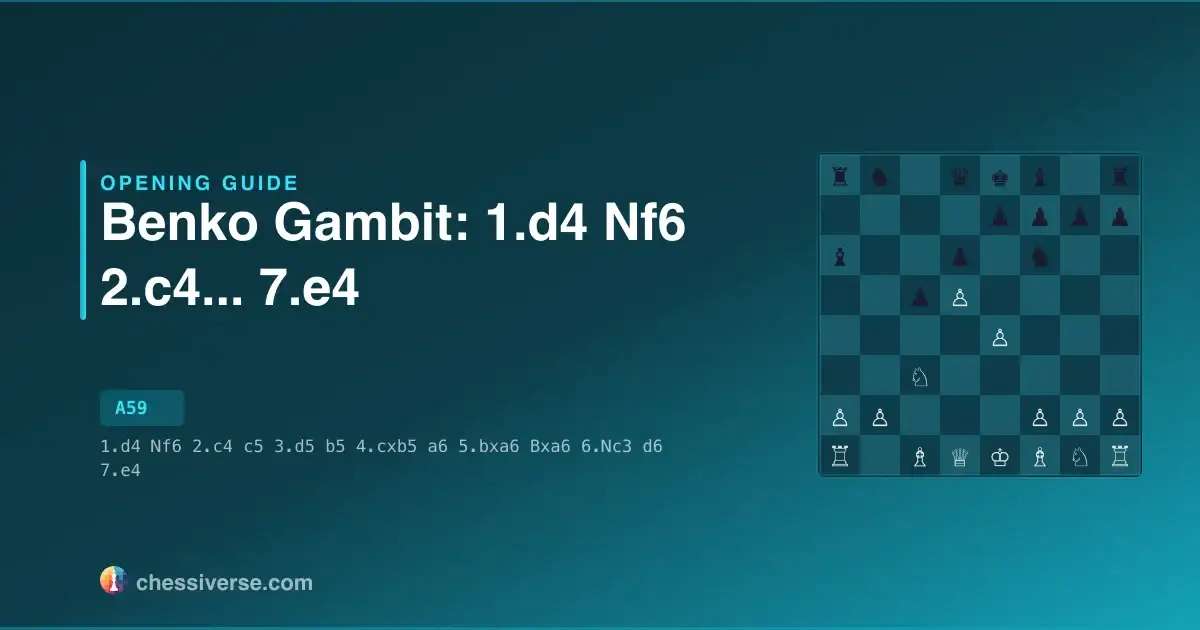


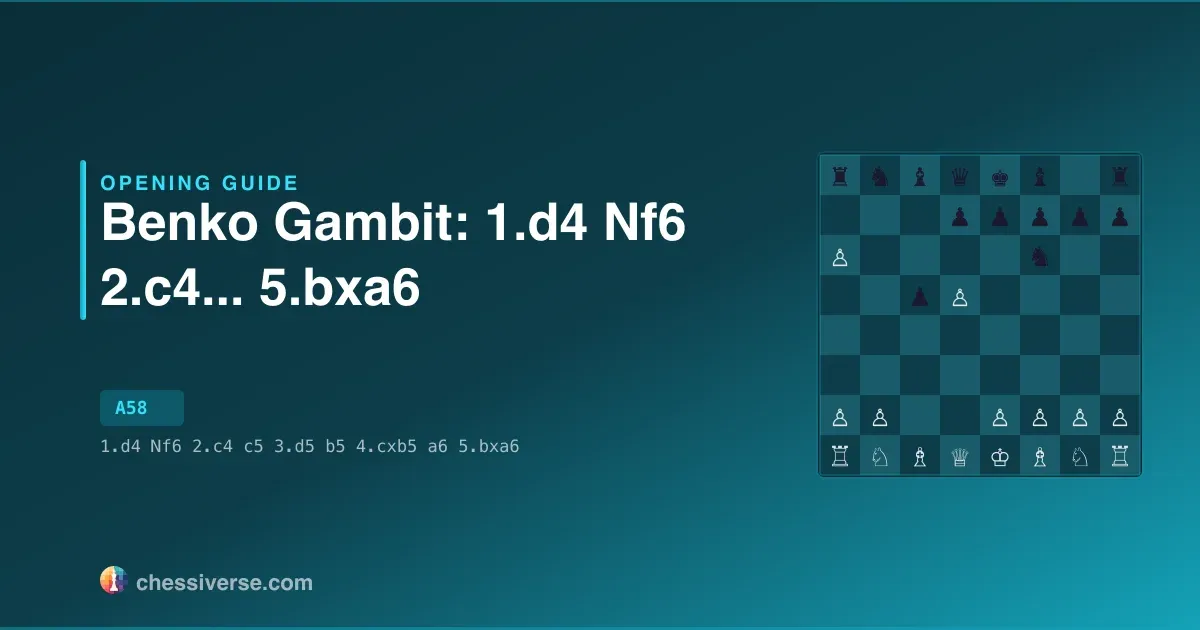
Starting from 1.d4 Nf6 2.c4 c5 3.d5 b5 4.cxb5 a6 5.bxa6, players enter the Benko Gambit Accepted: Fully Accepted Variation — ECO A58. White grabs the pawn and braces for the long siege that follows. Black isn't getting the material back any time soon, but every White piece has to spend the next twenty moves answering for it.
Strategic Overview
This is the Benko Gambit Accepted in its fullest form — White has scooped the a6-pawn and now has to figure out how to develop without his queenside collapsing. Black's compensation is structural and lasting: half-open a- and b-files for the rooks, a fianchettoed bishop on g7 raking the long diagonal, and constant pressure against b2 and a2 that ties down White's pieces for the entire game. The typical Black plan is straightforward and brutally effective: ...g6, ...Bg7, ...0-0, ...d6, ...Nbd7, double the rooks on the a- and b-files, and grind. White, in return, has an extra pawn and the chunky d5 pawn cramping Black's center. Endgames famously favor Black here — the extra pawn means very little when White's queenside pieces can never untangle. White's main strategic question is whether to return the pawn for development with lines like the Fianchetto System, or hold on and try to weather the storm. The Benko is one of the cleanest examples in opening theory of trading a pawn for long-term positional pressure, and it remains a serious choice at every level.
Key Ideas
The recurring motifs below distinguish a confident handler of this opening from a beginner:
- Half-open a- and b-files — Black's whole strategy hinges on these files. The rooks belong on a8 and b8, doubled if possible, slicing into White's queenside. The pressure against a2 and b2 is permanent and lasts deep into the endgame.
- The g7-bishop never stops working — Fianchettoing on g7 aims straight at White's queenside through the long diagonal. Combined with the rooks on the a- and b-files, it's a permanent attacking battery on positions White can never fully consolidate.
- Endgames favor Black — The extra pawn is hard for White to convert because his queenside development is permanently awkward. Trading pieces tends to help Black — the structural pressure remains while White's tactical chances disappear.
- White must justify the extra pawn — If White can't activate his pieces or generate central play, the pawn becomes meaningless. Lines where White returns the pawn for smoother development are often more pragmatic than greedily clinging to material.
History and Notable Players
It arises from the Benko Gambit. On the White side, Vladimir Lazarev (27 games), Vlastimil Hort (21 games), Zoltan Gyimesi (20 games) top the database. Notable Black exponents: Natalija Pogonina (35 games), Danilo Milanovic (26 games), Jan Plachetka (24 games).
Performance Across Rating Levels
How well the Benko Gambit Accepted: Fully Accepted Variation works depends on what level you're playing at. The 1200 bracket has 2,628 games (0.00% of all games at that level); White wins 45.3%, Black 51%, 3.7% are drawn. Move up to 1800 Elo and the share shifts to 0.03%, with White winning 42.3% versus Black's 52.5%. Among 2500-rated players the line appears in 0.24% of games and draws spike to 10.5%, indicating tight preparation. Positions also become less sharp as level rises (sharpness 0.96 → 0.90).
Time Control Patterns
Time control matters here: blitz players reach for this opening more than others. In bullet, it appears in 0.01% of games (378,040); White wins 45.8%. Blitz shows 0.03% adoption across 1,025,585 games, White scoring 44.5%. In rapid, the share rises to 0.01% — 107,684 games, White 43%. White's score swings 2.8pp across formats, so time control isn't just a stylistic choice here — it shifts the actual results.
Move Diversity and Theory Depth
Move choice is far from uniform in the Benko Gambit Accepted: Fully Accepted Variation. At 1200 Elo (2,628 games), the top reply is Bxa6, played 68.9% of the time. One other move takes at least 5% of games, and the top three moves account for 92.2% of games. Entropy: 1.43. By 2500 (32,223 games), g6 takes over as the top reply at 64%; two other moves reach 5% and the top three moves account for 97.3% of games. Entropy drops to 1.38.
Historical Trends
Year-over-year data tells you whether this opening is a contemporary fixture or a fading one. Adoption peaked in 2016 at 0.04% (23,027 games). By 2025 it sits at 0.02%, 46% below the peak but still 68% above its 2013 level, so the line is up over the full period despite easing from the high.
Main Lines and Variations
After 1.d4 Nf6 2.c4 c5 3.d5 b5 4.cxb5 a6 5.bxa6, the established follow-ups are:
Each branch leads to a different middlegame character — the resulting pawn structure decides what kind of game you get.
Common Mistakes
- Playing outside main lines — At 1000 Elo, only 87.4% of games stay with the three most-played moves; at 2000 that climbs to 96.6%. Most of the gap is players who pick a reasonable-looking move over the best one, and the position quietly drifts.
- Neglecting development — Extra pawn moves in the opening are tempting, especially when you "know the moves". Developing a piece each turn is the simple correction.
- Overextending the attack — Gambits look like permission to throw everything forward. They aren't — every attacking move should improve a piece. Random checks and threats burn the initiative once they fail to coordinate.
Practice on Chessiverse
Ready to try the Benko Gambit Accepted: Fully Accepted Variation against a bot? Pick an opponent at your level and play a game.