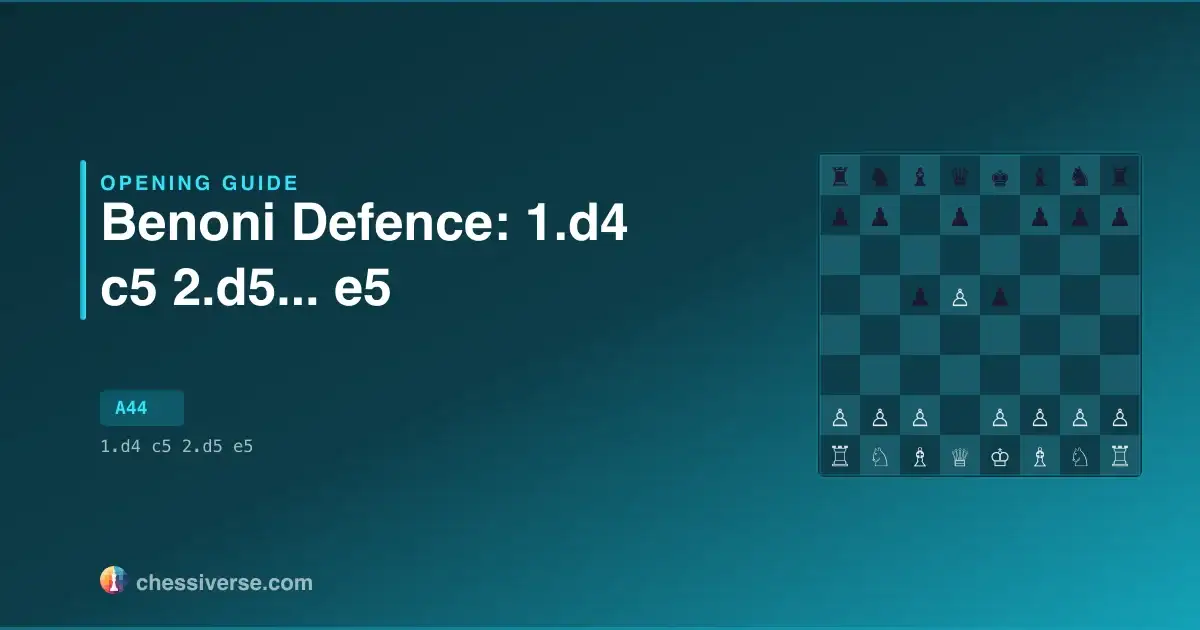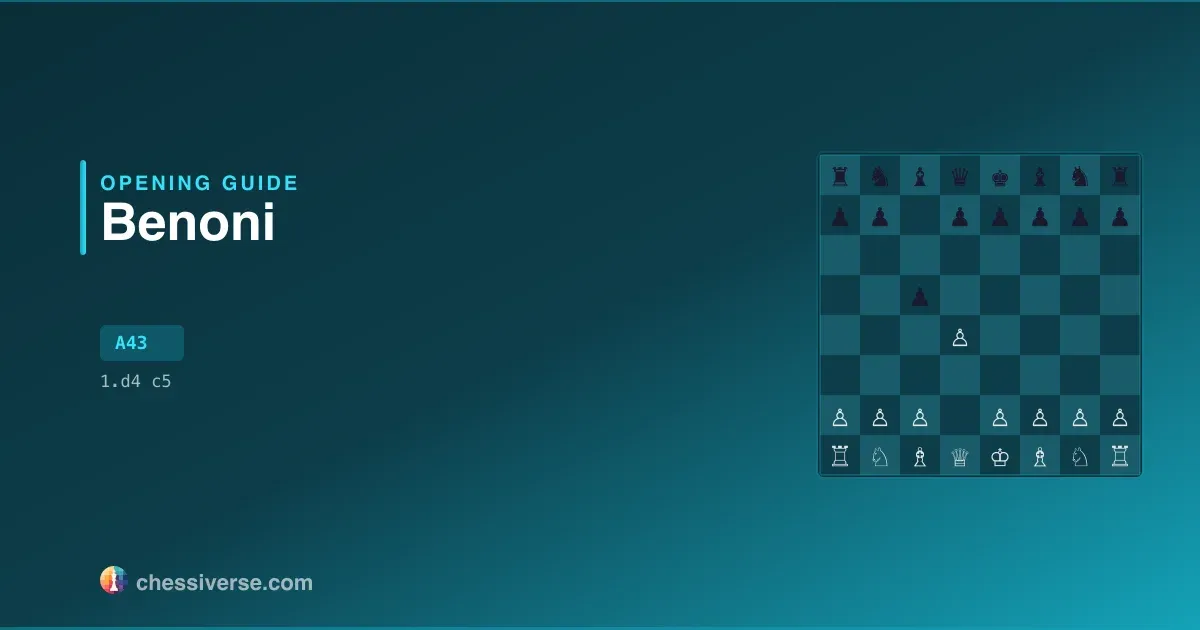
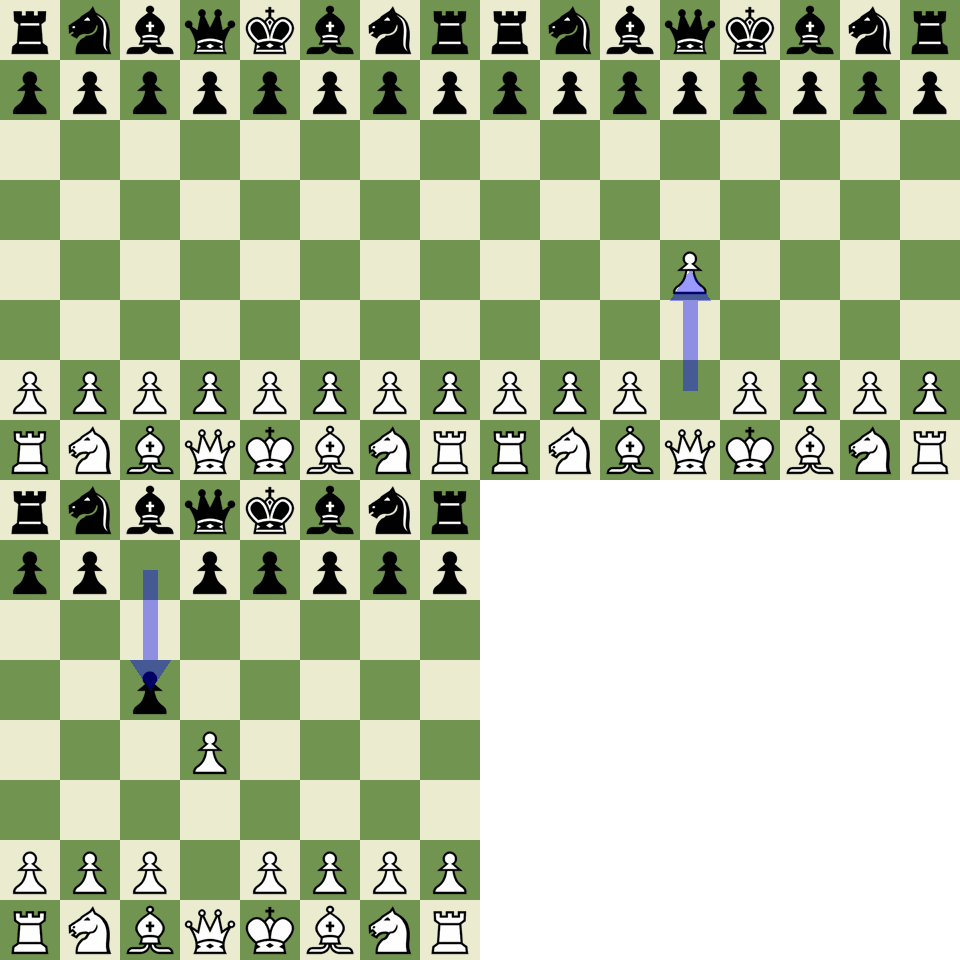
The Benoni Defense arises after 1.d4 c5 and falls under ECO code A43. Though uncommon in modern practice, the Old Benoni can produce tactical, sharp positions. Black immediately challenges d4 with the c-pawn, seeking active piece play and rapid development. White's standard response is d5, since capturing the pawn is inadvisable due to 2...e6, and attempts to defend it leave White struggling after ...a5 while Black gains a tempo. One strategic idea for Black is to steer toward a Modern Benoni while sidestepping the Four Pawn Attack (lines with an early f2-f4 for White): Black fianchettoes the king's bishop and waits until White commits the knight to f3, blocking the f-pawn, before continuing with ...e6 and ...exd5. Another approach involves keeping the long a1-h8 diagonal open for the bishop by delaying ...Nf6, instead developing the knight to e7. If White plays an early Nc3, Black may even consider ...Bxc3 to inflict doubled pawns. With 38.4 million Lichess games across all rating levels, it is a well-established opening choice.
- Black typically builds a queenside pawn majority and advances it for long-term play.
- Black fianchettos the bishop on g7, where its scope is unimpeded by pawns and it backs the queenside advance.
- In the Benko Gambit, Black hands over a pawn to open lines and generate durable queenside pressure.
History and Notable Players
It arises from the Queen's Pawn Systems (1...d5). Among the most prolific practitioners on the White side are Vlatko Kovacevic (39 games), Dragan Kosic (23 games), Karel Opocensky (19 games). On the Black side, notable exponents include Dragoljub Velimirovic (81 games), Peter Rahls (76 games), Jan Sikora Lerch (74 games).
Aaron Reinganum analyzed 1.d4 c5 in an 1825 book. Saint-Amant tried 1...c5 against Staunton in their 1843 match, after which Staunton covered it in his 1849 work. Blackburne was the first player known to score well with it, and Alekhine beat Bogoljubow with the Old Benoni in their 1934 match.
Named after: From the Hebrew Ben-Oni, 'son of my sorrow' - the melancholy pen title Aaron Reinganum gave his 1825 book analyzing the defense.
Notable players: Joseph Henry Blackburne, Alexander Alekhine, Ben Finegold
The Snake Benoni, invented in 1982 by Rolf Olav Martens, is named for the bishop's slithering path - and because 'orm', Swedish for snake, is an anagram of his initials.
Statistics
Based on 38.4 million Lichess games across all rating levels:
- White wins: 47.9%
- Black wins: 47.8%
- Draws: 4.3%
The statistics show a roughly balanced opening where both sides have equal chances.
Main Lines and Variations
After 1.d4 c5, the main continuations include:
Each of these lines leads to distinct types of positions and requires its own understanding of the resulting pawn structures and piece placements.
Practice on Chessiverse
The best way to learn the Benoni Defense is through practice. On Chessiverse, you can play chess against computer opponents that specialize in this opening. Our AI bots range from beginner to grandmaster level, each with unique playing styles — from aggressive attackers to solid defenders. Choose a bot that matches your rating and work your way up as you master the opening's key ideas.
Performance Across Rating Levels
The picture changes a lot as you climb the rating ladder. Among 1200-rated players, it appears in 0.56% of games — 3,794,093 of them on record — with White winning 48.5% and Black 48.1%. By 1800, popularity is 1.06% and White's score is 47.4% to Black's 48.2%. At 2500, 0.97% of games go into this opening; draws sit at 8.6% — the line is well-mapped at this level.
Time Control Patterns
Time control matters here: bullet players reach for this opening more than others. In bullet, it appears in 1.81% of games (48,213,073); White wins 47.8%. Blitz shows 0.90% adoption across 32,328,018 games, White scoring 47.9%. In rapid, the share rises to 0.55% — 6,106,287 games, White 48.3%.
Move Diversity and Theory Depth
Looking at move selection shows how forcing — or not — the position really is. At 1200 Elo (3,794,093 games), the top reply is dxc5, played 34% of the time. Six other moves each take at least 5% of games, and the top three moves account for 63.9% of games. Entropy: 2.77. By 2500 (132,097 games), d5 takes over as the top reply at 65.6%; only four other moves still reach 5% and the top three moves account for 81.1% of games. Entropy drops to 1.85. The narrowing is significant — strong players consolidate around a small set of best moves, while amateurs scatter across many plausible-looking options.
Historical Trends
Tracking the Benoni Defense year over year shows a clear story. Adoption peaked in 2020 at 0.84% (4,842,590 games). By 2025 it sits at 0.82%, 3% below the peak but still 36% above its 2013 level, so the line is up over the full period despite easing from the high.