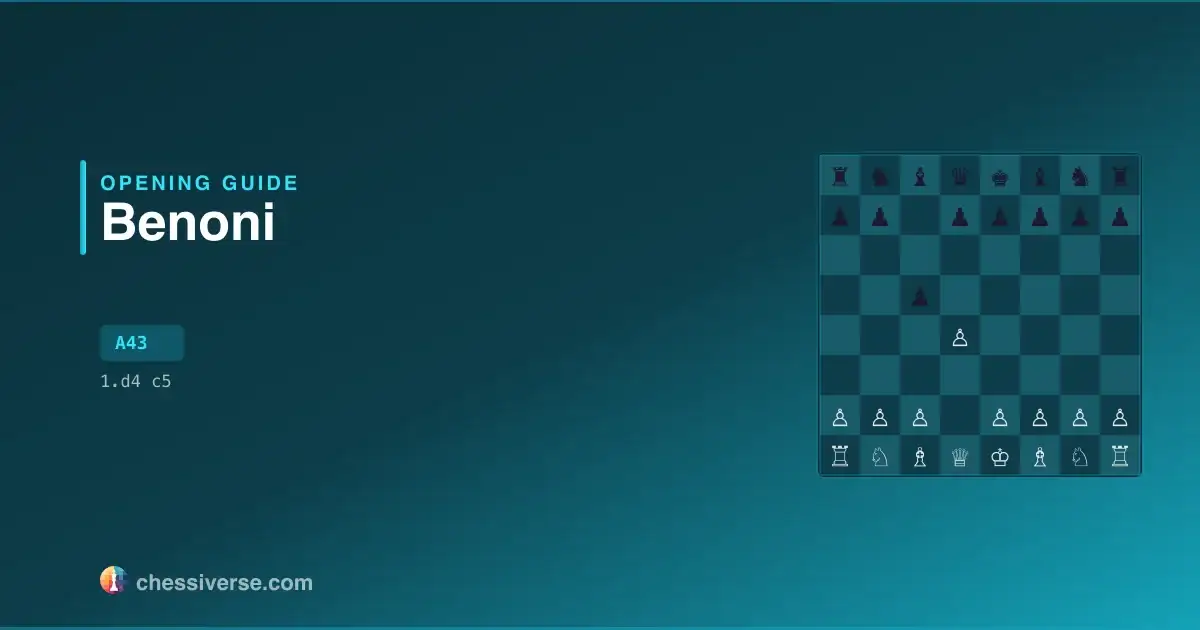




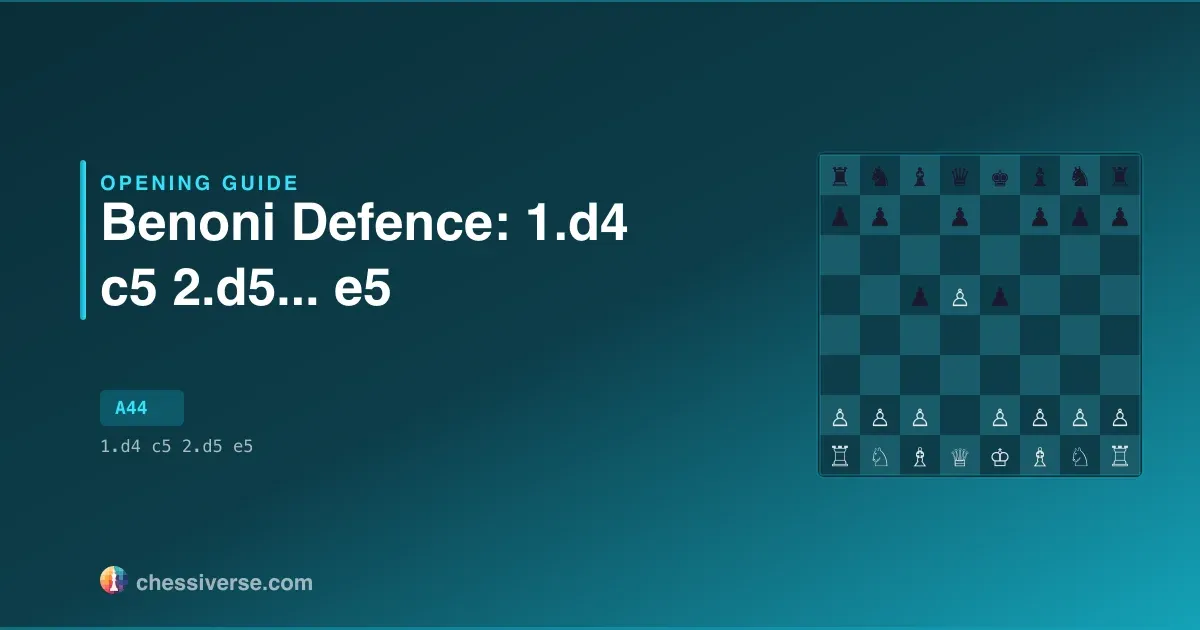
The Benoni Defense: Old Benoni begins with 1.d4 c5 2.d5 e5 (ECO A44). Black locks the center on move two and plants a stake in the King's Indian-style pawn structure they want. White's d5 is now permanent — and that pawn will be a target for the rest of the game.
Strategic Overview
2...e5 is the Czech-style Benoni structure where Black accepts a slightly cramped position in exchange for a rock-solid pawn chain on c5 and e5. The d5-pawn is fixed for both sides, which means the game becomes a slow positional fight around the d-file and the d5-square. White's standard reply is either 3.e4 or 3.c4, both reinforcing the central pawn. En passant capture with 3.dxe6 throws away White's space advantage — the d5-pawn is the entire point of the structure, and trading it gives up everything that makes White's position better. After 3.e4 or 3.c4, the game continues with normal development: White typically plays for f4 to challenge Black's e5-pawn, while Black plays slowly with ...d6, ...Be7, ...Nf6, and waits for the right pawn break. Black's main resources are the ...f5 break (challenging the kingside) and slow queenside expansion with ...a6 and ...b5. The structure is closed and the side that better understands which pieces matter and where wins. It's an opening for patient players who like positional buildup and don't mind being slightly cramped early.
Key Ideas
A few ideas come up again and again in this opening:
- Reinforce d5 with 3.e4 or 3.c4 — These are the only serious moves. Both pawn pushes support the d5-pawn, which is the structural foundation of White's entire position.
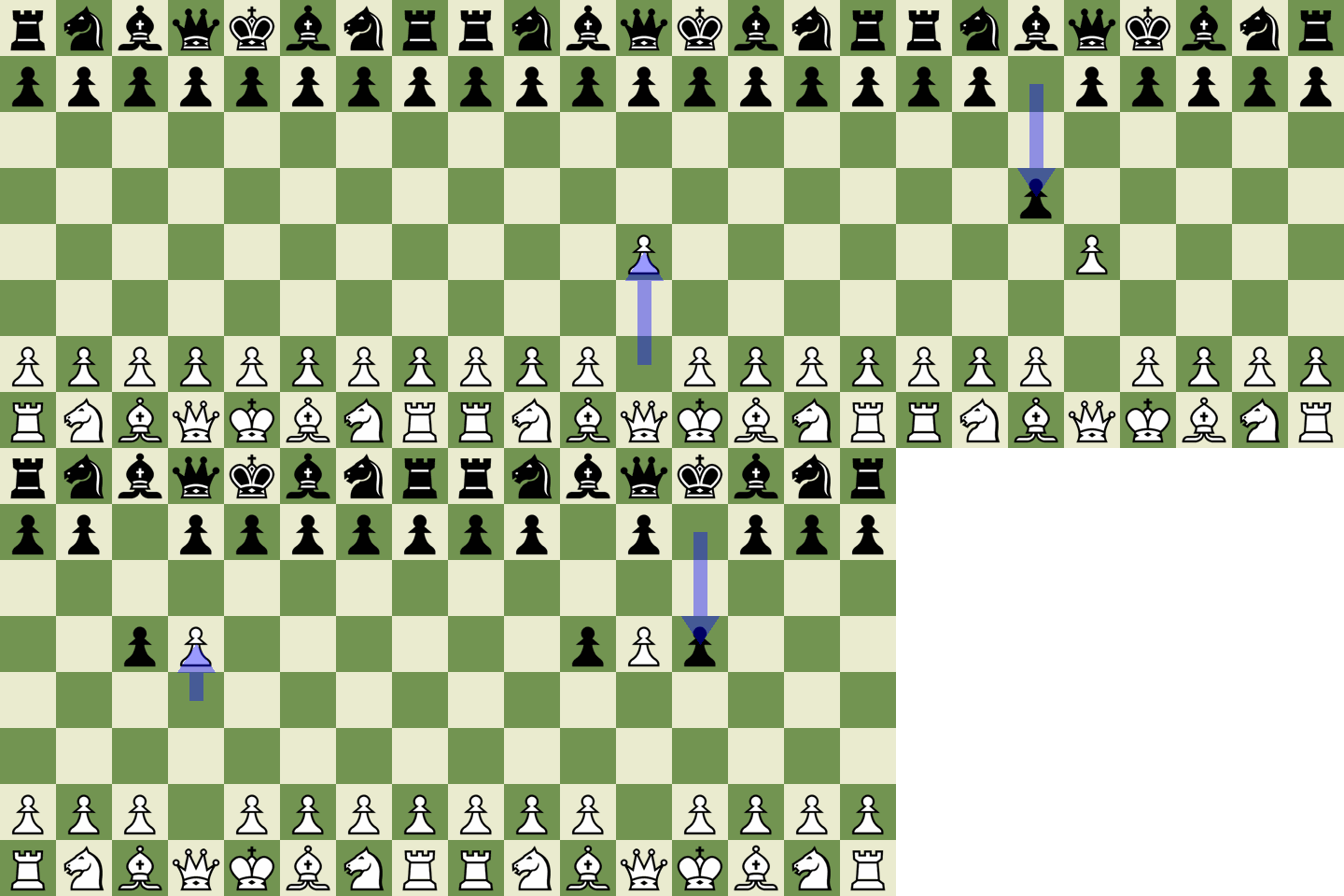
- Never capture en passant — 3.dxe6 throws away White's space advantage and the entire point of the structure. The d5-pawn is what gives White the better game; trading it is a positional mistake.
- f4 is White's main kingside break — Once development is complete, White looks for f4 to challenge Black's e5-pawn. If Black takes, White opens the f-file; if Black holds, White builds pressure.
- Black plays slowly and waits for ...f5 — Black's main resource is the ...f5 break, supported by ...Nf6 and proper piece coordination. Timing this break correctly is the whole strategic battle on Black's side.
History and Notable Players
It arises from the Benoni Defense. On the White side, Dejan Nestorovic (8 games), Jay R Bonin (6 games), Dragisa Blagojevic (6 games) top the database. Notable Black exponents: Peter Rahls (56 games), Goran A Kosanovic (23 games), Marek Vokac (20 games).
Performance Across Rating Levels
How well the Benoni Defense: Old Benoni works depends on what level you're playing at. At 1200 Elo, the opening shows up in 0.01% of games (36,843 samples). White scores 51.5%, Black 45.4%, draws 3.1%. Move up to 1800 Elo and the share shifts to 0.04%, with White winning 46.3% versus Black's 49.4%. At 2500, 0.19% of games go into this opening; draws sit at 7.4% — the line is well-mapped at this level.
Time Control Patterns
Time control matters here: blitz players reach for this opening more than others. In bullet, it appears in 0.04% of games (946,992); White wins 48.9%. Blitz shows 0.04% adoption across 1,387,908 games, White scoring 47.4%. In rapid, the share rises to 0.01% — 157,723 games, White 48.4%.
Move Diversity and Theory Depth
Looking at move selection shows how forcing — or not — the position really is. At 1200 Elo (36,843 games), the top reply is e4, played 41.7% of the time. Two other moves each take at least 5% of games, and the top three moves account for 93.1% of games. Entropy: 1.94. By 2500 (26,377 games), e4 is still the top reply, at 37.5%; two other moves reach 5% and the top three moves account for 93.6% of games. Entropy drops to 1.91. Even elite players don't fully agree on the best continuation here, which keeps the position dynamic.
Historical Trends
Long-term, the trajectory of this opening is informative. Adoption peaked in 2015 at 0.05% (10,162 games). By 2025 it sits at 0.03%, 28% below the peak but still 14% above its 2013 level, so the line is up over the full period despite easing from the high.
Common Mistakes
- Playing outside main lines — At 400 Elo, only 83.8% of games stay with the three most-played moves; at 2000 that climbs to 89%. Most of the gap is players who pick a reasonable-looking move over the best one, and the position quietly drifts.
- Neglecting development — Extra pawn moves in the opening are tempting, especially when you "know the moves". Developing a piece each turn is the simple correction.
- Playing without a plan — Each Benoni Defense: Old Benoni middlegame demands a specific approach. Decide whether the position calls for attack, manoeuvre, or simplification before reaching for a move.
Practice on Chessiverse
Ready to try the Benoni Defense: Old Benoni against a bot? Pick an opponent at your level and play a game.