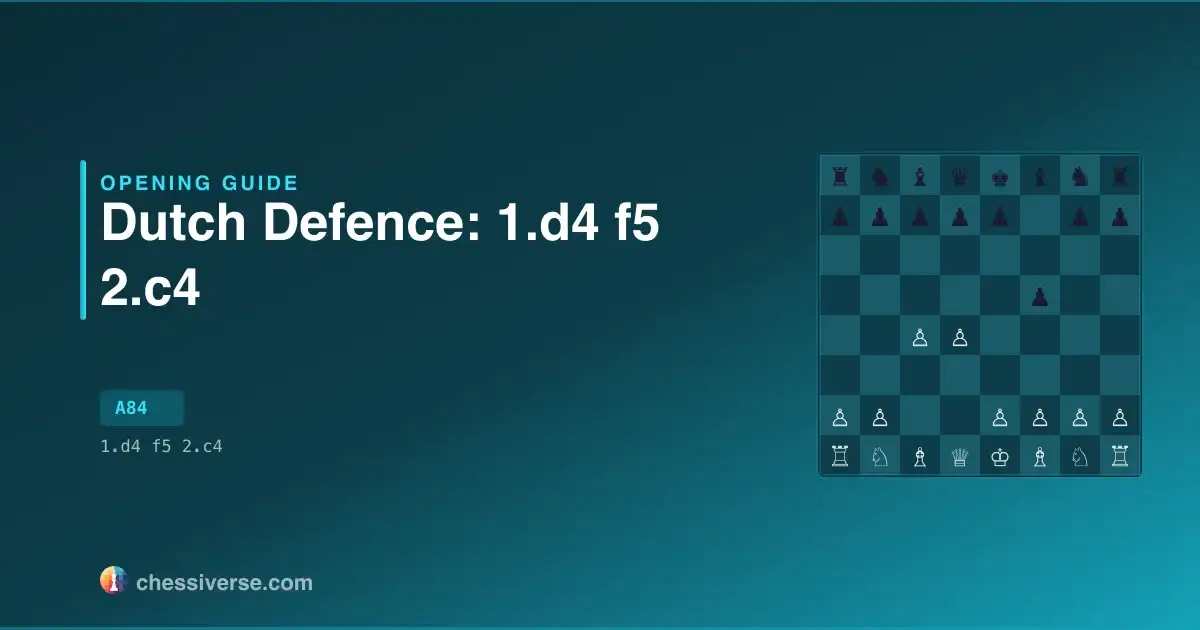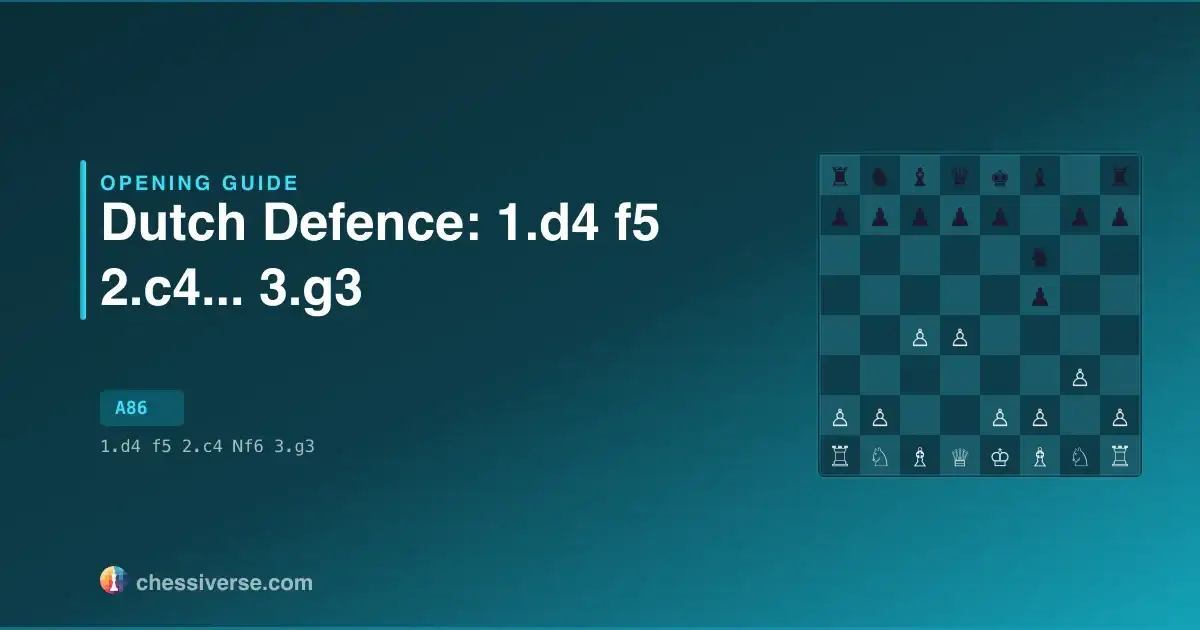



The Dutch Defense arises after 1.d4 f5 and falls under ECO code A80. As the fourth most common reply to 1. d4, the Dutch sees Black using the f-pawn to stake a claim on the e4 square. Since 1...f5 neither develops a piece nor prepares to (unlike 1...Nf6 or 1...d5), it ranks below Black's other main options for controlling e4. Moreover, advancing the f-pawn before castling carries inherent risk by exposing the kingside, as illustrated by the classic Hopton Attack trap: 2. Bg5 h6 3. Bh4 g5 3. Bg3 f4 (attempting to win the bishop) 4. e3 fxg3?? 5. Qh5#. Despite these drawbacks, the Dutch is a combative, distinctive choice that sets it apart from typical 1. d4 defenses, with Black directing maximum energy toward a kingside offensive. White's standard strategy involves a setup with Bg2, Nf3, short castling, and c4, achievable through various move orders. The most common is 2. g3, though 2. c4 and 2. Nf3 are also frequently played and generally lead to the same positions. With 22.3 million Lichess games across all rating levels, it is a well-established opening choice.
- Black grabs control of the e4 square with the f-pawn and aims the whole middlegame at an attack on White's king.
- In the Leningrad setup Black fianchettoes the bishop on g7, while the Stonewall plants pawns on d5 and f5 to lock down e4.
- The early ...f5 loosens Black's own kingside, so Black must watch the weakened e8-h5 diagonal.
History and Notable Players
It arises from the Queen's Pawn Systems (1...d5). Among the most prolific practitioners on the White side are Ivan Farago (56 games), Peter Lukacs (41 games), Loek Van Wely (40 games). On the Black side, notable exponents include Vladimir P Malaniuk (334 games), Thanh Trang Hoang (171 games), Pavel Potapov (134 games).
Elias Stein first championed the defence in 1789, and it has drawn strong opinions ever since: Tarrasch dismissed it as unsound in 1931. Its biggest stage came in the 1951 World Championship, where both Botvinnik and Bronstein played it, and grandmasters like Yusupov and Short revived the Stonewall in the 1980s and 90s.
Notable players: Alexander Alekhine, Bent Larsen, Miguel Najdorf, Hikaru Nakamura
The Dutch produced the Polish Immortal: Miguel Najdorf, playing the Stonewall, sacrificed all of his minor pieces on the way to delivering checkmate.
Statistics
Based on 22.3 million Lichess games across all rating levels:
- White wins: 50%
- Black wins: 45.5%
- Draws: 4.5%
The statistics show a roughly balanced opening where both sides have equal chances.
Main Lines and Variations
After 1.d4 f5, the main continuations include:
Each of these lines leads to distinct types of positions and requires its own understanding of the resulting pawn structures and piece placements.
Practice on Chessiverse
The best way to learn the Dutch Defense is through practice. On Chessiverse, you can play chess against computer opponents that specialize in this opening. Our AI bots range from beginner to grandmaster level, each with unique playing styles — from aggressive attackers to solid defenders. Choose a bot that matches your rating and work your way up as you master the opening's key ideas.
Performance Across Rating Levels
How well the Dutch Defense works depends on what level you're playing at. Among 1200-rated players, it appears in 0.30% of games — 2,057,082 of them on record — with White winning 51.3% and Black 45.1%. Move up to 1800 Elo and the share shifts to 0.65%, with White winning 49.7% versus Black's 45.7%. Among 2500-rated players the line appears in 0.64% of games and draws spike to 8.6%, indicating tight preparation.
Time Control Patterns
The Dutch Defense skews toward blitz chess. In bullet, it appears in 0.44% of games (11,720,535); White wins 49.6%. Blitz shows 0.50% adoption across 18,119,250 games, White scoring 50%. In rapid, the share rises to 0.38% — 4,163,840 games, White 50.3%.
Move Diversity and Theory Depth
Move choice is far from uniform in the Dutch Defense. At 1200 Elo (2,057,082 games), the top reply is c4, played 26.3% of the time. Four other moves each take at least 5% of games, and the top three moves account for 65.5% of games. Entropy: 2.80. By 2500 (86,882 games), c4 is still the top reply, at 21.9%; six other moves reach 5% and the top three moves account for 58.1% of games. Entropy rises to 2.94. Even elite players don't fully agree on the best continuation here, which keeps the position dynamic.