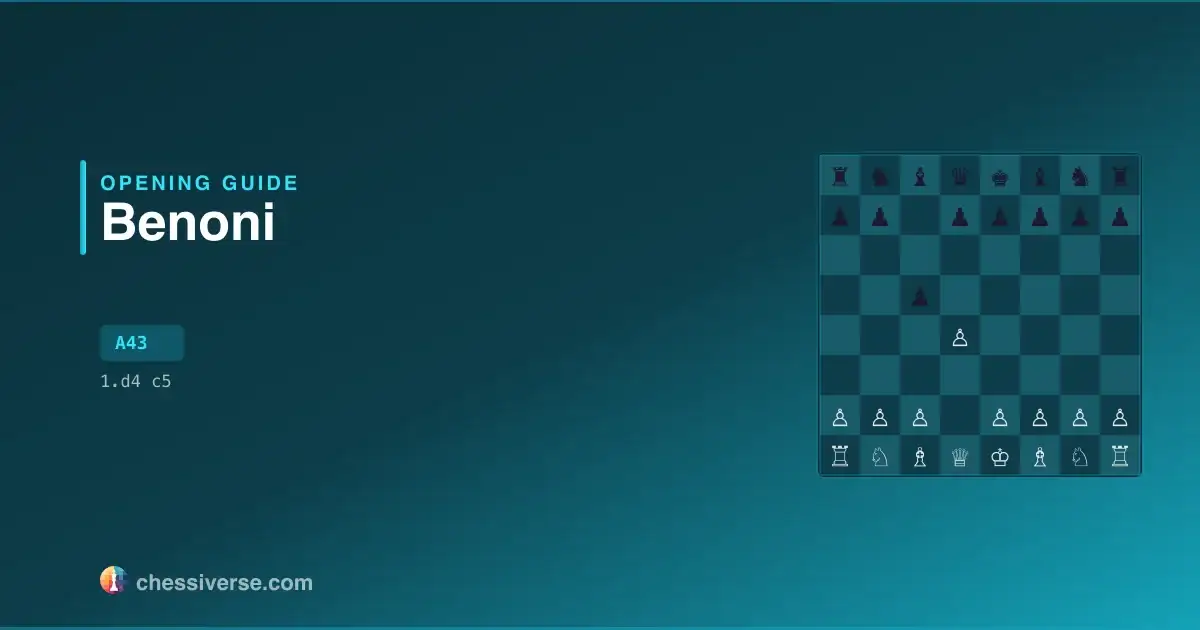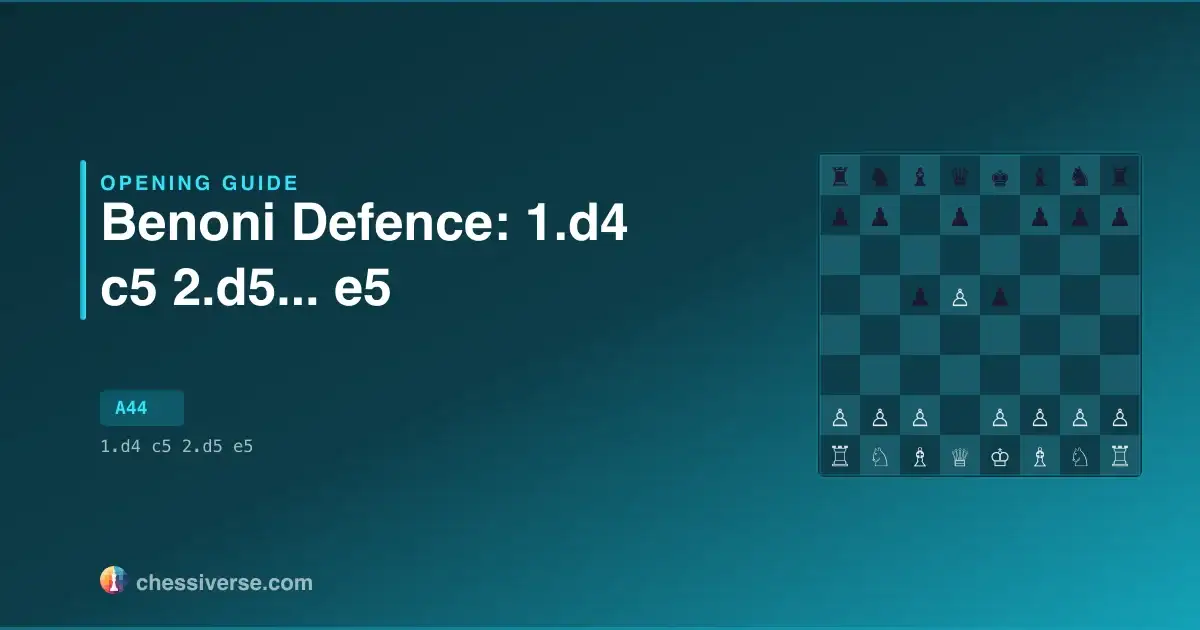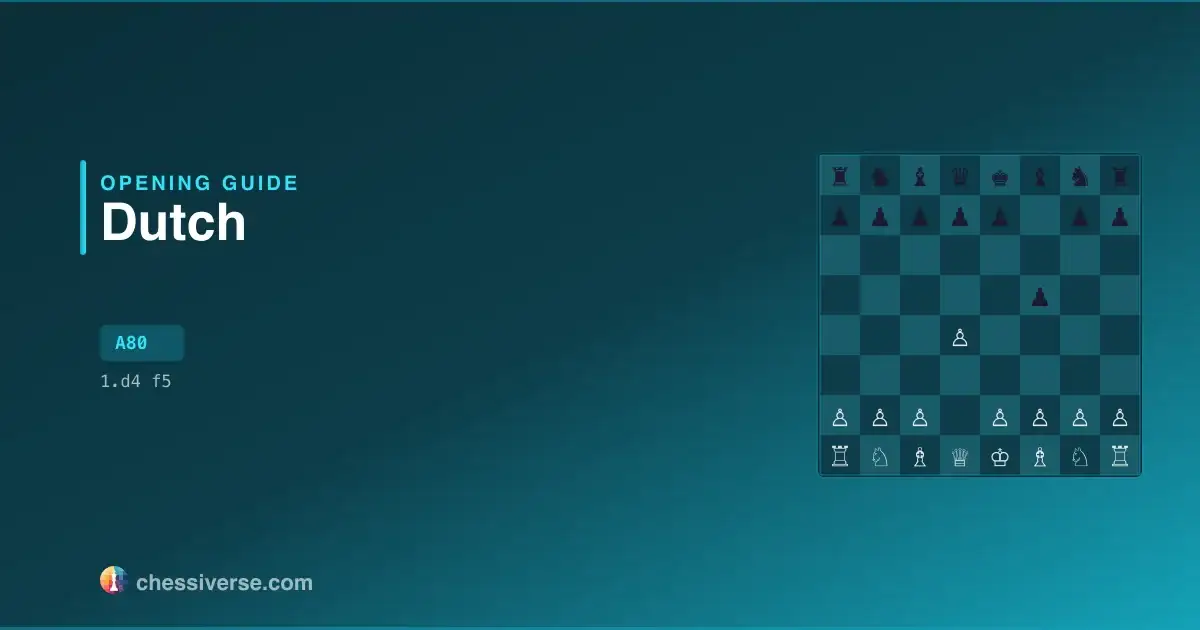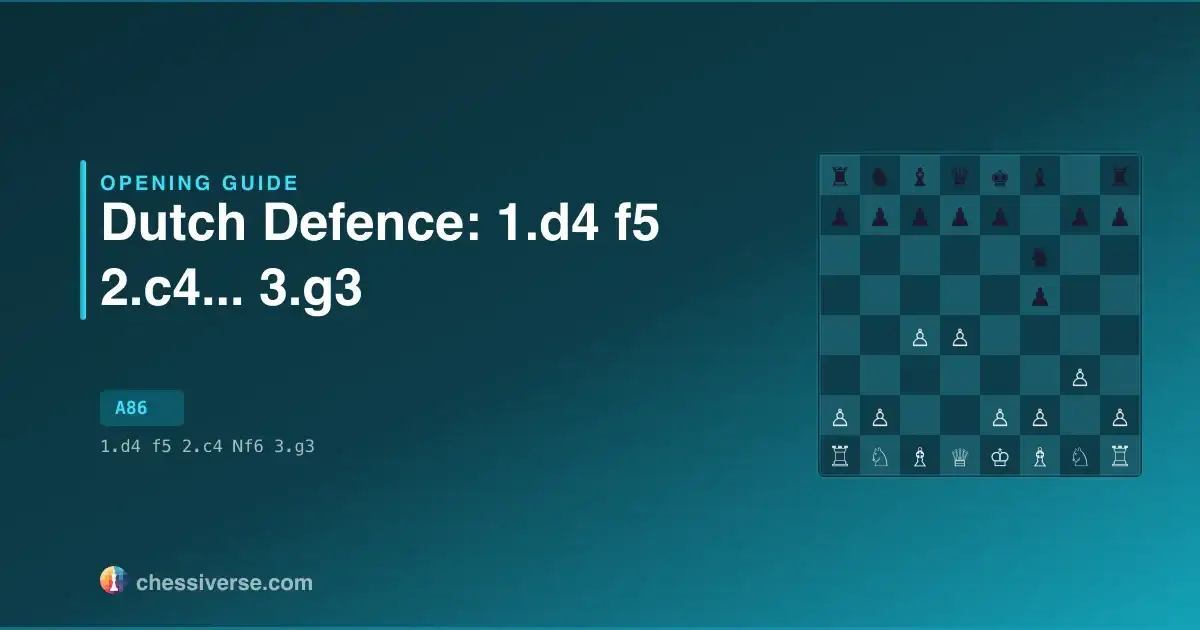


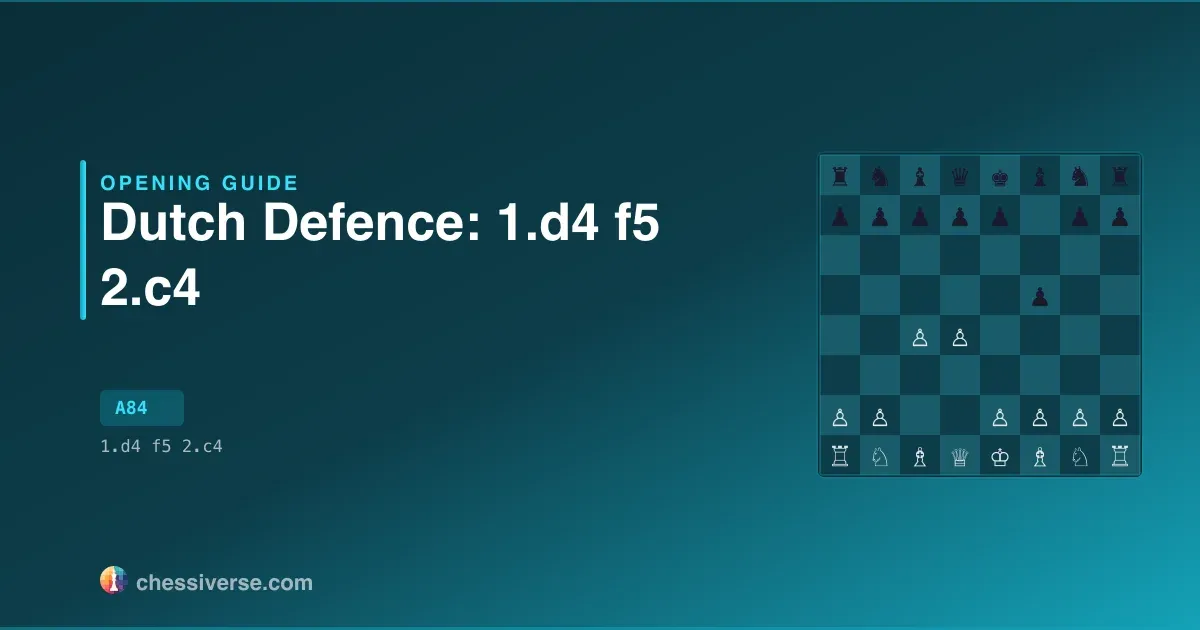
Starting from 1.d4 f5 2.c4, players enter the Dutch Defense — ECO A84. White grabs queenside space without committing the king's knight, leaving the door open for several setups. Black's whole game now hinges on which Dutch structure he picks.
Strategic Overview
After 2.c4 White stakes out the queenside and waits to see what Black is committing to. Black has three serious choices, and each leads to a fundamentally different middlegame. The Stonewall locks the structure with ...e6, ...d5, ...c6, building a wall of pawns on f5-e6-d5-c6 that grips e4 forever but leaves the c8-bishop sitting on its starting square with nothing to do — the trade-off is permanent and defines the whole game. The Leningrad goes the other way: ...g6, ...Bg7, ...d6, ...Nf6, and a quick castle, giving Black a dynamic kingside fianchetto setup where ...e5 is the long-term break. The third path is the Bladel approach with an early ...g6 and ...Nh6, which invites White to grab the center with e4 and turn the Dutch into a more open game where Black banks on the pawn majority. Strategically, the position revolves around two squares: e4 (Black's outpost) and e5 (Black's break). Whoever wins the e4-e5 battle usually wins the middlegame. The Stonewall is solid but static, the Leningrad is sharp and double-edged, and the Bladel is the theoretical and unbalanced try.
Key Ideas
The recurring motifs below distinguish a confident handler of this opening from a beginner:
- Stonewall: solid but static — The pawn chain on f5-e6-d5-c6 gives Black an iron grip on e4 and a clear plan with the knight landing there. The price is the dead c8-bishop, which spends the whole game waiting for a way out.
- Leningrad: dynamic kingside fianchetto — With ...g6, ...Bg7, ...d6 and ...Nf6, Black sets up for the ...e5 break. It's the most active Dutch setup and gives both sides chances in a sharp middlegame.
- Bladel with ...g6 and ...Nh6 — An offbeat theoretical line that allows White to play e4 and open the game. Black trades a central pawn for a side pawn and banks on a long-term endgame edge from the extra center pawn.
- The e4 square decides the middlegame — Across all three setups, e4 is the critical square. If Black can plant a knight there and keep it, he's well placed; if White trades it off or pushes through with e4 himself, the Dutch structure starts looking weaker.
History and Notable Players
It arises from the Dutch Defense. Among the most prolific White practitioners are Ivan Farago (20 games), Wolfgang Uhlmann (16 games), Alexander G Beliavsky (14 games). Black-side regulars include Vladimir P Malaniuk (41 games), Pavel Potapov (35 games), Thanh Trang Hoang (32 games).
Performance Across Rating Levels
How well the Dutch Defense works depends on what level you're playing at. At 1200 Elo, the opening shows up in 0.08% of games (556,585 samples). White scores 51.8%, Black 44.7%, draws 3.4%. Move up to 1800 Elo and the share shifts to 0.26%, with White winning 48.2% versus Black's 47%. At 2500, 0.14% of games go into this opening; draws sit at 9% — the line is well-mapped at this level. White's edge erodes by 5.3pp from 1200 to 2500 Elo, suggesting Black's counterplay is easier to find with experience.
Time Control Patterns
Look at the same opening across time controls and blitz stands out. In bullet, it appears in 0.16% of games (4,279,669); White wins 48.4%. Blitz shows 0.17% adoption across 6,286,258 games, White scoring 48.9%. In rapid, the share rises to 0.12% — 1,274,279 games, White 50%.
Move Diversity and Theory Depth
What players actually play after the opening moves depends heavily on rating. At 1200 Elo (556,585 games), the top reply is Nf6, played 60.6% of the time. One other move takes at least 5% of games, and the top three moves account for 84.7% of games. Entropy: 1.93. By 2500 (19,732 games), Nf6 dominates at 89.9% of replies; one other move reaches 5% and the top three moves account for 98.2% of games. Entropy drops to 0.63. That entropy collapse is the signature of a line where preparation pays off: at the top, players know the best move and play it.
Historical Trends
Year-over-year data tells you whether this opening is a contemporary fixture or a fading one. Adoption peaked in 2016 at 0.20% (121,465 games). By 2025 it sits at 0.15%, 24% below the peak and 20% under its 2013 level, leaving the line in decline.
Main Lines and Variations
The main branches off 1.d4 f5 2.c4 include:
Each branch leads to a different middlegame character — the resulting pawn structure decides what kind of game you get.
Common Mistakes
- Drifting away from main theory — At 400 Elo, the three most-played moves cover 72.3% of games, against 96.7% at 2000. The most popular deviation is e6 (played 19.3% of the time at 400, less so up top). It looks fine but quietly hands the better-prepared side an edge.
- Neglecting development — It can feel productive to make extra pawn moves early, but falling behind in piece development is what loses most amateur games — especially in open positions where active pieces find squares fast.
- Playing without a plan — Each Dutch Defense middlegame demands a specific approach. Decide whether the position calls for attack, manoeuvre, or simplification before reaching for a move.
Practice on Chessiverse
Ready to try the Dutch Defense against a bot? Pick an opponent at your level and play a game.