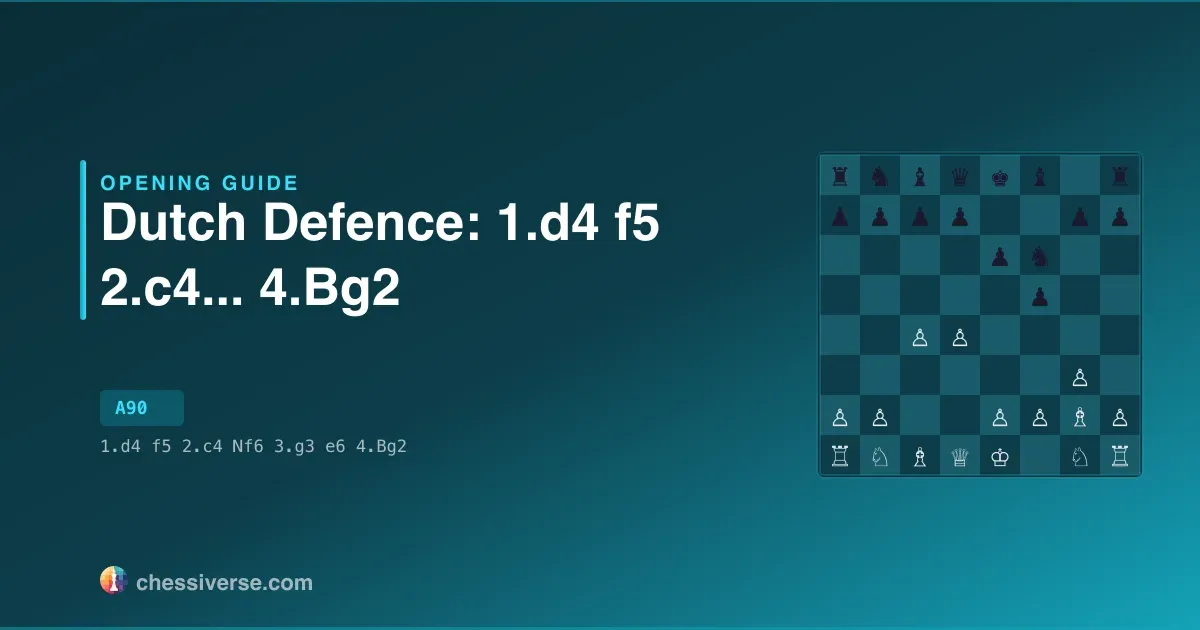
1.d4 f5 2.c4 Nf6 3.g3 e6 4.Bg2 opens the Dutch Defense: Classical Variation, ECO A90. Lichess records 399,808 games in this line, which gives us a reliable view of how it actually performs in practice.
History and Notable Players
It arises from the Dutch Defense: Fianchetto Variation. On the White side, Pia Cramling (18 games), Peter Lukacs (16 games), Igor Khenkin (16 games) top the database. Notable Black exponents: Evgeny Gleizerov (75 games), Mikhail Ulibin (59 games), Igor Naumkin (41 games).
Performance Across Rating Levels
The picture changes a lot as you climb the rating ladder. Among 1200-rated players, it appears in 0.00% of games — 4,132 of them on record — with White winning 54.5% and Black 42.1%. At 1800 the opening surfaces in 0.01% of games; White wins 51.4%, Black 43.2%, draws 5.4%. At the top end (2500+ Elo), popularity is 0.06% with 9.9% draws — a clear sign of how much theory rules the line at master level. White's edge erodes by 6.7pp from 1200 to 2500 Elo, suggesting Black's counterplay is easier to find with experience.
Move Diversity and Theory Depth
Move choice is far from uniform in the Dutch Defense: Classical Variation. At 1200 Elo (4,132 games), the top reply is Be7, played 28.7% of the time. Four other moves each take at least 5% of games, and the top three moves account for 61.8% of games. Entropy: 2.86. By 2500 (8,692 games), Be7 is still the top reply, at 39.7%; only three other moves still reach 5% and the top three moves account for 88.2% of games. Entropy drops to 1.99. The narrowing is significant — strong players consolidate around a small set of best moves, while amateurs scatter across many plausible-looking options.
Historical Trends
Tracking the Dutch Defense: Classical Variation year over year shows a clear story. Adoption peaked in 2016 at 0.013% (7,722 games). By 2025 it sits at 0.009%, 31% below the peak but still 23% above its 2013 level, so the line is up over the full period despite easing from the high.
Main Lines and Variations
The main branches off 1.d4 f5 2.c4 Nf6 3.g3 e6 4.Bg2 include:
Each branch leads to a different middlegame character — the resulting pawn structure decides what kind of game you get.
Common Mistakes
- Drifting away from main theory — At 400 Elo, the three most-played moves cover 51% of games, against 74% at 2000. The most popular deviation is Nc6 (played 16.7% of the time at 400, much less so up top). It looks fine but quietly hands the better-prepared side an edge.
- Neglecting development — Extra pawn moves in the opening are tempting, especially when you "know the moves". Developing a piece each turn is the simple correction.
- Playing without a plan — Each Dutch Defense: Classical Variation middlegame demands a specific approach. Decide whether the position calls for attack, manoeuvre, or simplification before reaching for a move.
Practice on Chessiverse
Ready to try the Dutch Defense: Classical Variation against a bot? Pick an opponent at your level and play a game.