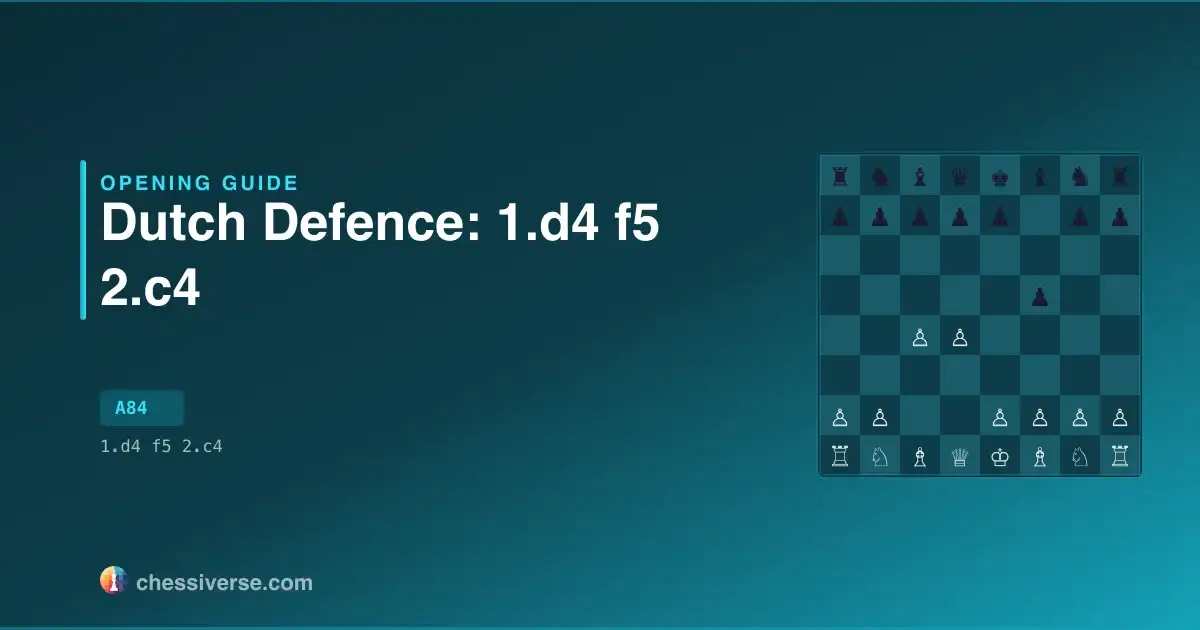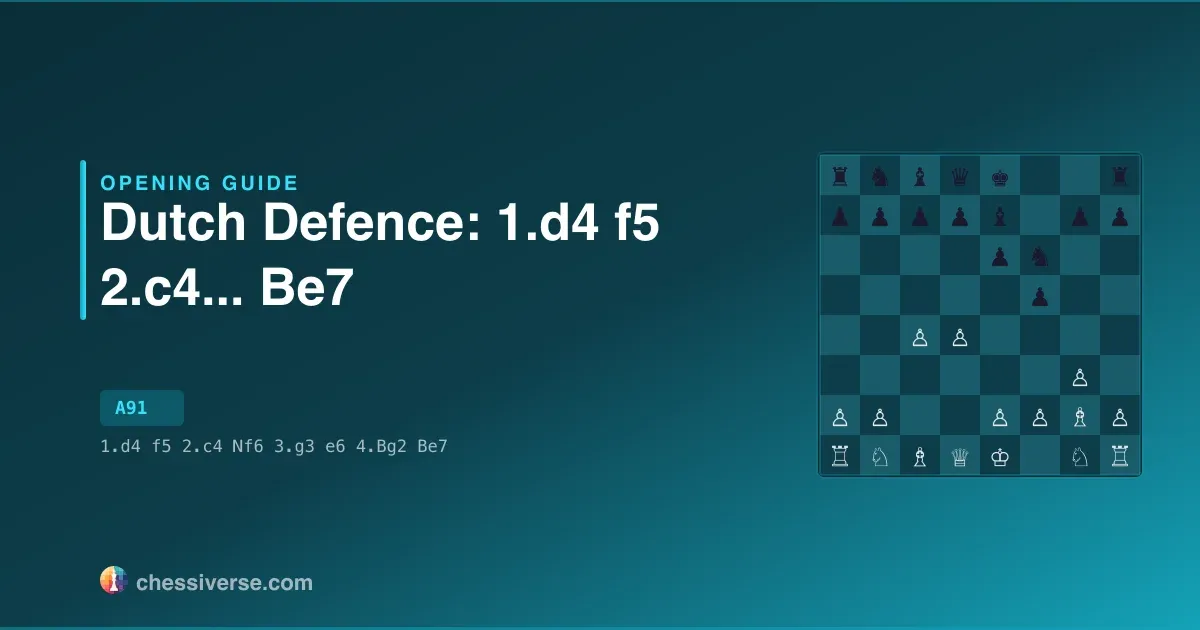
Starting from 1.d4 f5 2.c4 Nf6 3.g3 e6 4.Bg2 Be7, players enter the Dutch Defense: Classical Variation (4...Be7) — ECO A91. Across rating levels it shows up in 144,255 recorded games — enough data to map exactly where it succeeds and where it stalls.
History and Notable Players
It arises from the Dutch Defense: Classical Variation. Among the most prolific White practitioners are Glenn C Flear (7 games), Colin S Crouch (7 games), Ivan Farago (7 games). Black-side regulars include Simon K Williams (25 games), Igor Naumkin (25 games), Simon Williams (17 games).
Performance Across Rating Levels
The picture changes a lot as you climb the rating ladder. The 1200 bracket has 1,214 games (0.00% of all games at that level); White wins 52.1%, Black 44.6%, 3.4% are drawn. By 1800, popularity is 0.00% and White's score is 52.3% to Black's 42.5%. At 2500, 0.03% of games go into this opening; draws sit at 8.9% — the line is well-mapped at this level. White's edge erodes by 5.0pp from 1200 to 2500 Elo, suggesting Black's counterplay is easier to find with experience.
Move Diversity and Theory Depth
Move choice is far from uniform in the Dutch Defense: Classical Variation (4...Be7). At 1200 Elo (1,214 games), the top reply is Nf3, played 46.2% of the time. Two other moves each take at least 5% of games, and the top three moves account for 87.4% of games. Entropy: 2.06. By 2500 (3,453 games), Nf3 dominates at 58.8% of replies; two other moves reach 5% and the top three moves account for 93.6% of games. Entropy drops to 1.73.
Main Lines and Variations
From the position after 1.d4 f5 2.c4 Nf6 3.g3 e6 4.Bg2 Be7, the recognised continuations are:
Each branch leads to a different middlegame character — the resulting pawn structure decides what kind of game you get.
Common Mistakes
- Drifting away from main theory — At 1000 Elo, the three most-played moves cover 83.3% of games, against 90.8% at 2000. The most popular deviation is e3 (played 7.9% of the time at 1000, much less so up top). It looks fine but quietly hands the better-prepared side an edge.
- Neglecting development — It can feel productive to make extra pawn moves early, but falling behind in piece development is what loses most amateur games — especially in open positions where active pieces find squares fast.
- Playing without a plan — Each Dutch Defense: Classical Variation (4...Be7) middlegame demands a specific approach. Decide whether the position calls for attack, manoeuvre, or simplification before reaching for a move.
Practice on Chessiverse
Ready to try the Dutch Defense: Classical Variation (4...Be7) against a bot? Pick an opponent at your level and play a game.