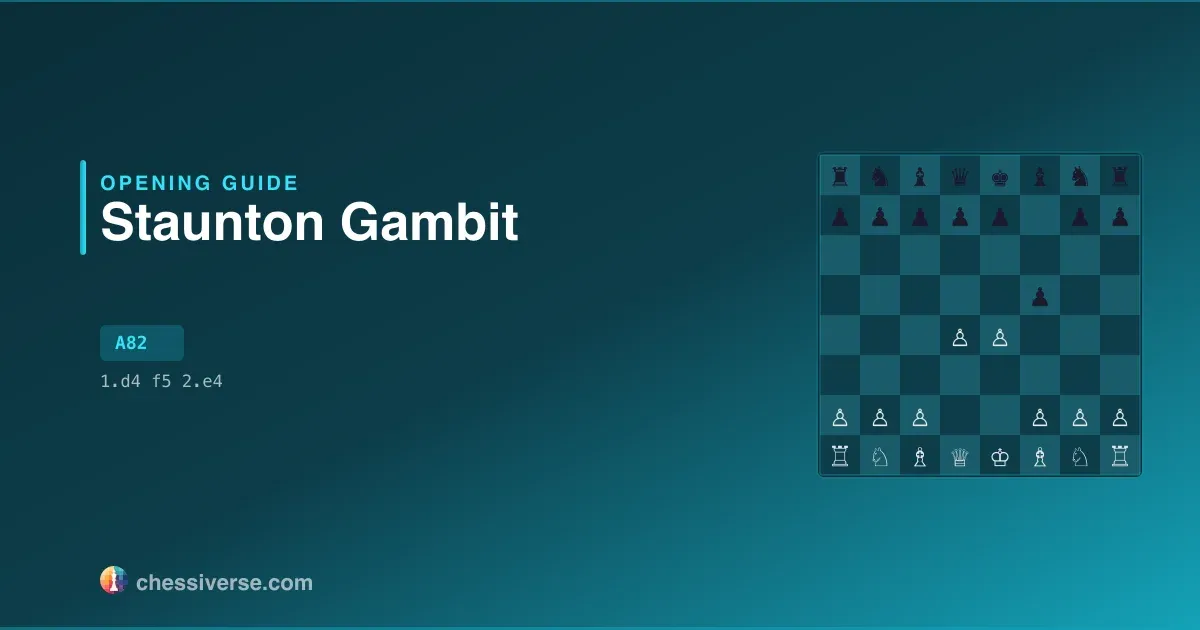
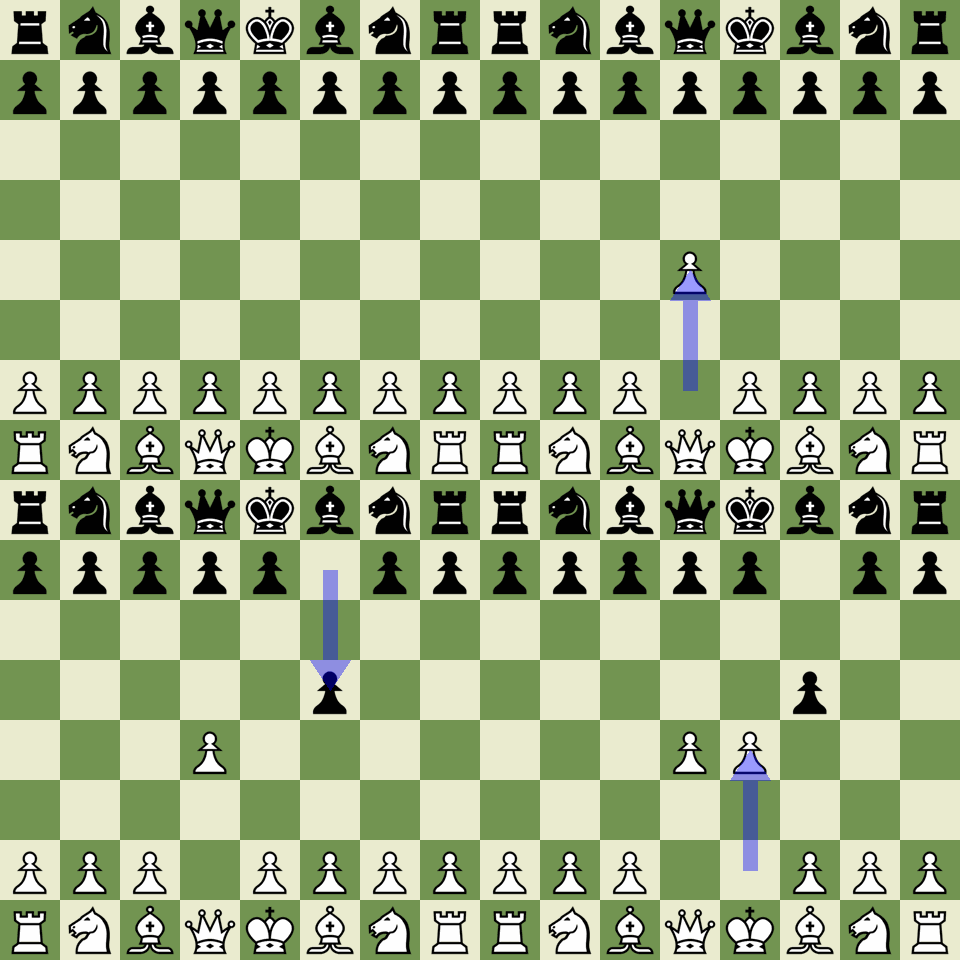
1.d4 f5 2.e4 opens the Staunton Gambit, ECO A82. White sacrifices a pawn on move two to crack open the position before Black can finish a Dutch setup. The h5-e8 diagonal is suddenly very exposed.
Strategic Overview
The Staunton Gambit is the most aggressive answer to the Dutch — White offers the e4 pawn straight away to rip lines open against Black's slightly weakened kingside. The idea is straightforward: after 2.e4 fxe4 3.Nc3 Nf6 4.Bg5, White piles pressure on f6 and the e-file, and the typical follow-up 4...e6 or 4...g6 leaves Black scrambling to develop without losing material or running into kingside threats. The h5-e8 diagonal, opened by ...f5, is the obvious sore spot White is trying to exploit before Black can plug it. The honest verdict is that Black has resources here. With careful play Black returns the pawn at a good moment, completes development, and emerges with the better structure — White has spent his energy on a recovery operation instead of a knockout. So the Staunton tends to score well in club play and against unprepared opponents, where the early pressure is genuinely uncomfortable to handle over the board, but at the top level it's not considered a serious try for an advantage. It's a practical weapon, not a theoretical refutation.
Key Ideas
The recurring motifs below distinguish a confident handler of this opening from a beginner:
- Pawn sac for open lines — White hands over e4 to blow open the position immediately. The point is to attack before Black can finish kingside development and lock the position down with a normal Dutch setup.
- The h5-e8 diagonal is the target — Black's ...f5 weakens the diagonal running into his king. White's whole gambit is built around exploiting that weakness with quick piece pressure, often involving Bg5 and Qd2-Qh6 ideas.
- Black should give the pawn back at the right moment — Holding the pawn at all costs is dangerous and unnecessary. Returning material to complete development and reach a comfortable middlegame is usually the cleanest path to equality.
- Practical weapon, not a refutation — With accurate defense Black is fine, but the Staunton scores well against unprepared opponents because the threats are concrete and unpleasant to navigate without prep. It works best as a surprise weapon.
History and Notable Players
It arises from the Dutch Defense. Among the most prolific White practitioners are Frank James Marshall (11 games), Wilfried Schroeder (8 games), Helmut Reefschlaeger (8 games). Black-side regulars include Vladimir P Malaniuk (9 games), Jacques Mieses (8 games), Saviely Tartakower (8 games).
Howard Staunton first played the gambit's main continuation against Bernhard Horwitz in London in 1846. For a long time it was a feared anti-Dutch weapon, but modern defensive methods have blunted it: White scores only around 50 percent with it, and it is rarely seen today.
Named after: Named for Howard Staunton, who introduced its main line 4.Bg5 in a game against Bernhard Horwitz in London, 1846.
Notable players: Howard Staunton
Once a feared weapon against the Dutch, the Staunton Gambit has been so thoroughly defused by modern defensive technique that White now scores only about 50 percent with it.
Performance Across Rating Levels
The picture changes a lot as you climb the rating ladder. At 1200 Elo, the opening shows up in 0.01% of games (53,196 samples). White scores 51.3%, Black 45.2%, draws 3.5%. At 1800 the opening surfaces in 0.03% of games; White wins 56.7%, Black 39.1%, draws 4.1%. At the top end (2500+ Elo), popularity is 0.05% with 7.9% draws — a clear sign of how much theory rules the line at master level.
Time Control Patterns
Time control matters here: blitz players reach for this opening more than others. In bullet, it appears in 0.02% of games (626,533); White wins 53.4%. Blitz shows 0.03% adoption across 933,351 games, White scoring 54.4%. In rapid, the share rises to 0.01% — 162,033 games, White 53.6%.
Move Diversity and Theory Depth
What players actually play after the opening moves depends heavily on rating. At 1200 Elo (53,196 games), the top reply is fxe4, played 63.3% of the time. Three other moves each take at least 5% of games, and the top three moves account for 83.9% of games. Entropy: 1.93. By 2500 (6,782 games), fxe4 dominates at 95.2% of replies; no other move reaches 5% and the top three moves account for 99% of games. Entropy drops to 0.37. That entropy collapse is the signature of a line where preparation pays off: at the top, players know the best move and play it.
Historical Trends
Long-term, the trajectory of this opening is informative. Adoption peaked in 2016 at 0.03% (17,016 games). By 2025 it sits at 0.02%, 10% below the peak but still 41% above its 2013 level, so the line is up over the full period despite easing from the high.
Main Lines and Variations
The main branches off 1.d4 f5 2.e4 include:
Each branch leads to a different middlegame character — the resulting pawn structure decides what kind of game you get.
Common Mistakes
- Drifting away from main theory — At 400 Elo, the three most-played moves cover 74.8% of games, against 94.2% at 2000. The most popular deviation is e6 (played 14.6% of the time at 400, much less so up top). It looks fine but quietly hands the better-prepared side an edge.
- Neglecting development — It can feel productive to make extra pawn moves early, but falling behind in piece development is what loses most amateur games — especially in open positions where active pieces find squares fast.
- Overextending the attack — Gambits look like permission to throw everything forward. They aren't — every attacking move should improve a piece. Random checks and threats burn the initiative once they fail to coordinate.
Practice on Chessiverse
Ready to try the Staunton Gambit against a bot? Pick an opponent at your level and play a game.