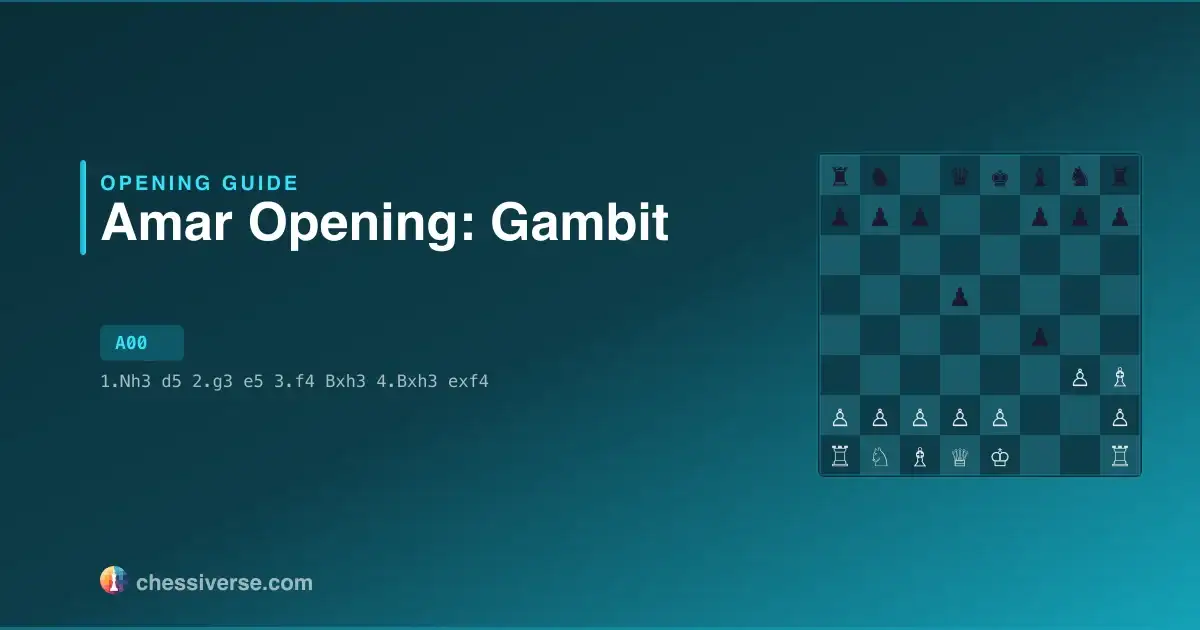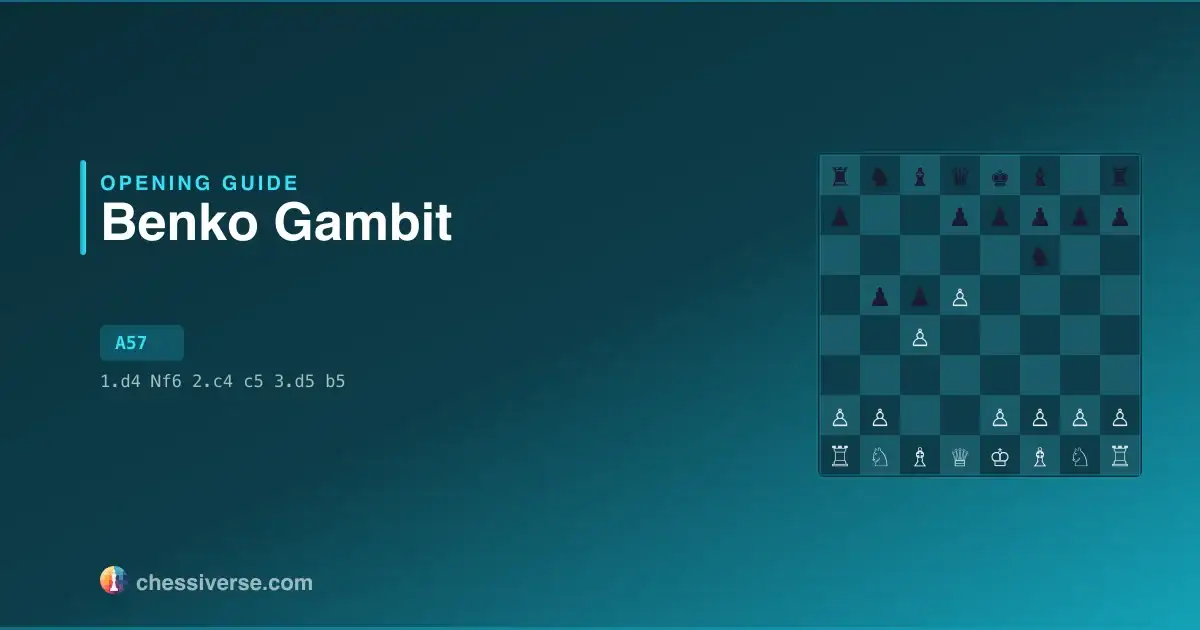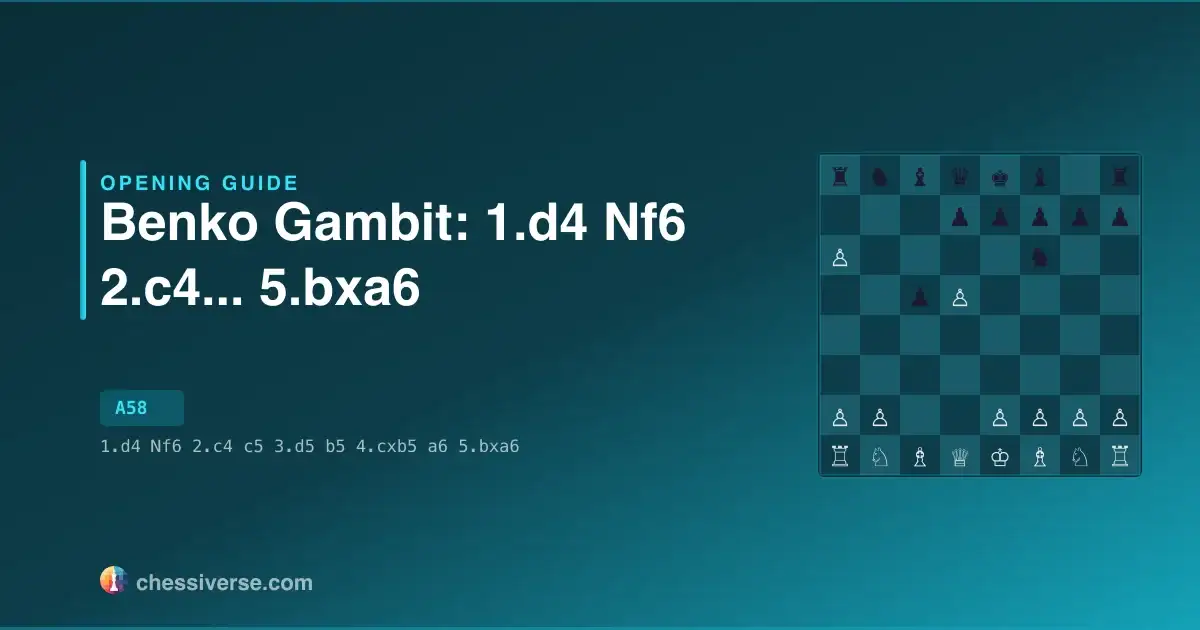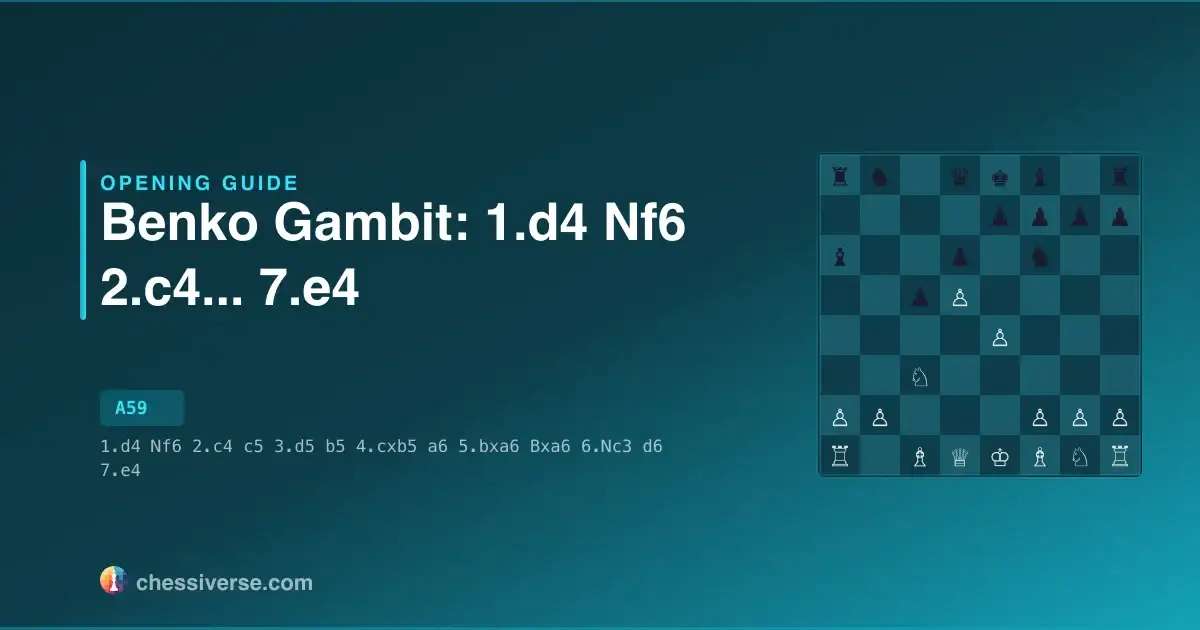




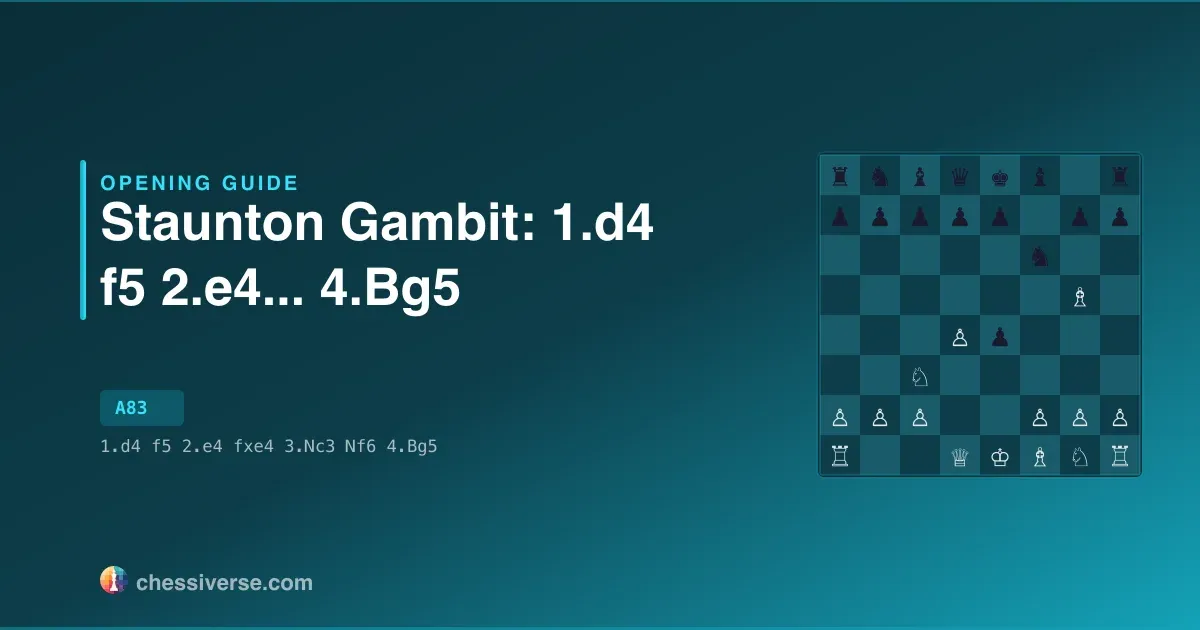
1.d4 f5 2.e4 fxe4 3.Nc3 Nf6 4.Bg5 opens the Dutch Defense: Staunton Gambit, ECO A83. Across rating levels it shows up in 395,635 recorded games — enough data to map exactly where it succeeds and where it stalls.
History and Notable Players
It arises from the Staunton Gambit. Among the most prolific White practitioners are Frank James Marshall (9 games), Wilfried Schroeder (8 games), Leandro Perdomo (7 games). Black-side regulars include Anna Muzychuk (6 games), Thanh Trang Hoang (6 games), Charles Jaffe (6 games).
Performance Across Rating Levels
How well the Dutch Defense: Staunton Gambit works depends on what level you're playing at. Among 1200-rated players, it appears in 0.00% of games — 5,019 of them on record — with White winning 54.7% and Black 41.9%. At 1800 the opening surfaces in 0.01% of games; White wins 57.7%, Black 37.4%, draws 5%. Among 2500-rated players the line appears in 0.04% of games and draws spike to 8%, indicating tight preparation. White's edge erodes by 7.2pp from 1200 to 2500 Elo, suggesting Black's counterplay is easier to find with experience.
Move Diversity and Theory Depth
Move choice is far from uniform in the Dutch Defense: Staunton Gambit. At 1200 Elo (5,019 games), the top reply is d5, played 51.8% of the time. Four other moves each take at least 5% of games, and the top three moves account for 81.2% of games. Entropy: 2.20. By 2500 (5,058 games), Nc6 takes over as the top reply at 40.4%; only three other moves still reach 5% and the top three moves account for 88.6% of games. Entropy drops to 2.00.
Historical Trends
Tracking the Dutch Defense: Staunton Gambit year over year shows a clear story. Adoption peaked in 2016 at 0.011% (6,538 games). By 2025 it sits at 0.008%, 21% below the peak but still 45% above its 2013 level, so the line is up over the full period despite easing from the high.
Common Mistakes
- Neglecting development — It can feel productive to make extra pawn moves early, but falling behind in piece development is what loses most amateur games — especially in open positions where active pieces find squares fast.
- Overextending the attack — Gambits look like permission to throw everything forward. They aren't — every attacking move should improve a piece. Random checks and threats burn the initiative once they fail to coordinate.
Practice on Chessiverse
Ready to try the Dutch Defense: Staunton Gambit against a bot? Pick an opponent at your level and play a game.