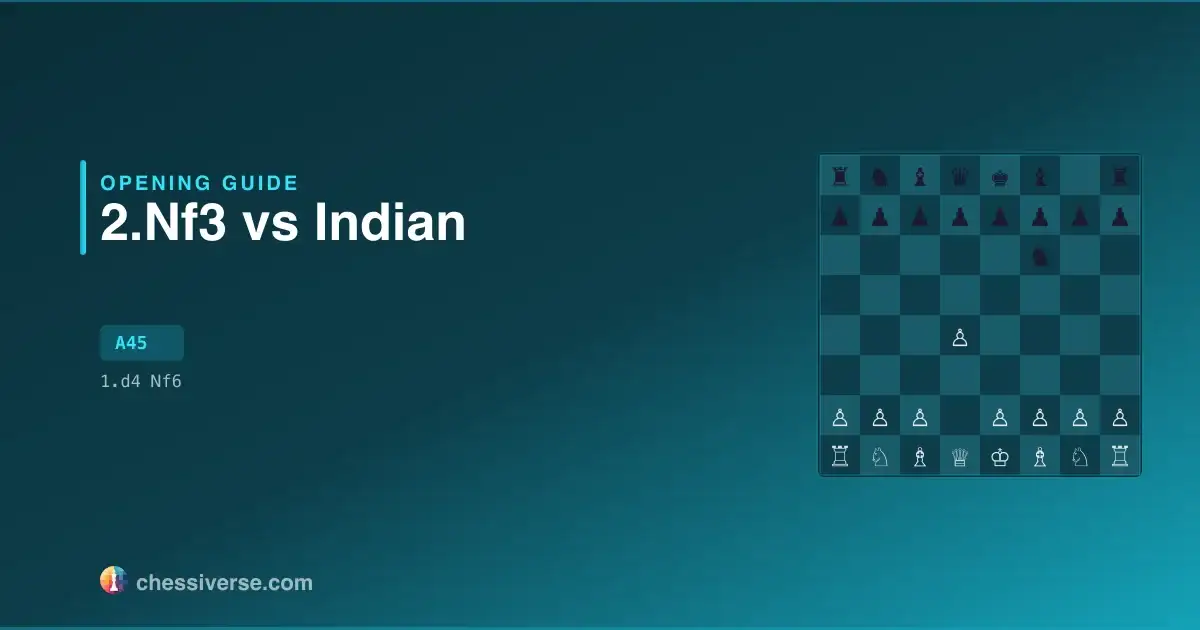




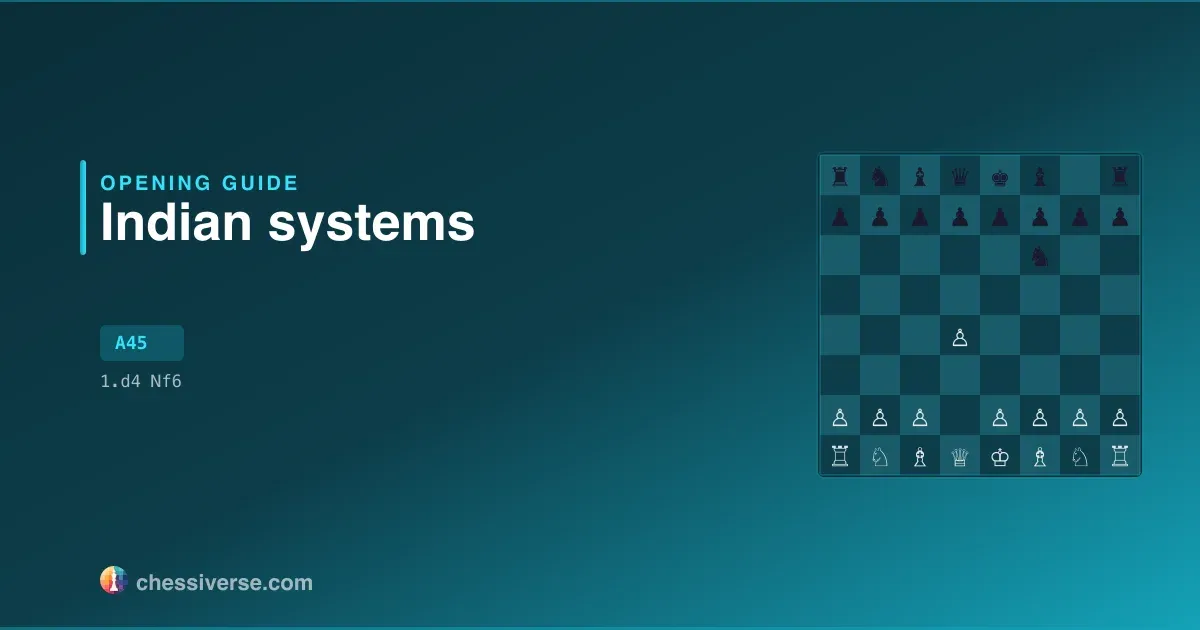
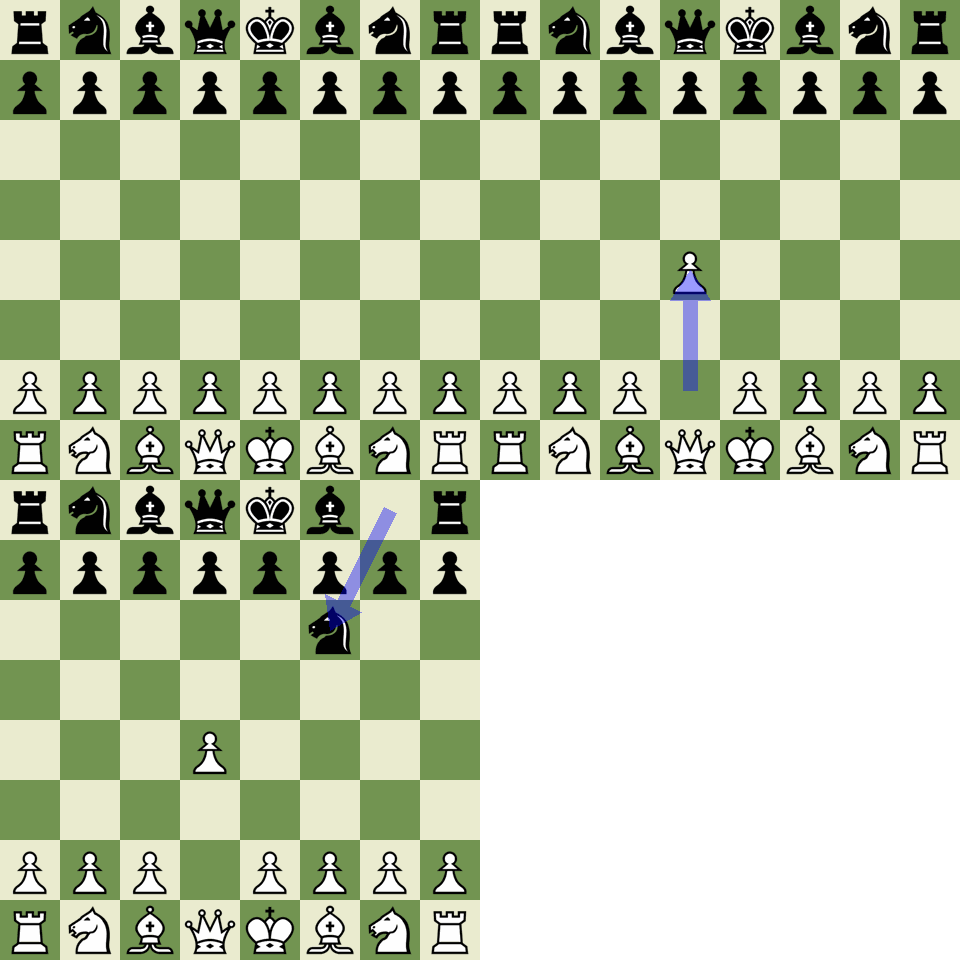
The Indian Defense Systems arises after 1.d4 Nf6 and falls under ECO code A45. By developing the knight to f6, Black takes control of e4 while keeping maximum flexibility, making this the most versatile reply to 1. d4. Rather than committing a pawn to the centre immediately, Black reserves the option of contesting it later with pawns or adopting a hypermodern approach, controlling the centre from a distance with pieces and undermining White's pawn structure through well-timed pawn advances. White, in turn, has considerable freedom to develop pieces or seize additional central space, and the resulting positions are rich in transpositional possibilities. White's primary continuation is 2. c4, which claims more territory and clamps down on d5, after which a knight can be developed behind the pawn chain with the prospect of eventually playing e4. Black can still challenge the centre directly with 2...d5, 2...c5 (Benoni), or 2...e5 (Budapest), but more often advances pawns only as needed to release the bishops via 2...e6, 2...g6, 2...d6, or 2...b6. With 231.8 million Lichess games across all rating levels, it is one of the most popular openings.
- Instead of meeting 1.d4 with 1...d5, Black invites White to seize the center, intending to attack and dismantle it from a distance.
- The knight on f6 is the springboard for a whole family of setups: fianchetto the king's bishop, pin with ...Bb4, or strike back with ...d5 later.
- Play is about long-term pressure on White's center rather than immediate symmetry, a hallmark of the hypermodern school.
History and Notable Players
It arises from the Queen's Pawn Systems (1...d5). Among the most prolific practitioners on the White side are Ivan Farago (1129 games), Aleksey Dreev (995 games), Svetozar Gligoric (884 games). On the Black side, notable exponents include Viktor Korchnoi (704 games), Wolfgang Uhlmann (569 games), Jan H Timman (559 games).
The name goes back to 1884 and the games of Moheschunder Bannerjee against John Cochrane, and Savielly Tartakower popularized the term in the early 1920s. Hypermodern advocates championed 1...Nf6 in the 1920s, but the defenses only gained full credibility in the late 1940s through Soviet analysis and practice.
Named after: Named for Moheschunder Bannerjee, an Indian player who used fianchetto setups against John Cochrane; the term dates to 1884; Tartakower spread it in the 1920s.
Notable players: David Bronstein, Samuel Reshevsky, Bobby Fischer, Garry Kasparov
The openings honor Moheschunder Bannerjee, whom Philip W. Sergeant described as a Brahman from up-country, as of 1848, who had never been beaten at chess; his fianchetto games against John Cochrane named the family.
Statistics
Based on 231.8 million Lichess games across all rating levels:
- White wins: 48.4%
- Black wins: 46.5%
- Draws: 5.1%
The statistics show a roughly balanced opening where both sides have equal chances.
Main Lines and Variations
After 1.d4 Nf6, the main continuations include:
Each of these lines leads to distinct types of positions and requires its own understanding of the resulting pawn structures and piece placements.
Common Mistakes to Avoid
- Allowing White to build an overwhelming center: Hypermodern openings allow White space in the center, but you need to strike back at the right moment. Delaying the counterattack too long can leave you without active play.
Practice on Chessiverse
The best way to learn the Indian Defense Systems is through practice. On Chessiverse, you can play chess against computer opponents that specialize in this opening. Our AI bots range from beginner to grandmaster level, each with unique playing styles — from aggressive attackers to solid defenders. Choose a bot that matches your rating and work your way up as you master the opening's key ideas.
Performance Across Rating Levels
The picture changes a lot as you climb the rating ladder. At 1200 Elo, the opening shows up in 2.52% of games (17,005,505 samples). White scores 48.8%, Black 47.5%, draws 3.7%. By 1800, popularity is 6.65% and White's score is 48.2% to Black's 46.8%. At 2500, 18.27% of games go into this opening; draws sit at 10% — the line is well-mapped at this level.
Time Control Patterns
Look at the same opening across time controls and blitz stands out. In bullet, it appears in 4.47% of games (118,858,374); White wins 49.6%. Blitz shows 5.28% adoption across 189,786,890 games, White scoring 48.6%. In rapid, the share rises to 3.80% — 42,055,761 games, White 47.3%. White's score swings 2.3pp across formats, so time control isn't just a stylistic choice here — it shifts the actual results.
Move Diversity and Theory Depth
Move choice is far from uniform in the Indian Defense Systems. At 1200 Elo (17,005,505 games), the top reply is c4, played 29.9% of the time. Four other moves each take at least 5% of games, and the top three moves account for 66.6% of games. Entropy: 2.76. By 2500 (2,490,794 games), c4 dominates at 53.5% of replies; four other moves reach 5% and the top three moves account for 86.2% of games. Entropy drops to 1.92. The narrowing is significant — strong players consolidate around a small set of best moves, while amateurs scatter across many plausible-looking options.
Historical Trends
Tracking the Indian Defense Systems year over year shows a clear story. Adoption peaked in 2020 at 5.54% (31,809,032 games). By 2025 it sits at 4.64%, 16% below the peak but still 27% above its 2013 level, so the line is up over the full period despite easing from the high.