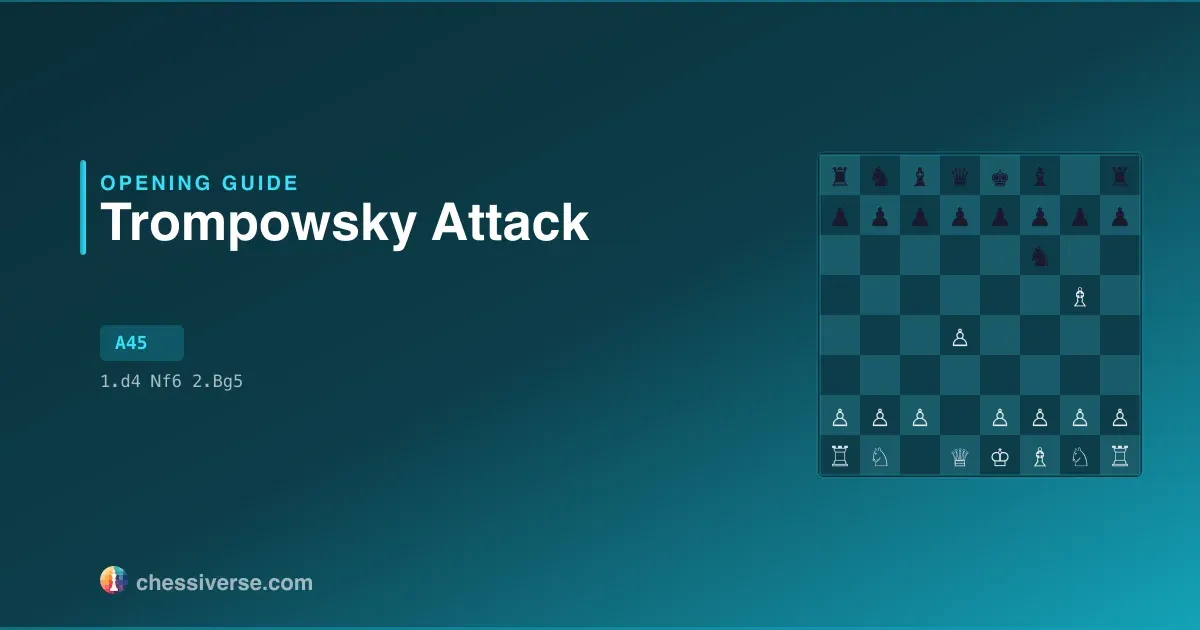
The Trompowsky Attack arises after 1.d4 Nf6 2.Bg5 and falls under ECO code A45. This relatively modern system carries less theoretical baggage than many mainline 1. d4 openings, with White immediately developing the bishop to g5 to put pressure on the f6 knight. In most variations, Black sidesteps doubled pawns (as in 2...Ne4 or 2...e6), though some lines (2...c5 or 2...d5) involve accepting them. Certain responses, specifically 2...e6 and 2...d5, can transpose into the Torre Attack after 3. Nf3, but the main line 2...Ne4 generally keeps the game in independent Trompowsky territory. In that main line, both sides move a developed minor piece twice — the knight travels from g8 to f6 to e4, and the bishop from c1 to g5 to f4 — after which Black enjoys unusual flexibility in development, with options like ...c5, ...d5, ...d6, or ...e6. The less common 2...e6, the Classical Defense, favors natural development over piece exchanges and can lead to the Torre Attack with 3. Nf3 or the Big Center Variation with 3. e4, where Black typically avoids trading minor pieces due to the pin and White often resolves the tension with 4. Bxf6. The rare 2...d5 invites transposition into the Torre Attack (3. Nf3) or Richter-Veresov (3. Nc3), but White can remain in the Trompowsky with 3. Bxf6, doubling Black's pawns. With 9.7 million Lichess games across all rating levels, it is one of the most popular openings.
- White threatens to take on f6 and saddle Black with doubled pawns, but it is no lethal threat: Black can simply go along with the idea
- By committing the bishop on move two, White dodges the huge theory of the King's Indian, Nimzo-Indian, Queen's Indian and Grunfeld
- Black's most popular answer is the cheeky 2...Ne4, breaking opening rules to kick the bishop straight away
History and Notable Players
It arises from the Indian Defense Systems. Among the most prolific practitioners on the White side are Ivan Farago (1129 games), Aleksey Dreev (995 games), Svetozar Gligoric (884 games). On the Black side, notable exponents include Viktor Korchnoi (704 games), Wolfgang Uhlmann (569 games), Jan H Timman (559 games).
Several players hit on 2.Bg5 independently in the 1930s: besides Trompowsky in Brazil, the master Karel Opocensky played it, and William Allen Ruth developed it at the same time in Pennsylvania, so it has also been called the Opocensky and Ruth Opening. Magnus Carlsen brought it to game 1 of the 2016 world championship against Sergey Karjakin.
Named after: Octavio Trompowsky (1897-1984), a Brazilian champion who championed 2.Bg5 in the 1930s and 1940s.
Notable players: Julian Hodgson, Antoaneta Stefanova, Magnus Carlsen, Arjun Erigaisi
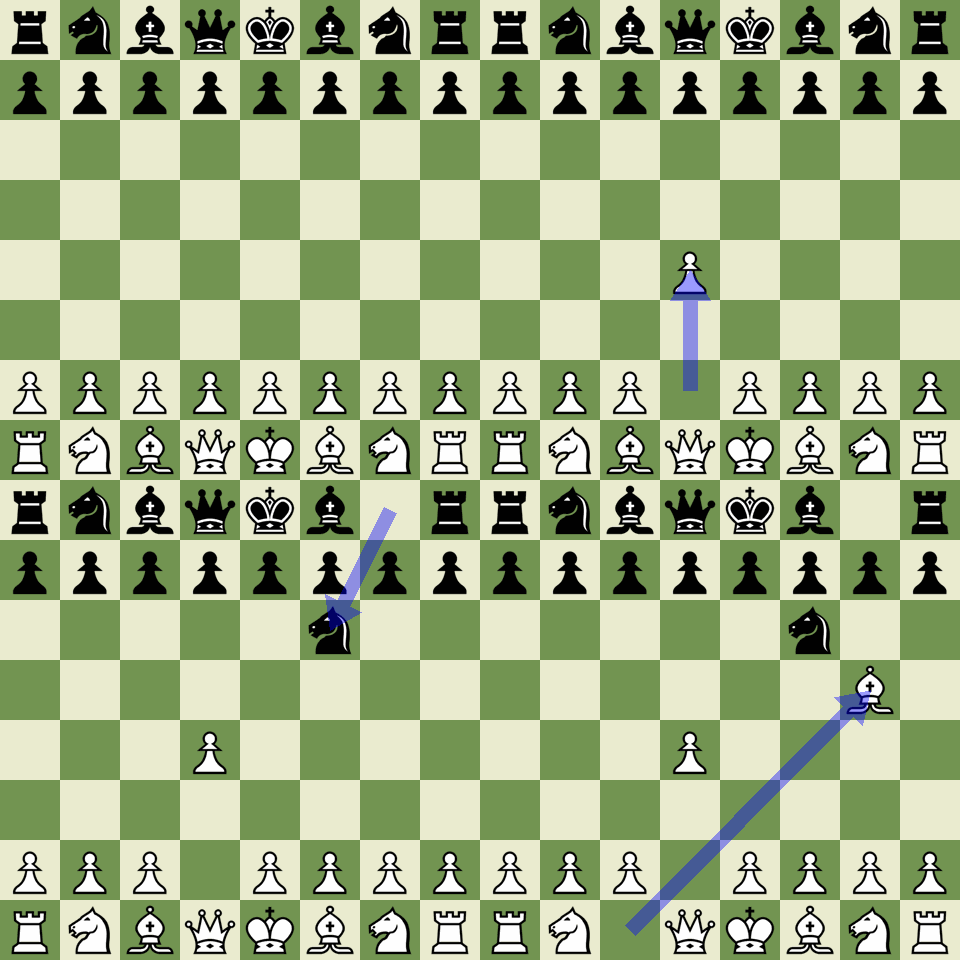
The Trompowsky produced the shortest master loss ever: in Djordjevic-Kovacevic, Bela Crkva 1984, White played 3.e3?? and resigned after 3...Qa5+, which wins the g5-bishop.
Statistics
Based on 9.7 million Lichess games across all rating levels:
- White wins: 48.9%
- Black wins: 45.9%
- Draws: 5.1%
The statistics show a roughly balanced opening where both sides have equal chances.
Practice on Chessiverse
The best way to learn the Trompowsky Attack is through practice. On Chessiverse, you can play chess against computer opponents that specialize in this opening. Our AI bots range from beginner to grandmaster level, each with unique playing styles — from aggressive attackers to solid defenders. Choose a bot that matches your rating and work your way up as you master the opening's key ideas.
Performance Across Rating Levels
The picture changes a lot as you climb the rating ladder. The 1200 bracket has 665,045 games (0.10% of all games at that level); White wins 48.7%, Black 47.6%, 3.8% are drawn. By 1800, popularity is 0.25% and White's score is 48.8% to Black's 46.4%. Among 2500-rated players the line appears in 1.41% of games and draws spike to 9.8%, indicating tight preparation.
Time Control Patterns
The Trompowsky Attack skews toward blitz chess. In bullet, it appears in 0.18% of games (4,677,622); White wins 49.6%. Blitz shows 0.23% adoption across 8,158,881 games, White scoring 49.3%. In rapid, the share rises to 0.14% — 1,568,553 games, White 47%. White's score swings 2.6pp across formats, so time control isn't just a stylistic choice here — it shifts the actual results.
Move Diversity and Theory Depth
Looking at move selection shows how forcing — or not — the position really is. At 1200 Elo (665,045 games), the top reply is e6, played 27.9% of the time. Five other moves each take at least 5% of games, and the top three moves account for 64.5% of games. Entropy: 2.84. By 2500 (192,641 games), d5 takes over as the top reply at 24.7%; only four other moves still reach 5% and the top three moves account for 72.4% of games. Entropy drops to 2.49.
Historical Trends
Year-over-year data tells you whether this opening is a contemporary fixture or a fading one. Adoption peaked in 2016 at 0.25% (153,013 games). By 2025 it sits at 0.19%, 24% below the peak but still 50% above its 2013 level, so the line is up over the full period despite easing from the high.