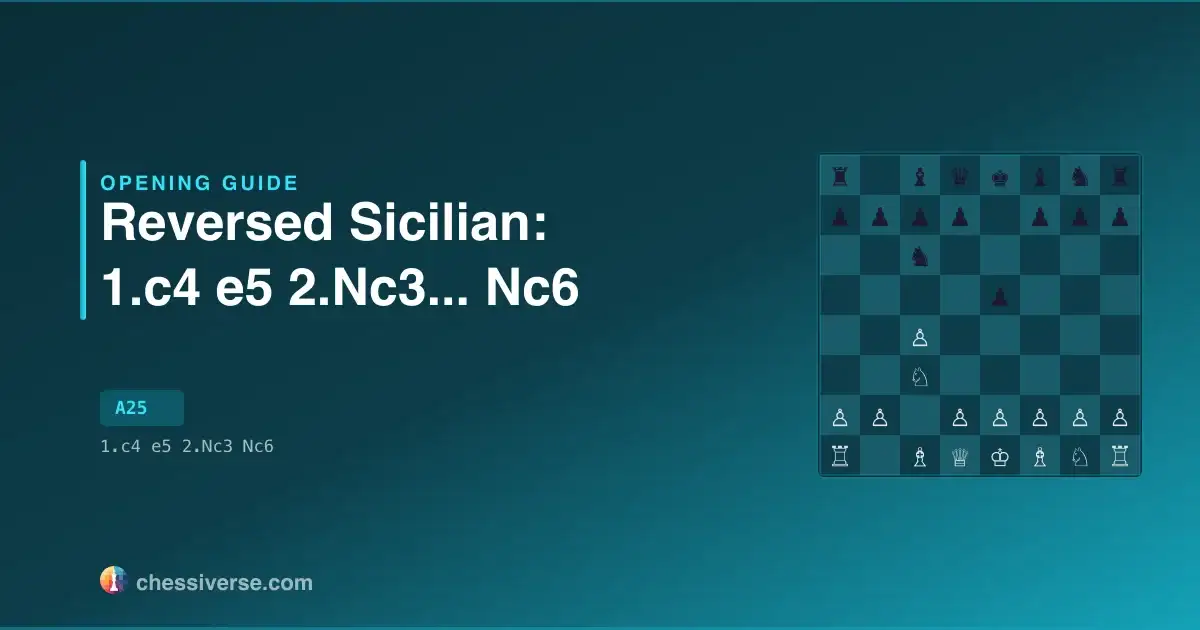


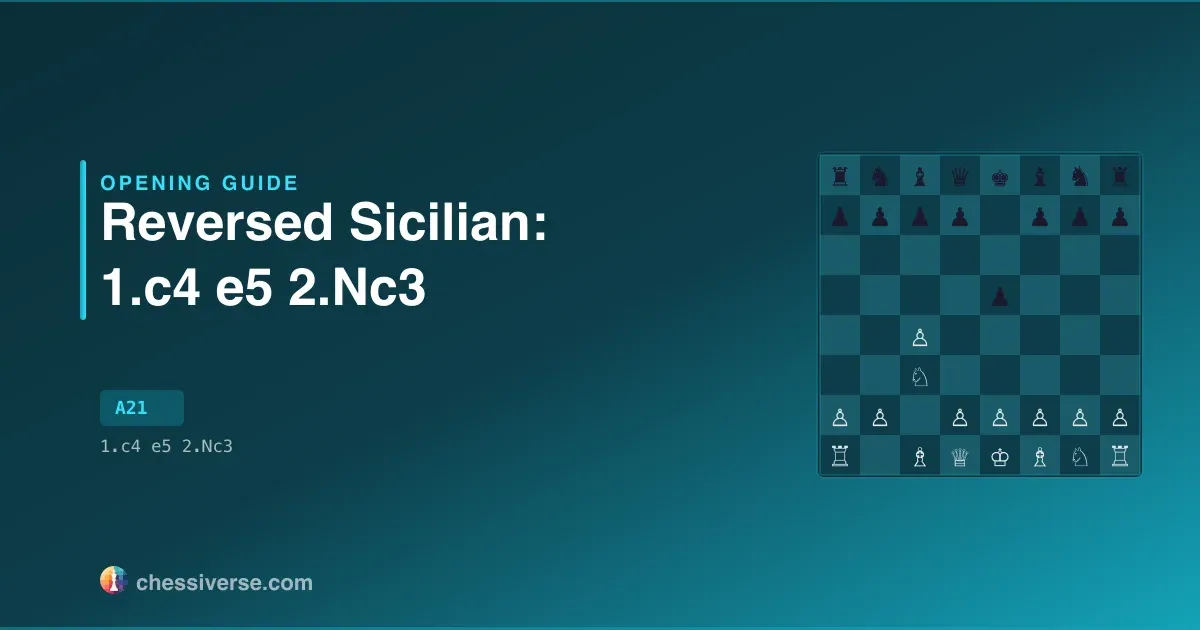
The English Opening: King's English Variation, Reversed Sicilian begins with 1.c4 e5 2.Nc3 (ECO A21). White piles a second piece onto d5 and signals serious intent. The Nc3 knight is the cornerstone of every independent Reversed Sicilian line — every Black plan has to address it.
Strategic Overview
2.Nc3 is the standard move because it does three useful things at once: contests d5, keeps the d-pawn flexible, and prepares either Nf3 or g3 setups. The most popular follow-up is the Bremen System with 3.g3 and 4.Bg2, which adds a third attacker to d5 from distance and keeps the king's knight free to go to e2 or f3 depending on Black's plan. Black has several reasonable replies. 2...Nf6 is the flexible main line — solid, controls d5, and keeps options open. 2...Nc6 leads to sharper play, especially when White goes for a queenside expansion with e3, Nge2, d4, Rb1, and b4 while Black counterattacks on the kingside with ...f5 and pawn pushes. The challenge for both sides is that the kingside attack can become genuinely dangerous if White isn't careful — overextending the queenside pawns gives Black real targets. 2...Bb4 is the third try, which White can challenge with Nd5 chasing the bishop, but most players prefer 3.e3 or 3.Nf3 and let Black take the knight to create dark-square imbalances. The opening rewards players who like positional buildup but can switch to concrete play when the pawn breaks happen.
Key Ideas
A few ideas come up again and again in this opening:
- Two knights on d5 from move two — Reinforcing the c4-pawn's attack on d5 is the structural point. Black can't easily push ...d5 in one move, which forces them into either ...Nf6 setups or central concessions.
- Bremen System: g3, Bg2, then knight flexibility — By delaying the king's knight, White can choose between Nf3 (active) and Ne2 (keeping the long diagonal clear). The Bg2 will press d5 for the whole game.
- Queenside expansion is White's main long-term plan — Moves like e3, Nge2, d4, Rb1, and b4 give White space and pressure on the queenside. The downside is that overextension leaves real holes for Black to attack.
- Don't neglect the kingside against ...f5 — If Black gets the ...f5 break in, the kingside attack with ...f4 and ...g5 can become dangerous fast. White needs to keep the king's position covered while pushing on the queenside.
History and Notable Players
It arises from the Reversed Sicilian. On the White side, Normunds Miezis (204 games), Wolfgang Uhlmann (191 games), Colin Anderson McNab (118 games) top the database. Notable Black exponents: Jan H Timman (62 games), Oleg M Romanishin (59 games), Vassily Smyslov (56 games).
Performance Across Rating Levels
Popularity and results vary sharply by rating level. Among 1200-rated players, it appears in 0.55% of games — 3,691,473 of them on record — with White winning 52.1% and Black 44.3%. At 1800 the opening surfaces in 0.72% of games; White wins 51.9%, Black 43.3%, draws 4.7%. At the top end (2500+ Elo), popularity is 0.69% with 9.3% draws — a clear sign of how much theory rules the line at master level. White's edge erodes by 5.4pp from 1200 to 2500 Elo, suggesting Black's counterplay is easier to find with experience.
Time Control Patterns
The English Opening: King's English Variation, Reversed Sicilian skews toward blitz chess. In bullet, it appears in 0.47% of games (12,605,007); White wins 52.5%. Blitz shows 0.63% adoption across 22,681,639 games, White scoring 51.7%. In rapid, the share rises to 0.62% — 6,830,909 games, White 52.2%.
Move Diversity and Theory Depth
Looking at move selection shows how forcing — or not — the position really is. At 1200 Elo (3,691,473 games), the top reply is Nf6, played 35.1% of the time. Five other moves each take at least 5% of games, and the top three moves account for 69% of games. Entropy: 2.75. By 2500 (94,586 games), Nf6 is still the top reply, at 41%; only two other moves still reach 5% and the top three moves account for 91.5% of games. Entropy drops to 2.01. The narrowing is significant — strong players consolidate around a small set of best moves, while amateurs scatter across many plausible-looking options.
Historical Trends
Year-over-year data tells you whether this opening is a contemporary fixture or a fading one. Adoption peaked in 2020 at 0.70% (4,041,572 games). By 2025 it sits at 0.60%, 15% below the peak and roughly back to its 2013 level, leaving the line flat over the full period.
Main Lines and Variations
The main branches off 1.c4 e5 2.Nc3 include:
- English Opening: King's English Variation, Two Knights Variation
- English Opening: King's English Variation, Reversed Closed Sicilian
Each branch leads to a different middlegame character — the resulting pawn structure decides what kind of game you get.
Common Mistakes
- Drifting away from main theory — At 400 Elo, the three most-played moves cover 65.2% of games, against 71.5% at 2000. The most popular deviation is Bc5 (played 14.6% of the time at 400, much less so up top). It looks fine but quietly hands the better-prepared side an edge.
- Neglecting development — Extra pawn moves in the opening are tempting, especially when you "know the moves". Developing a piece each turn is the simple correction.
- Ignoring the kingside attack — In sharp Sicilian lines, White typically castles long and pushes the h-pawn. Without your own counterplay on the queenside or in the centre, White's attack lands first.
Practice on Chessiverse
Ready to try the English Opening: King's English Variation, Reversed Sicilian against a bot? Pick an opponent at your level and play a game.