



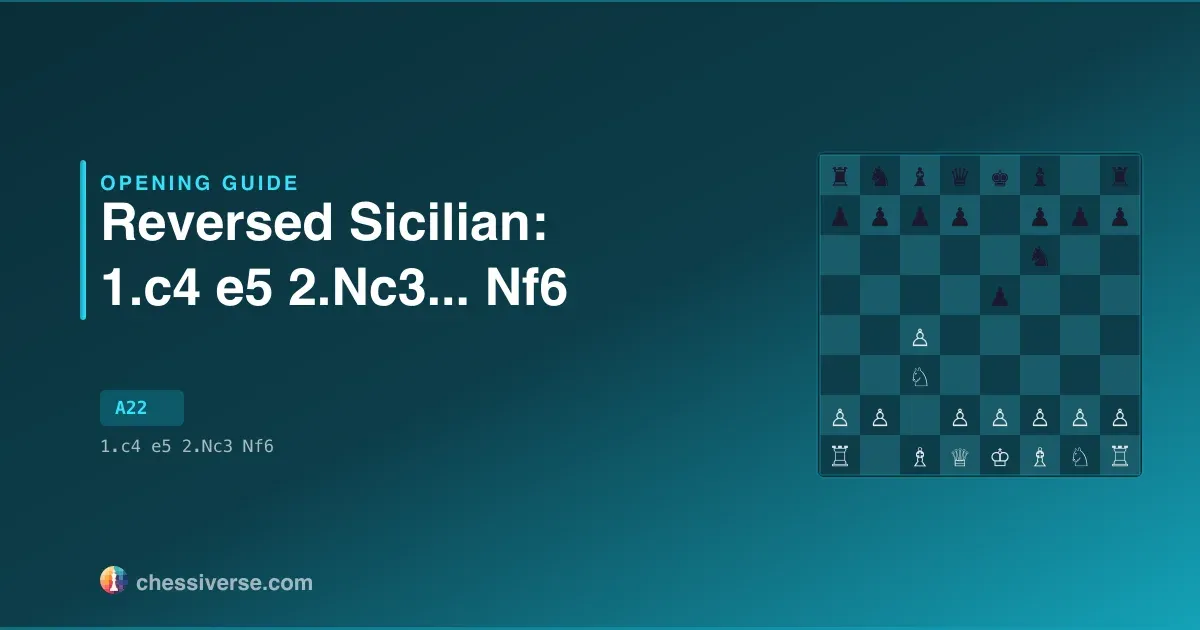
Starting from 1.c4 e5 2.Nc3 Nf6, players enter the English Opening: King's English Variation, Two Knights Variation — ECO A22. Black mirrors White's flexibility — both knights on natural squares, no central commitments yet. The whole game now turns on whether White heads for the English Four Knights or the slower Bremen System.
Strategic Overview
After 2...Nf6 White faces a real strategic choice. The natural move 3.Nf3 forces Black to defend the e5-pawn, and ...Nc6 leads straight into the English Four Knights — a structure where White typically fianchettos with g3 and Bg2, castles, and pressures d5 from distance while Black plays ...Bb4 to pin the c3-knight and threaten doubled pawns. The other path is the Bremen System with 3.g3 and 4.Bg2, where White develops the king's bishop before committing the knight. This has two real benefits: the Bg2 hits d5 immediately, and the king's knight can go to either f3 or e2 depending on what Black does. Black's main counter to the Bremen is the Keres Variation with ...c6, building a solid pawn structure that White has to undermine with d4 or e3-d4 plans. The character of the resulting middlegame depends heavily on which path is chosen. The Four Knights is more open and tactical; the Bremen is slower and more strategic. Both give White a slight initiative but neither claims a serious advantage — Black has good resources in both.
Key Ideas
When players succeed in this line, they usually do so by leaning on the following themes:
- 3.Nf3 leads to the English Four Knights — Forcing Black to defend e5 with ...Nc6 sets up the Four Knights structure. From there, White fianchettos and pressures d5 from distance while Black looks for ...Bb4 ideas.
- Bremen System keeps the knight flexible — 3.g3 prepares Bg2 before committing the king's knight. This lets White choose between Nf3 and Ne2 based on Black's setup, and keeps maximum pressure on d5.
- Keres Variation with ...c6 is Black's main weapon — Against the Bremen, ...c6 builds a sturdy pawn duo with ...d5 to follow. White has to undermine this structure with pawn breaks or accept that Black has equalized.
- The ...Bb4 pin matters in both setups — Pinning the c3-knight is a core Black idea — it weakens White's grip on d5 and threatens doubled pawns. White's piece coordination has to account for this idea throughout the opening.
History and Notable Players
It arises from the English Opening: King's English Variation, Reversed Sicilian. Among the most prolific White practitioners are Normunds Miezis (134 games), Wolfgang Uhlmann (120 games), Viktor Korchnoi (73 games). Black-side regulars include Oleg M Romanishin (62 games), Ivan Farago (62 games), Anatoly Karpov (53 games).
Performance Across Rating Levels
How well the English Opening: King's English Variation, Two Knights Variation works depends on what level you're playing at. Among 1200-rated players, it appears in 0.20% of games — 1,363,049 of them on record — with White winning 50.7% and Black 45.6%. By 1800, popularity is 0.34% and White's score is 51.4% to Black's 43.7%. At 2500, 0.39% of games go into this opening; draws sit at 9.7% — the line is well-mapped at this level. White's edge erodes by 3.8pp from 1200 to 2500 Elo, suggesting Black's counterplay is easier to find with experience.
Time Control Patterns
Look at the same opening across time controls and blitz stands out. In bullet, it appears in 0.17% of games (4,538,865); White wins 52.5%. Blitz shows 0.27% adoption across 9,774,282 games, White scoring 51.2%. In rapid, the share rises to 0.26% — 2,908,604 games, White 50.6%.
Move Diversity and Theory Depth
Looking at move selection shows how forcing — or not — the position really is. At 1200 Elo (1,363,049 games), the top reply is g3, played 34.2% of the time. Four other moves each take at least 5% of games, and the top three moves account for 68.2% of games. Entropy: 2.61. By 2500 (53,525 games), Nf3 takes over as the top reply at 61.9%; only one other move still reaches 5% and the top three moves account for 95.4% of games. Entropy drops to 1.40. The narrowing is significant — strong players consolidate around a small set of best moves, while amateurs scatter across many plausible-looking options.
Historical Trends
Long-term, the trajectory of this opening is informative. Adoption peaked in 2020 at 0.31% (1,789,775 games). By 2025 it sits at 0.25%, 21% below the peak and roughly back to its 2013 level, leaving the line flat over the full period.
Main Lines and Variations
After 1.c4 e5 2.Nc3 Nf6, the established follow-ups are:
- English Opening: King's English Variation, Two Knights Variation, Keres Variation
- English Opening: King's English Variation, Two Knights Variation, Fianchetto Line
Each branch leads to a different middlegame character — the resulting pawn structure decides what kind of game you get.
Common Mistakes
- Drifting away from main theory — At 400 Elo, the three most-played moves cover 68.1% of games, against 81% at 2000. The most popular deviation is e4 (played 19.5% of the time at 400, less so up top). It looks fine but quietly hands the better-prepared side an edge.
- Neglecting development — It can feel productive to make extra pawn moves early, but falling behind in piece development is what loses most amateur games — especially in open positions where active pieces find squares fast.
- Ignoring the kingside attack — In sharp Sicilian lines, White typically castles long and pushes the h-pawn. Without your own counterplay on the queenside or in the centre, White's attack lands first.
Practice on Chessiverse
Ready to try the English Opening: King's English Variation, Two Knights Variation against a bot? Pick an opponent at your level and play a game.