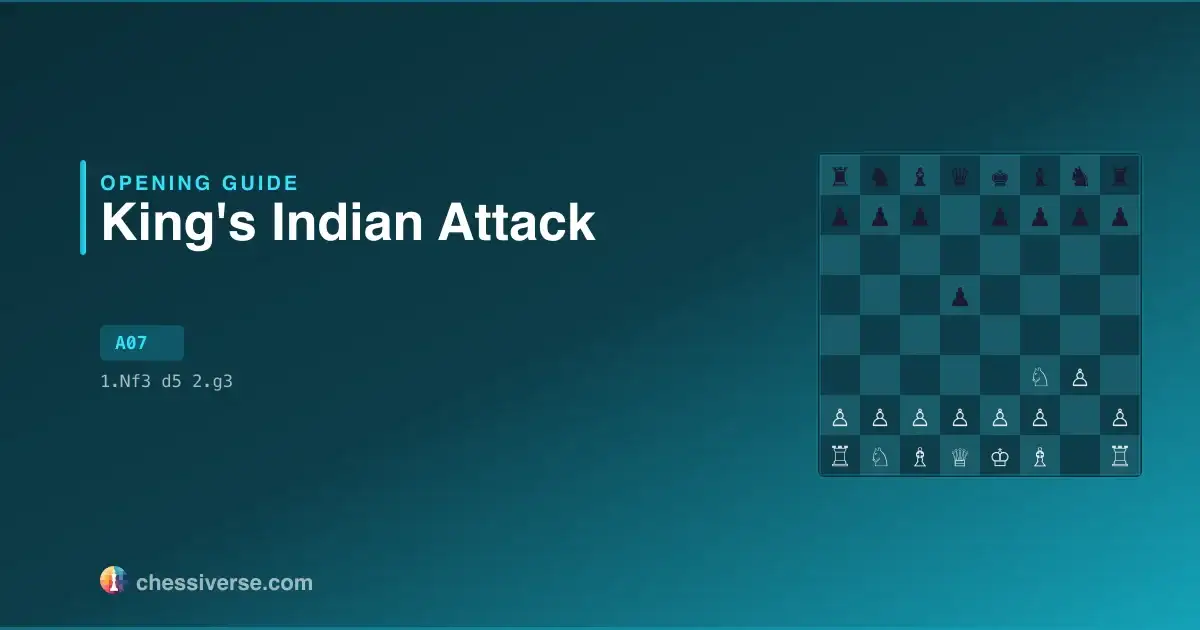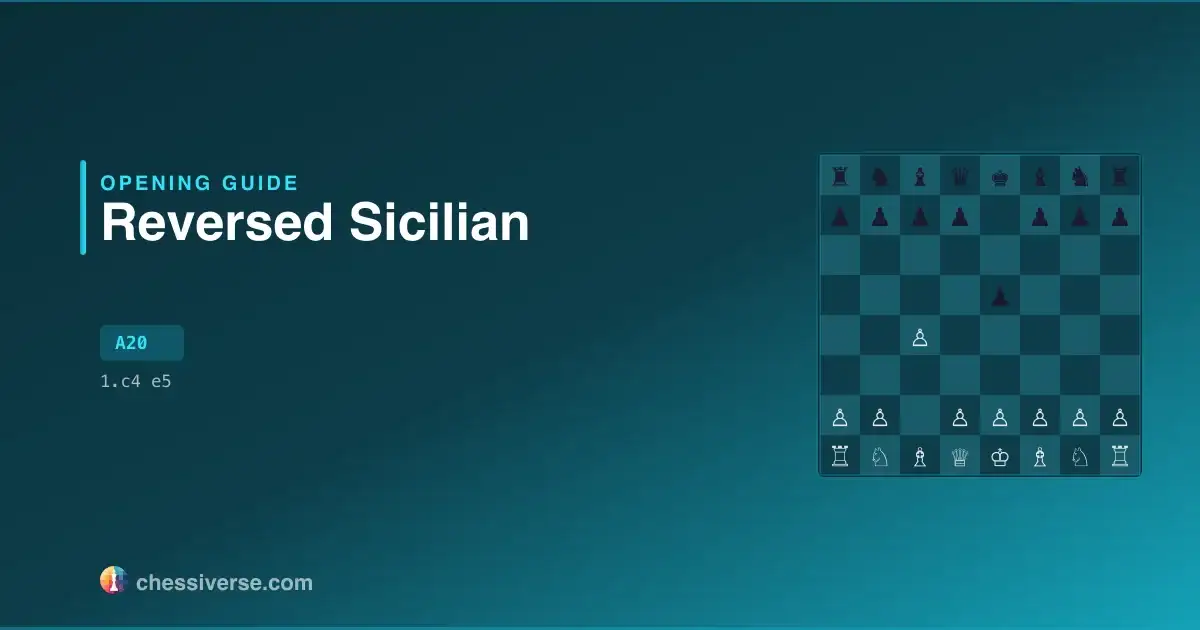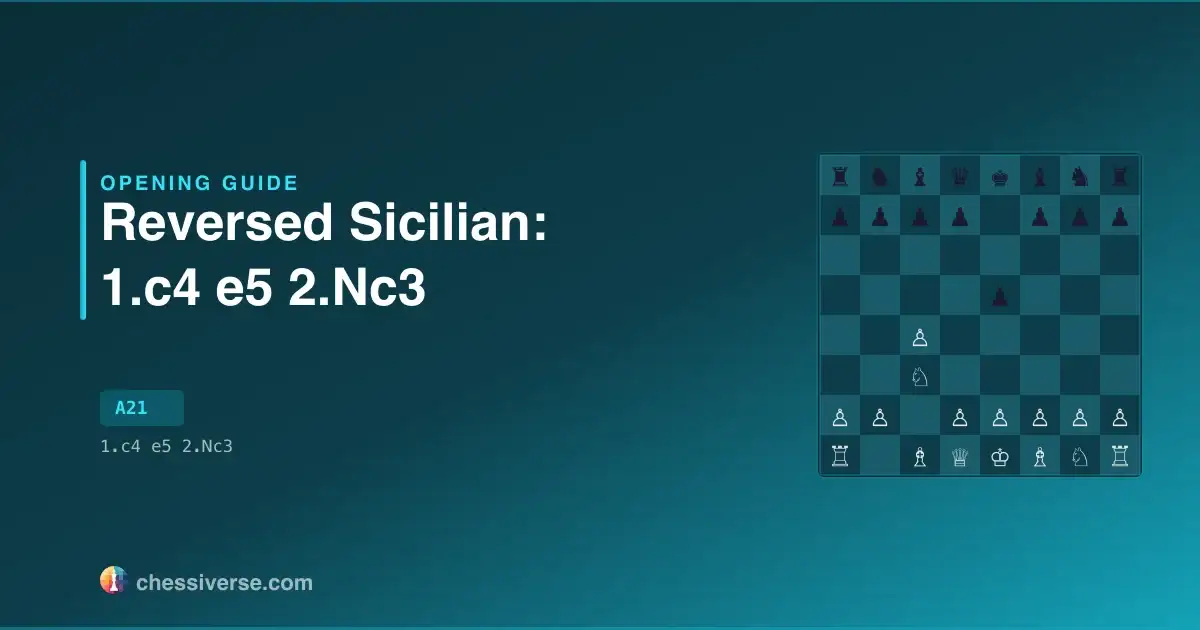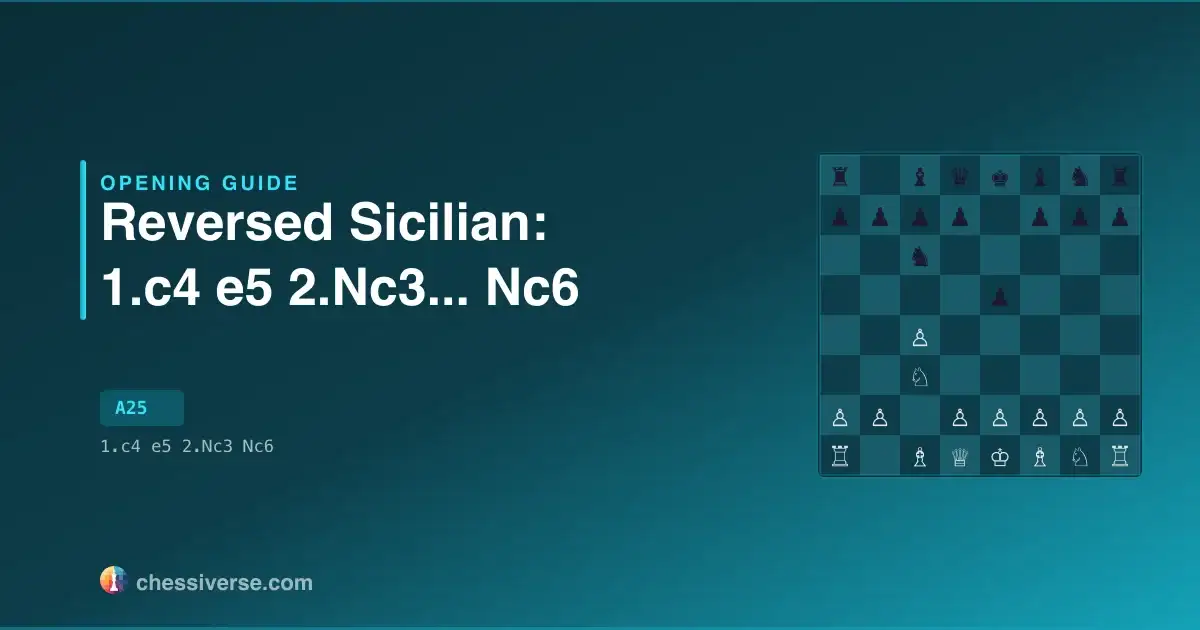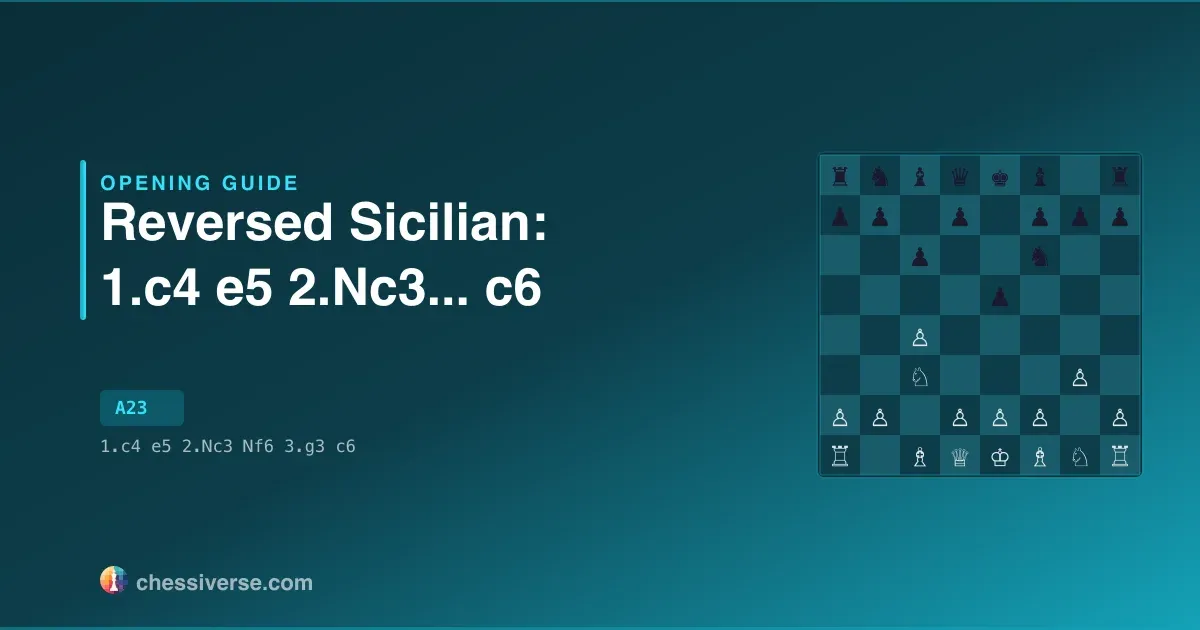
1.c4 e5 2.Nc3 Nf6 3.g3 c6 opens the English Opening: King's English Variation, Two Knights Variation, Keres Variation, ECO A23. Black plays the Keres Variation — solid, principled, and built around the ...d5 break. The c6-pawn supports a future ...d5 push while denying White's pieces the natural square.
Strategic Overview
3...c6 is the Keres Variation, a structural reply to the Bremen System. The idea is simple: prepare ...d5 with full pawn support and turn the position into a Black version of the Slav. Once Black gets ...d5 in, White's fianchettoed bishop on g2 has less work to do because the d5-pawn blocks the long diagonal. White's main task now is to find a way to undermine the c6-d5 pawn duo before it becomes permanent. Options include cxd5 followed by Nf3 and d3 to pressure e5, or e3 and d4 to challenge the center from underneath. Black's setup is comfortable and hard to break — ...Bg4 or ...Bf5 develops the light-squared bishop actively before ...e6 ever locks it in, and ...Nbd7 or ...Na6 finishes piece development. The middlegame typically becomes a slow positional battle around the c-file and the d5-square. White has a slight space advantage but no real targets; Black has a solid structure with active pieces. It's the kind of opening where understanding matters more than memorization — both sides need to know what they're aiming for.
Key Ideas
The recurring motifs below distinguish a confident handler of this opening from a beginner:
- Prepare ...d5 with full support — The c6-pawn backs up an eventual ...d5 push. Once Black gets ...d5 in safely, the structure becomes a Slav-style fortress that's very hard to crack.
- Neutralize the Bg2 bishop — Once ...d5 lands, White's fianchettoed bishop has limited scope. That's the structural goal of the Keres setup — make White's best piece look ordinary.
- White's main lever is cxd5 or e3-d4 — Undermining the c6-d5 pawn duo is essential. Either trade on d5 to open the c-file, or build a kingside structure with d4 to challenge the center from below.
- Develop the light-squared bishop early — Before locking it in with ...e6, get the c8-bishop to f5 or g4. That's the piece that suffers most if you delay; everything else has natural squares.
History and Notable Players
It arises from the English Opening: King's English Variation, Two Knights Variation. On the White side, Normunds Miezis (17 games), Mark E Taimanov (7 games), Georg Schuler (6 games) top the database. Notable Black exponents: Paul Keres (13 games), Peter Rahls (8 games), Alexander Raetsky (8 games).
Performance Across Rating Levels
The picture changes a lot as you climb the rating ladder. At 1200 Elo, the opening shows up in 0.01% of games (51,514 samples). White scores 50.1%, Black 46.5%, draws 3.4%. Move up to 1800 Elo and the share shifts to 0.03%, with White winning 50.2% versus Black's 44.7%. At 2500, 0.03% of games go into this opening; draws sit at 10% — the line is well-mapped at this level. White's edge erodes by 6.9pp from 1200 to 2500 Elo, suggesting Black's counterplay is easier to find with experience.
Time Control Patterns
Look at the same opening across time controls and blitz stands out. In bullet, it appears in 0.01% of games (221,023); White wins 50.8%. Blitz shows 0.02% adoption across 593,008 games, White scoring 50%. In rapid, the share rises to 0.02% — 177,545 games, White 49.6%.
Move Diversity and Theory Depth
Looking at move selection shows how forcing — or not — the position really is. At 1200 Elo (51,514 games), the top reply is Bg2, played 87.2% of the time. No other move reaches 5% of games, and the top three moves account for 93.9% of games. Entropy: 0.89. By 2500 (3,444 games), Nf3 takes over as the top reply at 36.9%; two other moves reach 5% and the top three moves account for 97.7% of games. Entropy rises to 1.74. Even elite players don't fully agree on the best continuation here, which keeps the position dynamic.
Historical Trends
Long-term, the trajectory of this opening is informative. Adoption peaked in 2020 at 0.0173% (99,164 games). By 2025 it sits at 0.0170%, 2% below the peak but still 70% above its 2013 level, so the line is up over the full period despite easing from the high.
Common Mistakes
- Neglecting development — Extra pawn moves in the opening are tempting, especially when you "know the moves". Developing a piece each turn is the simple correction.
- Ignoring the kingside attack — In sharp Sicilian lines, White typically castles long and pushes the h-pawn. Without your own counterplay on the queenside or in the centre, White's attack lands first.
Practice on Chessiverse
Ready to try the English Opening: King's English Variation, Two Knights Variation, Keres Variation against a bot? Pick an opponent at your level and play a game.