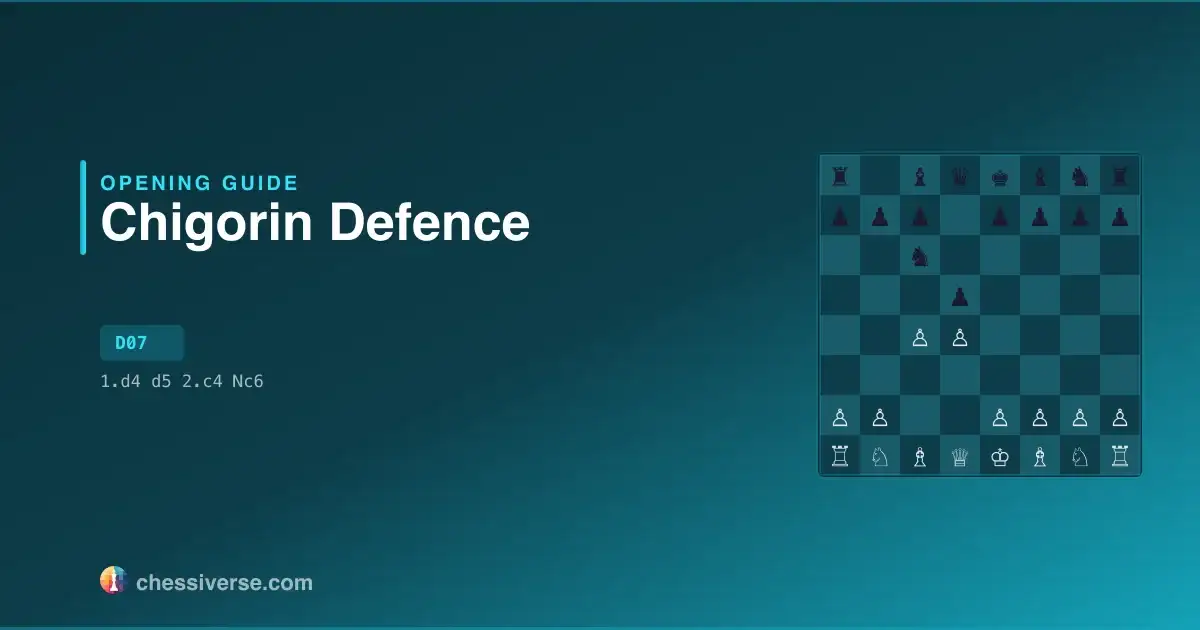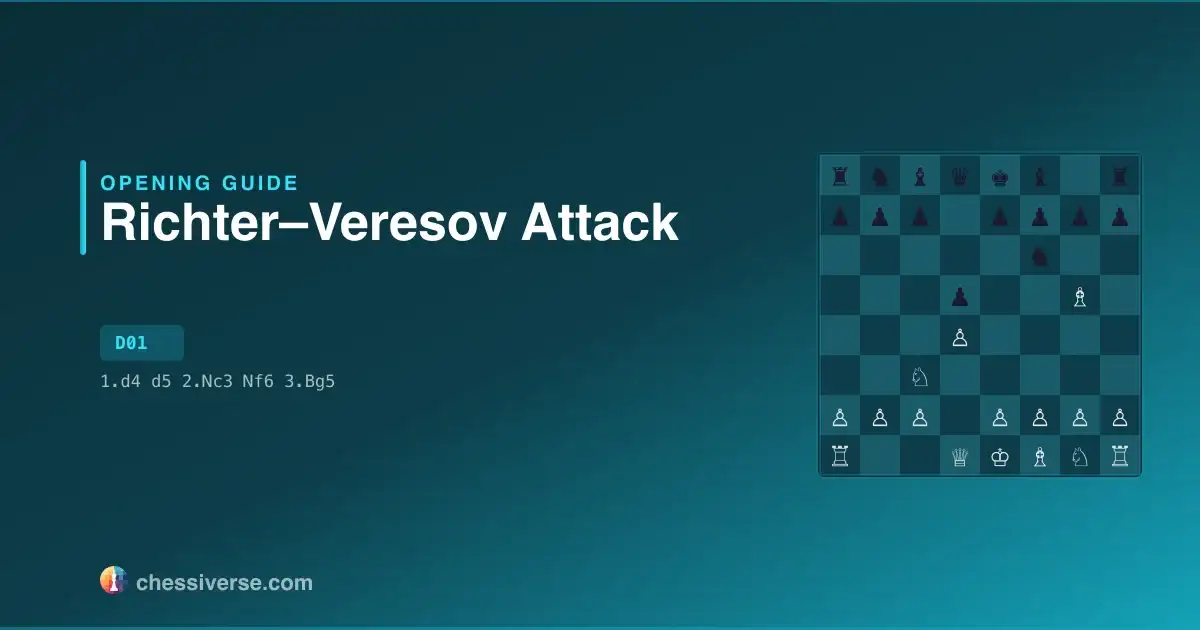




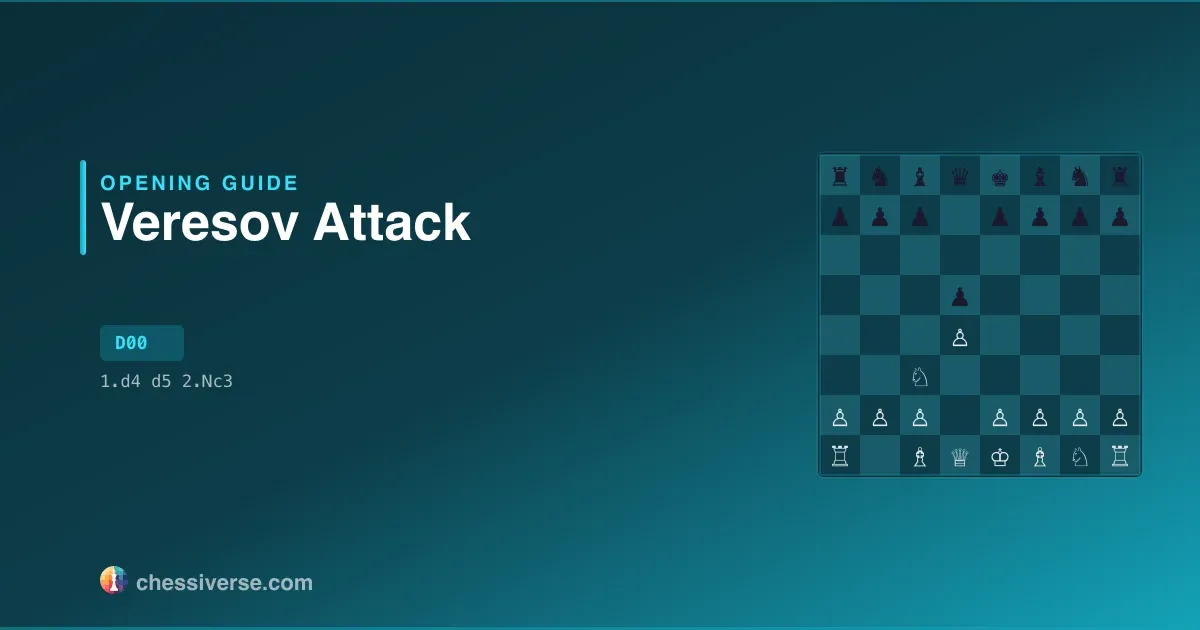
The Veresov Attack arises after 1.d4 d5 2.Nc3 and falls under ECO code D00. Named after Mikhail Chigorin, this opening is transpositional in nature and relatively uncommon at the highest levels, since the knight on c3 blocks the c-pawn from challenging Black's d5 pawn. Despite this, the system is considered sound and tends to produce closed positions with slow, strategic maneuvering. The principal continuations are 2...Nf6 3. Bf4, entering the Jobava London System, and 2...Nf6 3. Bg5, the Richter-Veresov Attack, which can transpose into the French Defense after 3...e6 or remain in independent territory after 3...Nbd7. Black has a wide range of alternatives: 2...e6 (usually leading to the same lines), 2...c6 (often transposing to the Caro-Kann after 3. e4), 2...g6, 2...Bf5, and more adventurous tries such as 2...f5!? (the Dutch Variation), 2...c5!? (the relatively unexplored Irish Gambit), or the unclear 2...e5!? (the Shaviliuk Gambit). After 2...Nc6 3. e4, the position transposes into the Nimzowitsch Defense. With 41.3 million Lichess games across all rating levels, it is one of the most popular openings.
- White often aims for quick queenside castling backed by f3 and e4, building a big pawn center before launching an attack.
- A key decision is whether to take on f6 to damage Black's pawn structure (Veresov's treatment) or keep the bishop and push f3 (Richter's treatment).
- The setup mirrors the Ruy Lopez on the queenside, but the resulting play is completely different.
History and Notable Players
It arises from the Queen's Pawn Systems (1...d5). Among the most prolific practitioners on the White side are Aleksey Dreev (417 games), Loek Van Wely (394 games), Ivan Farago (388 games). On the Black side, notable exponents include Aleksey Dreev (540 games), Oleg Korneev (437 games), Alexei Shirov (414 games).
The opening goes back to a Marshall-Wolf game at Monte Carlo 1902. Tartakower treated it as a closed maneuvering system in the 1920s, Kurt Richter scored dazzling attacking wins with it in the 1930s, and Gavriil Veresov deepened its theory from World War II into the 1960s. It has never been common at the top level, though many elite players have tried it.
Named after: German IM Kurt Richter and Soviet master Gavriil Veresov, who employed the opening regularly for more than 25 years.
Notable players: Gavriil Veresov, Kurt Richter, Savielly Tartakower, Alexander Morozevich
The opening looks like a Ruy Lopez reflected onto the other wing, yet plays nothing like one - and grandmasters as strong as Spassky, Tal, Smyslov and Karpov have all given it an occasional outing.
Statistics
Based on 41.3 million Lichess games across all rating levels:
- White wins: 49.2%
- Black wins: 46.3%
- Draws: 4.5%
The statistics show a roughly balanced opening where both sides have equal chances.
Main Lines and Variations
After 1.d4 d5 2.Nc3, the main continuations include:
Each of these lines leads to distinct types of positions and requires its own understanding of the resulting pawn structures and piece placements.
Practice on Chessiverse
The best way to learn the Veresov Attack is through practice. On Chessiverse, you can play chess against computer opponents that specialize in this opening. Our AI bots range from beginner to grandmaster level, each with unique playing styles — from aggressive attackers to solid defenders. Choose a bot that matches your rating and work your way up as you master the opening's key ideas.
Performance Across Rating Levels
Popularity and results vary sharply by rating level. The 1200 bracket has 8,003,383 games (1.19% of all games at that level); White wins 49.1%, Black 46.8%, 4.1% are drawn. Move up to 1800 Elo and the share shifts to 0.52%, with White winning 50.2% versus Black's 45.2%. At the top end (2500+ Elo), popularity is 0.53% with 8.9% draws — a clear sign of how much theory rules the line at master level.
Time Control Patterns
Time control matters here: rapid players reach for this opening more than others. In bullet, it appears in 0.59% of games (15,555,292); White wins 51.7%. Blitz shows 0.80% adoption across 28,752,535 games, White scoring 49.7%. In rapid, the share rises to 1.13% — 12,555,994 games, White 48.2%. White's score swings 3.5pp across formats, so time control isn't just a stylistic choice here — it shifts the actual results.
Move Diversity and Theory Depth
Move choice is far from uniform in the Veresov Attack. At 1200 Elo (8,003,383 games), the top reply is Nf6, played 46.7% of the time. Four other moves each take at least 5% of games, and the top three moves account for 80.7% of games. Entropy: 2.28. By 2500 (72,448 games), Nf6 dominates at 55% of replies; only three other moves still reach 5% and the top three moves account for 85.7% of games. Entropy drops to 2.04.
Historical Trends
Long-term, the trajectory of this opening is informative. Adoption peaked in 2013 at 1.10% (31,790 games). By 2025 it sits at 1.02%, down 7% from that high, leaving the line flat.