



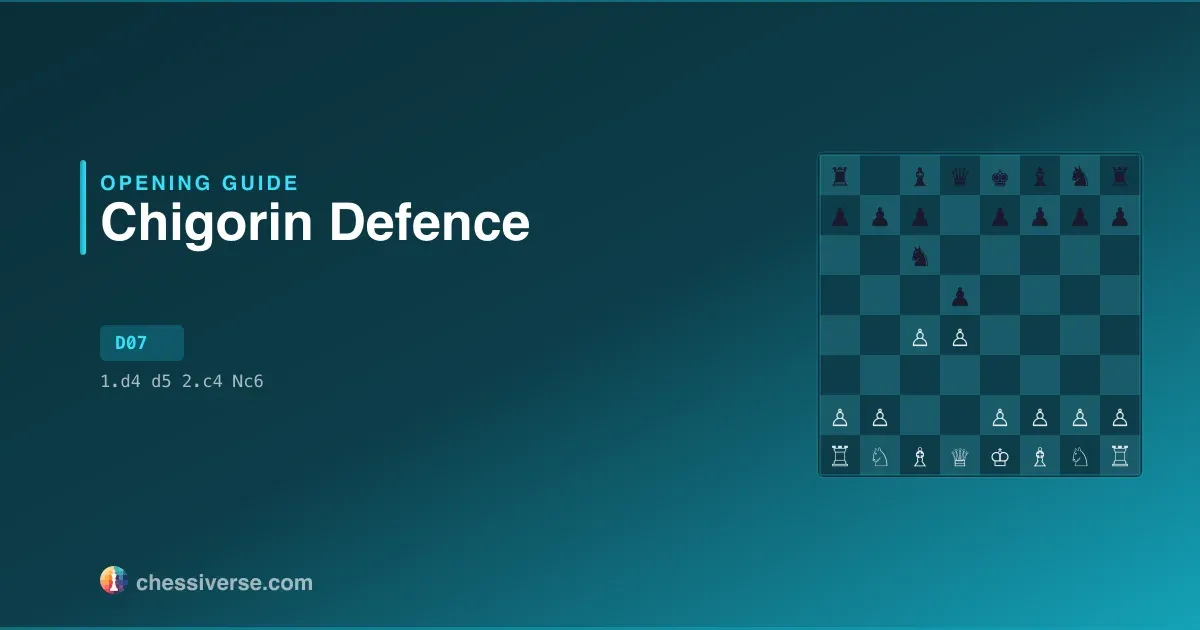
The Chigorin Defense begins with 1.d4 d5 2.c4 Nc6 (ECO D07). Black ignores everything classical chess teaches you and develops a knight to c6 instead of defending d5. The point: trade pieces for pawns, knights for bishops, and outplay your opponent in the unbalanced middlegame.
Strategic Overview
The Chigorin is a defiant defence to the Queen's Gambit that throws classical pawn-structure wisdom out the window. Instead of defending d5 with ...e6 or ...c6 (the standard Queen's Gambit Declined and Slav approaches), Black develops the queen's knight to c6 and accepts that d5 will eventually fall or be traded. In return Black gets fast piece play, the bishop pair after typical Bf4 sequences, and an unbalanced game where understanding outweighs memorisation. The knight on c6 looks awkward because it blocks the c-pawn, but Chigorin's whole point is that the knight is doing useful work — supporting e5 ideas, pressuring d4, and contesting central squares with pieces rather than pawns. Black often ends up with doubled pawns or strange pawn structures, but the bishop pair and active piece play provide concrete compensation. Recent years have seen renewed interest because of crossovers with the Black Knights' Tango, where similar piece-placement ideas can transpose into Chigorin-style positions. It's not a defence for everyone — you have to be comfortable with off-beat structures and dynamic piece play — but it's a perfectly respectable choice that scores well in practice against opponents who haven't studied it.
Key Ideas
When players succeed in this line, they usually do so by leaning on the following themes:
- Pieces over pawns — The whole opening rejects the Queen's Gambit's classical pawn-chain debate. Black says: I'll take the bishop pair and active pieces, you take the better pawn structure, and we'll see whose chess understanding is sharper.
- ...Nc6 supports e5 ideas — The knight on c6 may block the c-pawn but it does real work in the centre — controlling d4 and e5, and preparing piece-driven plans rather than the standard ...c6/...c5 pawn moves of other Queen's Gambit lines.
- Theory has grown via the Black Knights' Tango — Modern engagement with the Chigorin has expanded because positions arising from 1...Nf6 and 2...Nc6 (the Tango) can transpose into Chigorin structures. The cross-pollination has produced new playable lines and revived old ones.
History and Notable Players
It arises from the Queen's Gambit. On the White side, Vladimir Epishin (11 games), Glenn C Flear (10 games), Felix Levin (9 games) top the database. Notable Black exponents: Igor Miladinovic (104 games), Gergely Antal (43 games), Ilja Zaragatski (43 games).
An offbeat reply to the Queen's Gambit that breaks classical rules: Black gives up the d5 strongpoint and blocks the c-pawn in exchange for fast piece play. Vasily Smyslov used it to hold Garry Kasparov to a draw in the 1980s, and Alexander Morozevich later became almost its only regular grandmaster advocate.
Named after: Named for the 19th-century Russian master Mikhail Chigorin.
Notable players: Mikhail Chigorin, Vasily Smyslov, Alexander Morozevich
Alexander Morozevich, called perhaps the only modern grandmaster to play the Chigorin regularly, has published a book on it offering both a theoretical and a personal view.
Performance Across Rating Levels
Popularity and results vary sharply by rating level. The 1200 bracket has 926,082 games (0.14% of all games at that level); White wins 54.5%, Black 41.9%, 3.6% are drawn. At 1800 the opening surfaces in 0.13% of games; White wins 52.7%, Black 42.7%, draws 4.6%. Among 2500-rated players the line appears in 0.13% of games and draws spike to 10%, indicating tight preparation. White's edge erodes by 6.2pp from 1200 to 2500 Elo, suggesting Black's counterplay is easier to find with experience.
Time Control Patterns
Look at the same opening across time controls and bullet stands out. In bullet, it appears in 0.24% of games (6,349,490); White wins 53%. Blitz shows 0.14% adoption across 5,131,970 games, White scoring 52.9%. In rapid, the share rises to 0.10% — 1,055,890 games, White 55.7%. White's score swings 2.8pp across formats, so time control isn't just a stylistic choice here — it shifts the actual results.
Move Diversity and Theory Depth
Move choice is far from uniform in the Chigorin Defense. At 1200 Elo (926,082 games), the top reply is Nc3, played 32.7% of the time. Three other moves each take at least 5% of games, and the top three moves account for 76% of games. Entropy: 2.36. By 2500 (18,156 games), Nf3 takes over as the top reply at 36.1%; three other moves reach 5% and the top three moves account for 91.5% of games. Entropy drops to 1.92.
Historical Trends
Year-over-year data tells you whether this opening is a contemporary fixture or a fading one. Adoption peaked in 2015 at 0.15% (32,713 games). By 2025 it sits at 0.13%, 14% below the peak and roughly back to its 2013 level, leaving the line flat over the full period.
Common Mistakes
- Drifting away from main theory — At 400 Elo, the three most-played moves cover 70.6% of games, against 86.8% at 2000. The most popular deviation is e3 (played 18.7% of the time at 400, less so up top). It looks fine but quietly hands the better-prepared side an edge.
- Neglecting development — Extra pawn moves in the opening are tempting, especially when you "know the moves". Developing a piece each turn is the simple correction.
- Playing without a plan — Each Chigorin Defense middlegame demands a specific approach. Decide whether the position calls for attack, manoeuvre, or simplification before reaching for a move.
Practice on Chessiverse
Ready to try the Chigorin Defense against a bot? Pick an opponent at your level and play a game.