



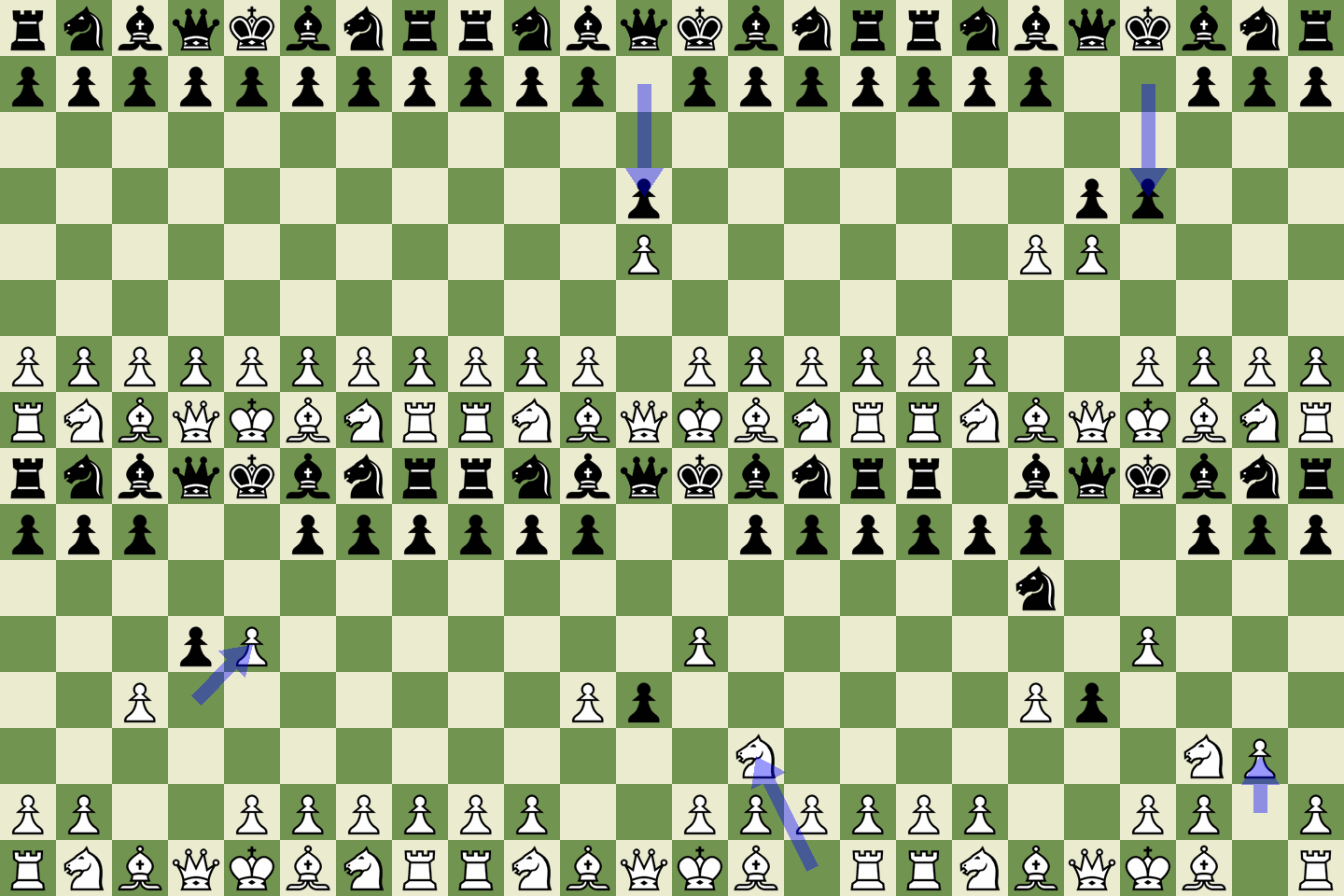
1.d4 d5 2.c4 e5 3.dxe5 d4 4.Nf3 Nc6 5.g3 opens the Queen's Gambit Declined: Albin Countergambit, Fianchetto Variation, ECO D09. Lichess records 400,796 games in this line, which gives us a reliable view of how it actually performs in practice.
History and Notable Players
It arises from the Albin Countergambit. On the White side, Jukka Johansson (4 games), Aleksey Dreev (4 games), Milos Kozak (4 games) top the database. Notable Black exponents: Maxim Chetverik (14 games), Alexander Reprintsev (9 games), Alexander Morozevich (8 games).
Performance Across Rating Levels
The picture changes a lot as you climb the rating ladder. Among 1200-rated players, it appears in 0.00% of games — 6,074 of them on record — with White winning 55.6% and Black 41.4%. Move up to 1800 Elo and the share shifts to 0.01%, with White winning 54.6% versus Black's 40.8%. At the top end (2500+ Elo), popularity is 0.03% with 9.3% draws — a clear sign of how much theory rules the line at master level. White's edge erodes by 5.3pp from 1200 to 2500 Elo, suggesting Black's counterplay is easier to find with experience.
Move Diversity and Theory Depth
What players actually play after the opening moves depends heavily on rating. At 1200 Elo (6,074 games), the top reply is Bg4, played 33.8% of the time. Six other moves each take at least 5% of games, and the top three moves account for 65.5% of games. Entropy: 2.71. By 2500 (3,849 games), Nge7 takes over as the top reply at 40.4%; only two other moves still reach 5% and the top three moves account for 90.5% of games. Entropy drops to 2.03. The narrowing is significant — strong players consolidate around a small set of best moves, while amateurs scatter across many plausible-looking options.
Historical Trends
Tracking the Queen's Gambit Declined: Albin Countergambit, Fianchetto Variation year over year shows a clear story. Adoption peaked in 2015 at 0.015% (3,237 games). By 2025 it sits at 0.007%, 52% below the peak and 28% under its 2013 level, leaving the line in decline.
Common Mistakes
- Drifting away from main theory — At 400 Elo, the three most-played moves cover 53.9% of games, against 81.6% at 2000. The most popular deviation is Bc5 (played 14.8% of the time at 400, much less so up top). It looks fine but quietly hands the better-prepared side an edge.
- Neglecting development — Extra pawn moves in the opening are tempting, especially when you "know the moves". Developing a piece each turn is the simple correction.
- Overextending the attack — Gambits look like permission to throw everything forward. They aren't — every attacking move should improve a piece. Random checks and threats burn the initiative once they fail to coordinate.
Practice on Chessiverse
Ready to try the Queen's Gambit Declined: Albin Countergambit, Fianchetto Variation against a bot? Pick an opponent at your level and play a game.