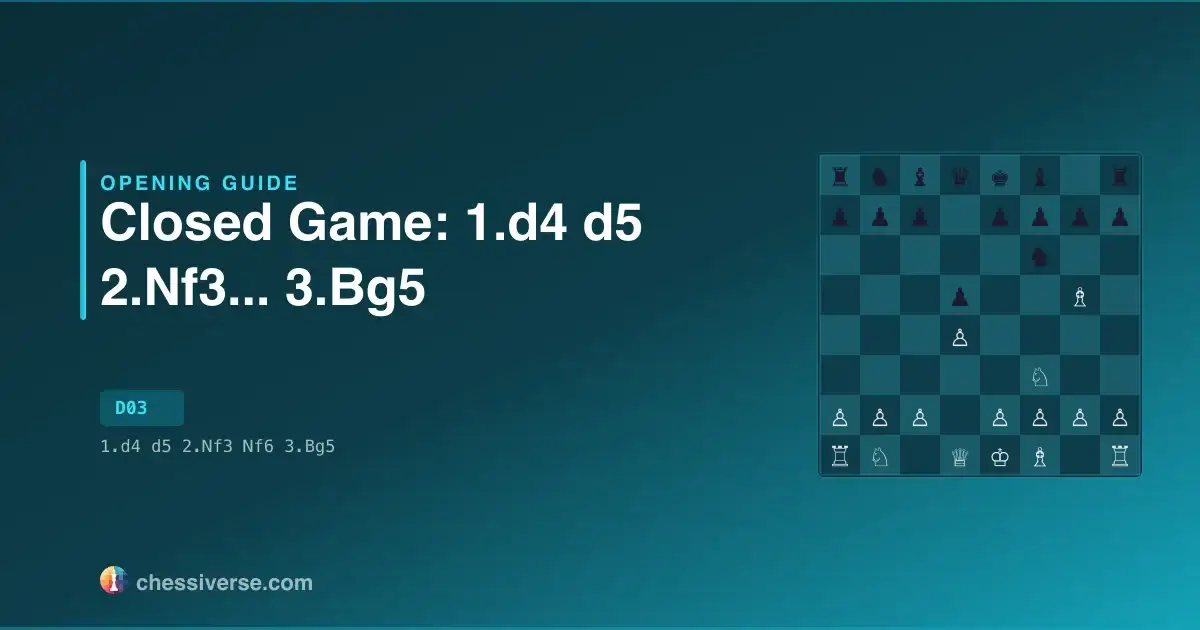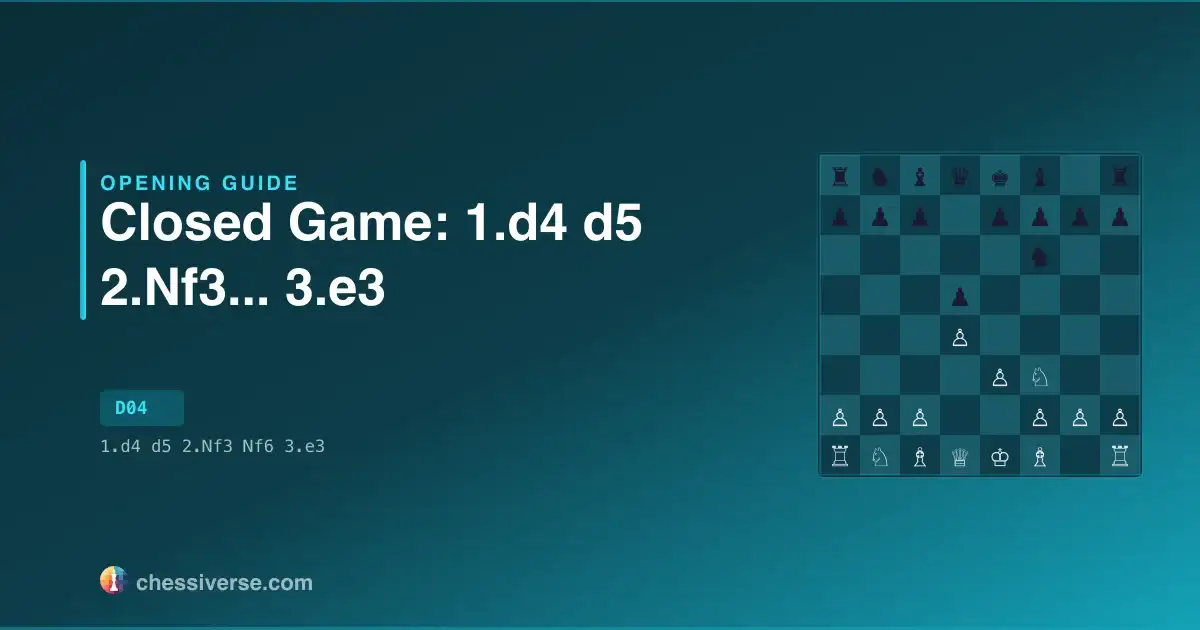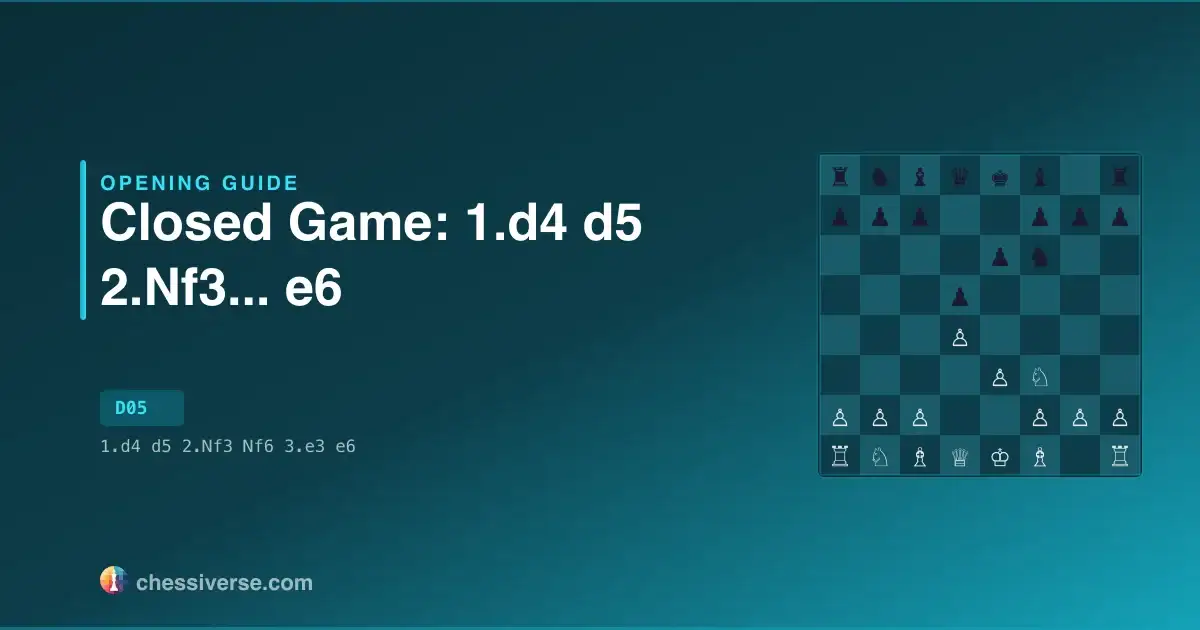




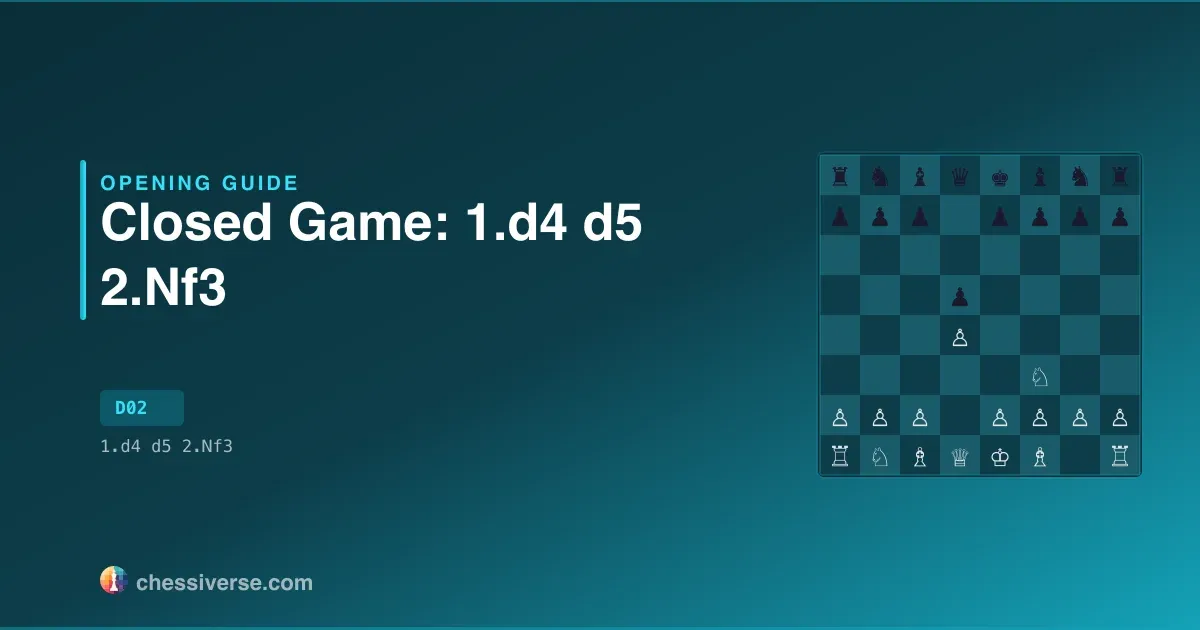
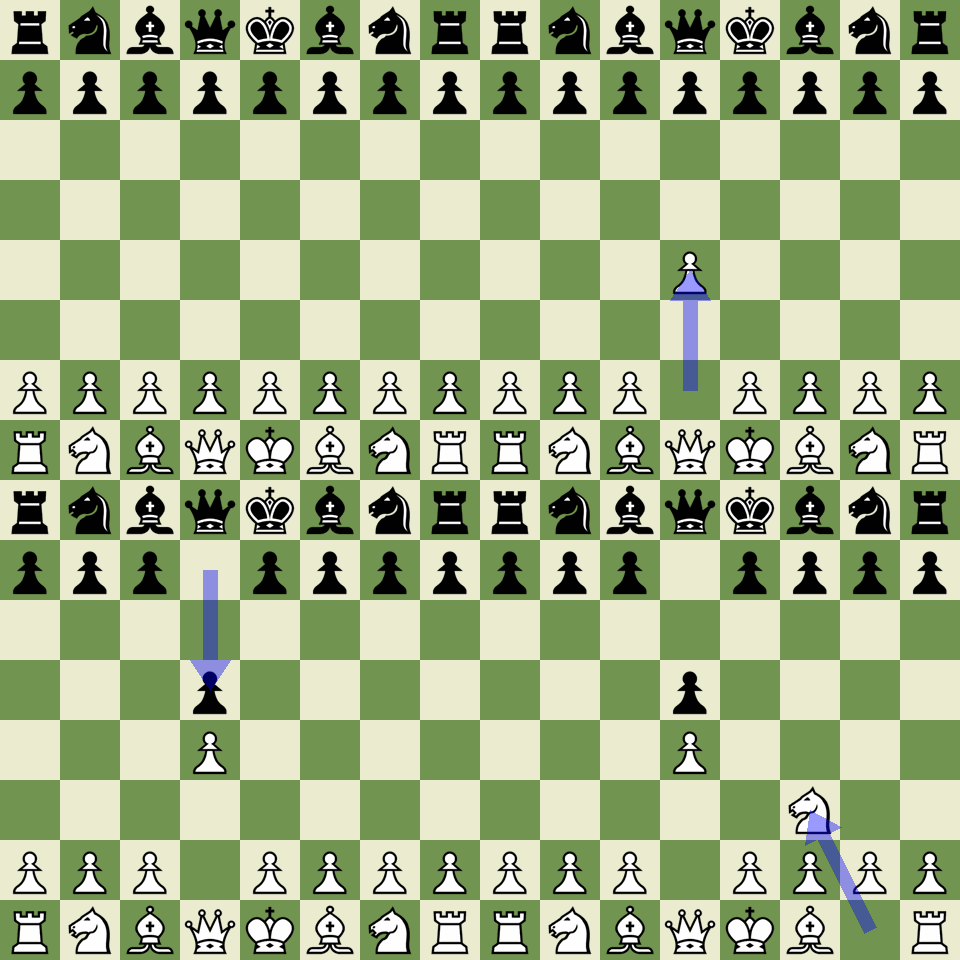
The Queen's Pawn Game: Zukertort Variation arises after 1.d4 d5 2.Nf3 and falls under ECO code D02. This versatile developing move keeps White's options open. It most commonly transposes into a Queen's Gambit, but also serves as a gateway to the Colle System, a solid setup that aims for an e2-e4 pawn break and can produce more aggressive positions than typical d4 lines. Black has multiple development schemes available, with 2...Nf6 being the most popular choice thanks to its own flexibility. With 105.6 million Lichess games across all rating levels, it is one of the most popular openings.
History and Notable Players
It arises from the Queen's Pawn Systems (1...d5). Among the most prolific practitioners on the White side are Pia Cramling (248 games), Ulf Andersson (182 games), Michal Krasenkow (154 games). On the Black side, notable exponents include Oleg Korneev (118 games), Jonny Hector (111 games), Zoltan Varga (103 games).
Statistics
Based on 105.6 million Lichess games across all rating levels:
- White wins: 50.9%
- Black wins: 44.1%
- Draws: 5%
White holds a moderate edge statistically, though Black has good practical chances.
Main Lines and Variations
After 1.d4 d5 2.Nf3, the main continuations include:
Each of these lines leads to distinct types of positions and requires its own understanding of the resulting pawn structures and piece placements.
Practice on Chessiverse
The best way to learn the Queen's Pawn Game: Zukertort Variation is through practice. On Chessiverse, you can play chess against computer opponents that specialize in this opening. Our AI bots range from beginner to grandmaster level, each with unique playing styles — from aggressive attackers to solid defenders. Choose a bot that matches your rating and work your way up as you master the opening's key ideas.
Performance Across Rating Levels
How well the Queen's Pawn Game: Zukertort Variation works depends on what level you're playing at. The 1200 bracket has 14,258,055 games (2.11% of all games at that level); White wins 50.9%, Black 45%, 4.1% are drawn. At 1800 the opening surfaces in 2.36% of games; White wins 51.5%, Black 43.2%, draws 5.4%. At the top end (2500+ Elo), popularity is 2.91% with 11.7% draws — a clear sign of how much theory rules the line at master level. White's edge erodes by 4.1pp from 1200 to 2500 Elo, suggesting Black's counterplay is easier to find with experience.
Time Control Patterns
Time control matters here: blitz players reach for this opening more than others. In bullet, it appears in 2.10% of games (55,768,485); White wins 52.4%. Blitz shows 2.29% adoption across 82,461,129 games, White scoring 51%. In rapid, the share rises to 2.09% — 23,163,406 games, White 50.6%.
Move Diversity and Theory Depth
Move choice is far from uniform in the Queen's Pawn Game: Zukertort Variation. At 1200 Elo (14,258,055 games), the top reply is Nc6, played 35% of the time. Four other moves each take at least 5% of games, and the top three moves account for 70.8% of games. Entropy: 2.69. By 2500 (397,497 games), Nf6 takes over as the top reply at 62.3%; only three other moves still reach 5% and the top three moves account for 86.9% of games. Entropy drops to 1.82. The narrowing is significant — strong players consolidate around a small set of best moves, while amateurs scatter across many plausible-looking options.