

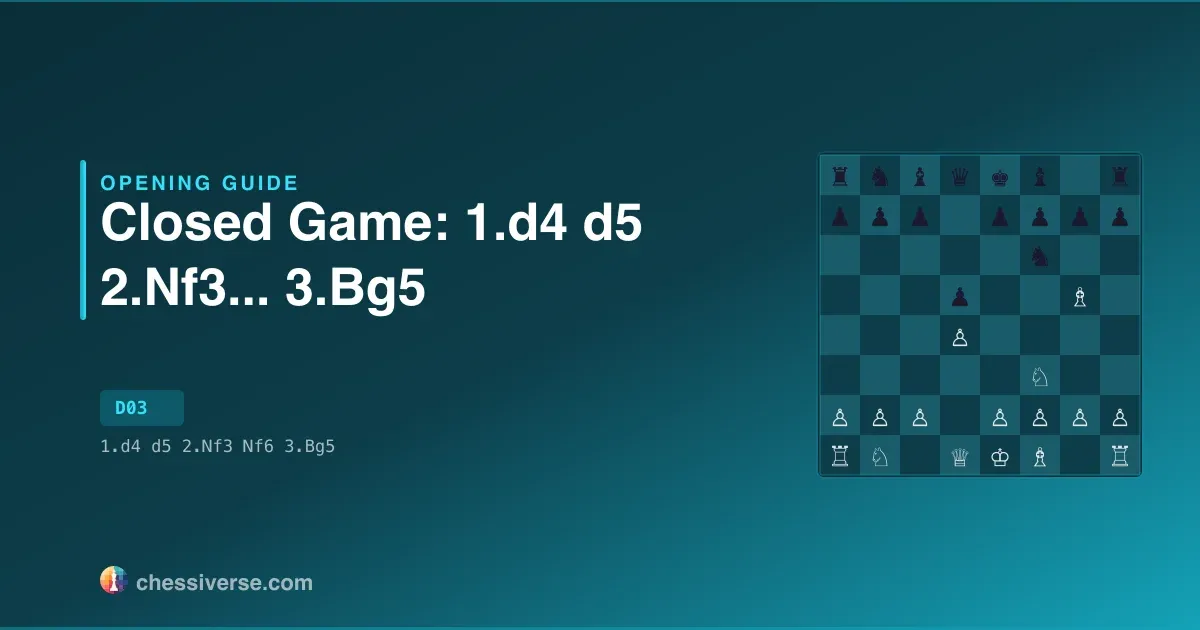
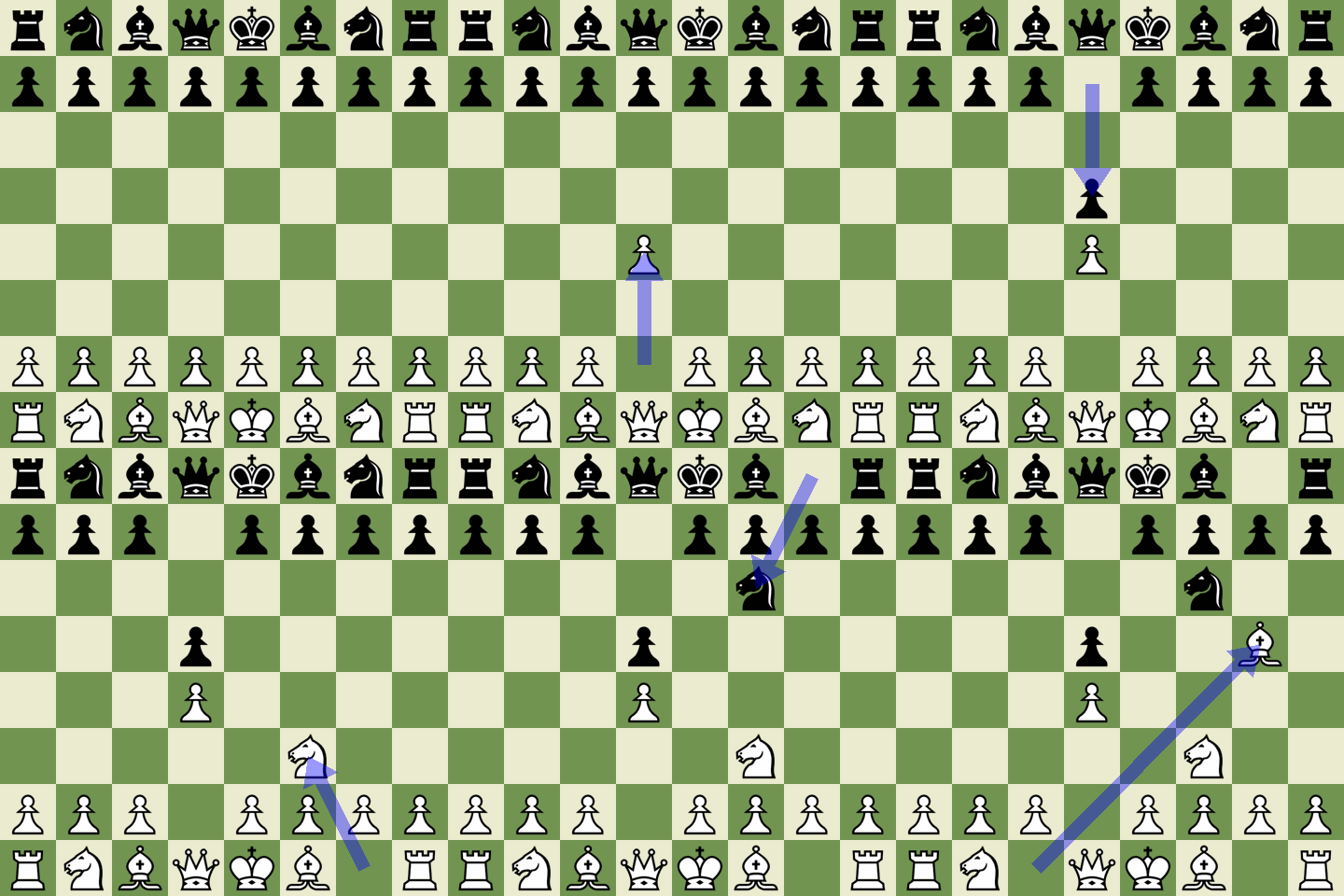
Starting from 1.d4 d5 2.Nf3 Nf6 3.Bg5, players enter the Queen's Pawn Game: Torre Attack — ECO D03. The Torre Attack is the d-pawn surprise weapon — Bg5 on move three with no c4 in sight. It promises a quiet life but punishes any inaccuracy on Black's part with a sharp kingside attack.
Strategic Overview
The Torre is a system opening for White: Nf3, Bg5, e3, c3, Nbd2, Bd3, and either O-O or slow build-up. The defining feature is the early bishop on g5 pinning Black's f6-knight without the supporting c4 push that turns this into a Queen's Gambit. By skipping c4, White accepts that the central tension is less intense, but gains a couple of practical advantages: simpler theory, attacking targets on the kingside if Black plays passively, and the ability to deploy any d-pawn structure the position calls for. Against ...e6 setups, White often gets exactly what they want — a kingside attack with classic patterns like Ne5, f4, and a queen lift. Black's sharper option ...c5 is the modern preferred reply because it challenges the centre directly and refuses to play into White's slow build-up. At grandmaster level the Torre is judged to give White equality at best, which is why it's mostly a surprise weapon. At club level it scores well precisely because it sidesteps deep theory and rewards understanding of typical attacking patterns over memorisation.
Key Ideas
A few ideas come up again and again in this opening:
- It's a system, not a theoretical line — White plays the same set-up regardless of what Black does: Nf3, Bg5, e3, Nbd2, Bd3. The whole point is that you don't have to learn what to do on move 12 — you have to learn what your pieces are supposed to do.
- Skipping c4 trades centre for attack — No c4 means no Queen's Gambit. White accepts a less ambitious central plan and gets a freer hand on the kingside with ideas like Ne5, f4, and queen lifts toward h3 or g3.
- ...c5 is Black's best practical reply — Against passive ...e6 Black walks into White's plans. Striking the centre with ...c5 challenges d4 immediately, creates piece-play options on the c-file, and prevents White from settling into the comfortable slow build-up.
History and Notable Players
It arises from the Queen's Pawn Game: Zukertort Variation. Among the most prolific White practitioners are Horst Neumann (23 games), Jesus Menendez Villar (20 games), Vladimir Chubar (20 games). Black-side regulars include Laszlo Gonda (6 games), Milan Kolesar (6 games), Bengt Wikman (5 games).
Performance Across Rating Levels
Popularity and results vary sharply by rating level. Among 1200-rated players, it appears in 0.05% of games — 334,408 of them on record — with White winning 49.9% and Black 45.9%. By 1800, popularity is 0.13% and White's score is 50% to Black's 44.5%. Among 2500-rated players the line appears in 0.14% of games and draws spike to 11.1%, indicating tight preparation. Positions also become less sharp as level rises (sharpness 0.96 → 0.89).
Time Control Patterns
The Queen's Pawn Game: Torre Attack skews toward bullet chess. In bullet, it appears in 0.11% of games (2,886,330); White wins 51.1%. Blitz shows 0.10% adoption across 3,450,982 games, White scoring 49.8%. In rapid, the share rises to 0.06% — 653,251 games, White 48.1%. White's score swings 3.0pp across formats, so time control isn't just a stylistic choice here — it shifts the actual results.
Move Diversity and Theory Depth
Looking at move selection shows how forcing — or not — the position really is. At 1200 Elo (334,408 games), the top reply is e6, played 28.4% of the time. Six other moves each take at least 5% of games, and the top three moves account for 63.2% of games. Entropy: 2.95. By 2500 (18,426 games), Ne4 takes over as the top reply at 50.1%; only five other moves still reach 5% and the top three moves account for 77.8% of games. Entropy drops to 2.26. The narrowing is significant — strong players consolidate around a small set of best moves, while amateurs scatter across many plausible-looking options.
Historical Trends
Year-over-year data tells you whether this opening is a contemporary fixture or a fading one. Adoption peaked in 2016 at 0.095% (58,443 games). By 2025 it sits at 0.086%, 10% below the peak but still 32% above its 2013 level, so the line is up over the full period despite easing from the high.
Common Mistakes
- Neglecting development — It can feel productive to make extra pawn moves early, but falling behind in piece development is what loses most amateur games — especially in open positions where active pieces find squares fast.
- Playing without a plan — Each Queen's Pawn Game: Torre Attack middlegame demands a specific approach. Decide whether the position calls for attack, manoeuvre, or simplification before reaching for a move.
Practice on Chessiverse
Ready to try the Queen's Pawn Game: Torre Attack against a bot? Pick an opponent at your level and play a game.