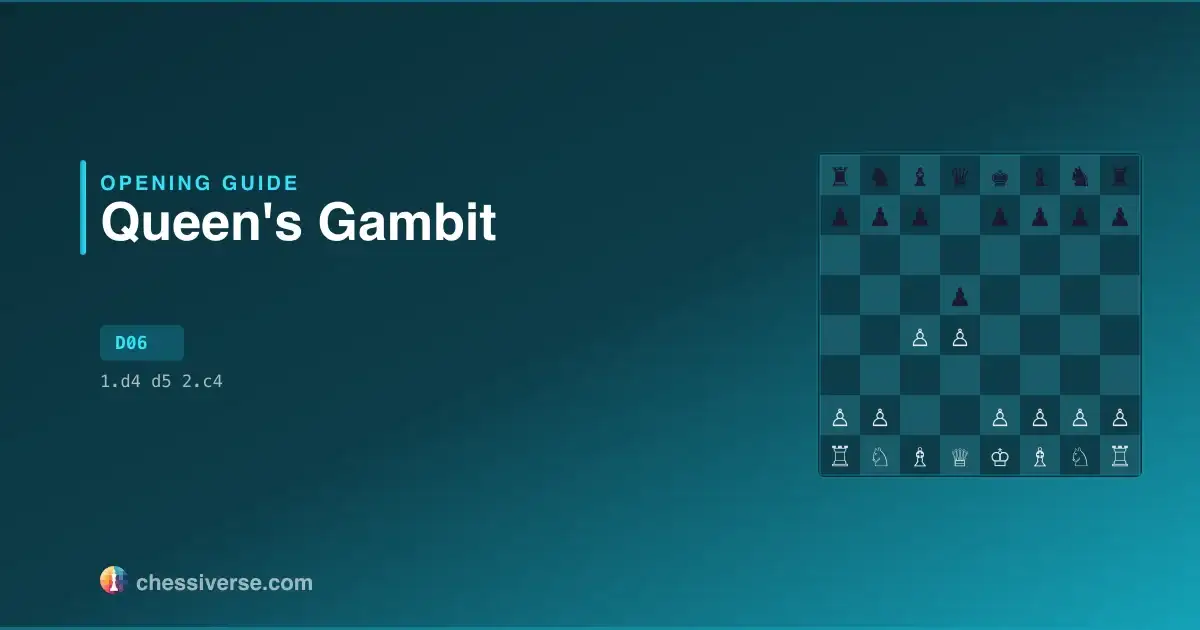




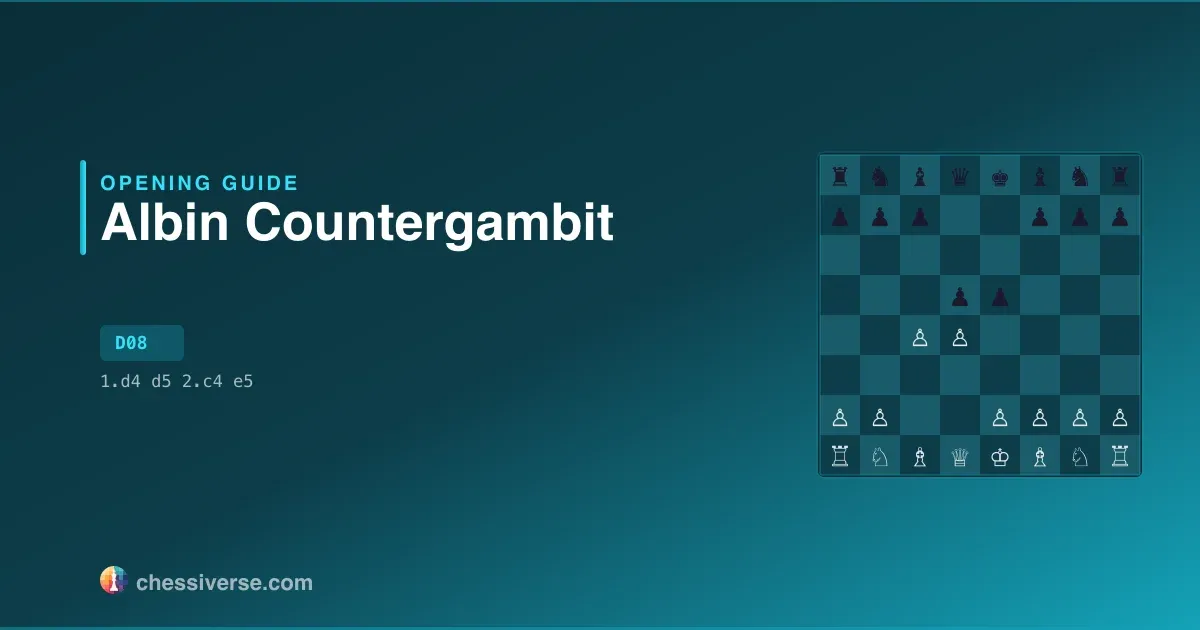
1.d4 d5 2.c4 e5 opens the Albin Countergambit, ECO D08. Black turns the Queen's Gambit on its head with 2...e5 — sacrificing a pawn to plant a wedge on d4 and play for the initiative. The Lasker Trap that lurks here features a move-7 underpromotion to a knight, one of the rarest motifs in opening theory.
Strategic Overview
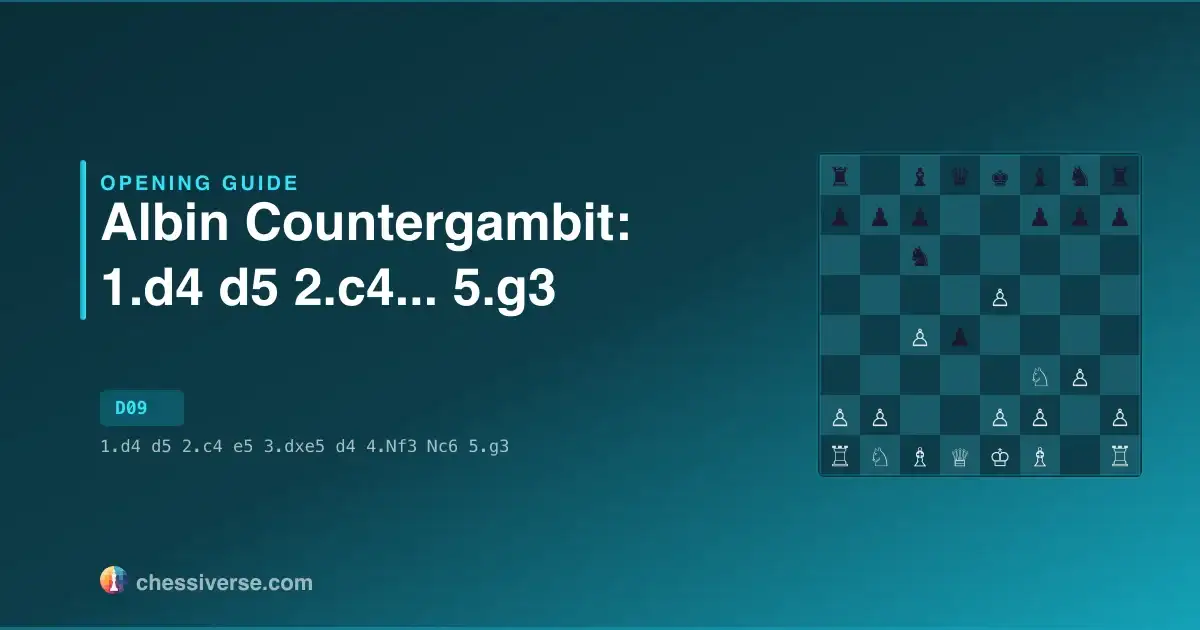
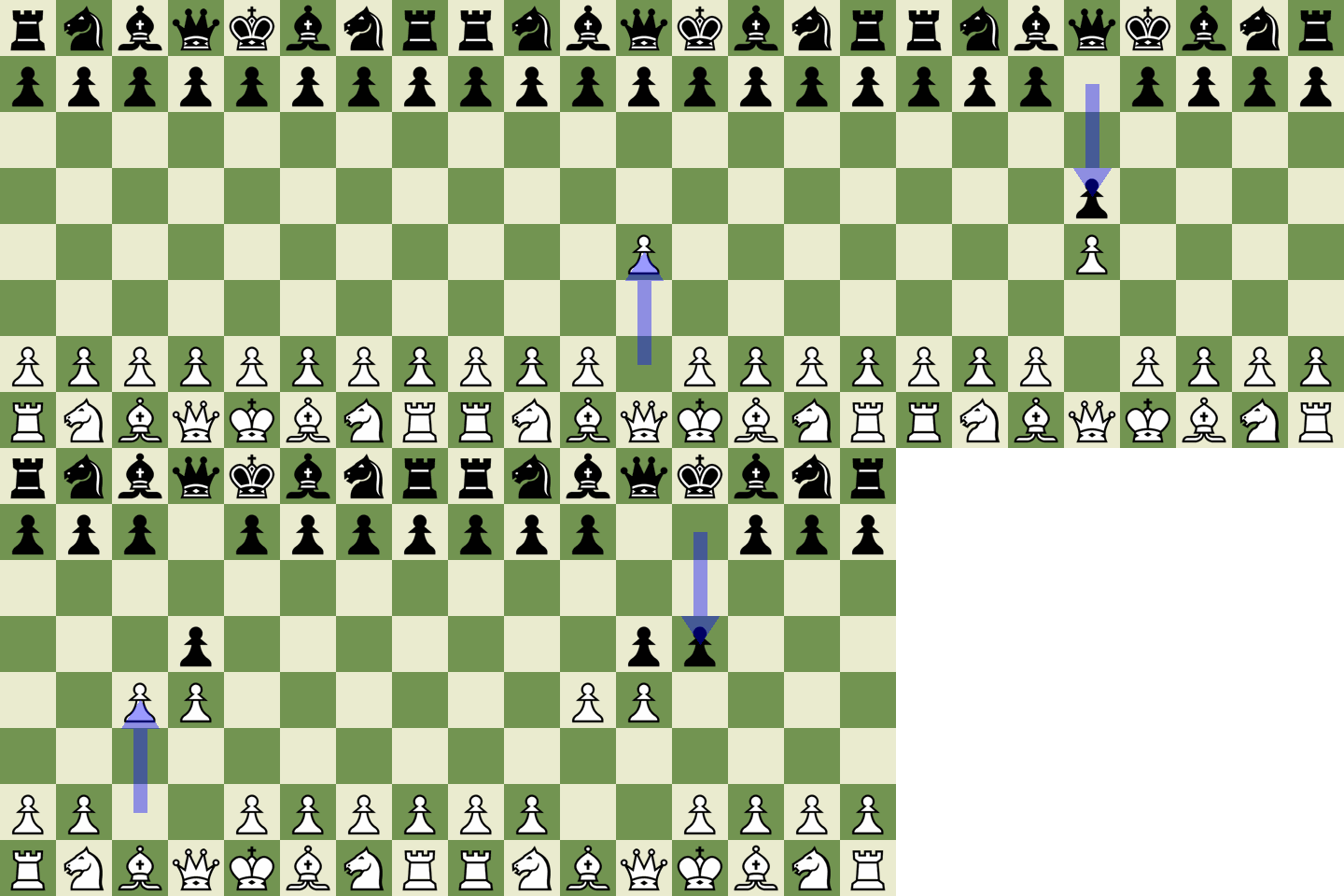
The Albin is a real counter-gambit, not a one-trick attack. After 3.dxe5 d4, Black gives up a pawn but installs a passed pawn deep in White's position that's much more annoying than it looks. The d4-pawn cramps White's queenside development, denies the natural Nc3 square, and creates constant low-level tactics that White has to watch for. The most famous of those is the Lasker Trap: after the careless 4.e3? Bb4+ 5.Bd2 dxe3!! and if 6.Bxb4?? exf2+ 7.Ke2 fxg1=N+!! — Black underpromotes to a knight with check and ends up with a winning attack. Move-seven underpromotions essentially don't exist in opening theory; this one does, and it's worth remembering as a warning against carelessly opening the e-file. White's correct treatment is 4.Nf3, calmly developing and refusing to grab a second pawn before the position is settled. The main plan involves the fianchetto with g3 and Bg2, supporting the centre and preparing Nbd2 to redeploy the knight around the d4-pawn. Black often castles long and tries to whip up a kingside attack with pieces. The Albin's reputation as dubious is overstated — at amateur level it's a serious surprise weapon, and even strong players have used it as an occasional try.
Key Ideas
A few ideas come up again and again in this opening:
- The d4-pawn is the entire compensation — Black is a pawn down but the d4-pawn is genuinely strong: it cramps White's development, blocks the c3-square, and stays defended by tactics. White usually has to return the pawn to neutralise it, which is exactly the equal game Black is playing for.
- The Lasker Trap shows why e3 is dangerous — The line 4.e3? Bb4+ 5.Bd2 dxe3 6.Bxb4?? exf2+ 7.Ke2 fxg1=N+ is a real opening trap with a real underpromotion. White can't safely grab the d-pawn with e3 until pieces are developed and the e-file is safe.
- g3 and Bg2 is White's safest plan — The fianchetto is White's most reliable try for an edge. The bishop on g2 supports the centre, eyes Black's queenside if Black castles long, and helps prepare the eventual recovery of the d4-pawn under good conditions.
- Castling long is Black's attacking plan — Because White often castles short and Black has the d4-wedge cramping the queenside, opposite-side castling with attacking ideas like ...Bh3 and ...h-pawn pushes is a typical scheme that gives Black real chances.
History and Notable Players
The earliest known analysis dates to Salvioli vs. Cavallotti, Milan 1881. The name traces to Adolf Albin. It arises from the Queen's Gambit. Among the most prolific White practitioners are Frank James Marshall (19 games), Dawid Markelowicz Janowski (8 games), Amos Burn (7 games). Black-side regulars include Maxim Chetverik (22 games), Alexander Morozevich (19 games), Alexander Reprintsev (17 games).
Cavallotti first used the line against Salvioli at Milan 1881, but it got its name after Albin tried it against Lasker in New York in 1893. It is not played often at master level, though Alexander Morozevich had some success with it in the 2000s.
Named after: Adolf Albin, who used it against Emanuel Lasker in New York in 1893.
Notable players: Adolf Albin, Alexander Morozevich
Its Lasker Trap punishes the careless 4.e3: after 4...Bb4+ 5.Bd2 dxe3, if White grabs the bishop Black wins the queen by promoting to a knight - one of the few underpromotions that shows up in real games.
Performance Across Rating Levels
The picture changes a lot as you climb the rating ladder. The 1200 bracket has 811,807 games (0.12% of all games at that level); White wins 51.8%, Black 44.4%, 3.8% are drawn. At 1800 the opening surfaces in 0.23% of games; White wins 49%, Black 46.2%, draws 4.8%. Among 2500-rated players the line appears in 0.17% of games and draws spike to 9.8%, indicating tight preparation. White's edge erodes by 4.9pp from 1200 to 2500 Elo, suggesting Black's counterplay is easier to find with experience.
Time Control Patterns
Time control matters here: blitz players reach for this opening more than others. In bullet, it appears in 0.15% of games (3,868,058); White wins 49.5%. Blitz shows 0.18% adoption across 6,384,407 games, White scoring 49.6%. In rapid, the share rises to 0.16% — 1,735,423 games, White 50.7%.
Move Diversity and Theory Depth
Looking at move selection shows how forcing — or not — the position really is. At 1200 Elo (811,807 games), the top reply is dxe5, played 43.4% of the time. Four other moves each take at least 5% of games, and the top three moves account for 76.7% of games. Entropy: 2.28. By 2500 (22,781 games), dxe5 dominates at 79.5% of replies; only two other moves still reach 5% and the top three moves account for 91% of games. Entropy drops to 1.17. That entropy collapse is the signature of a line where preparation pays off: at the top, players know the best move and play it.
Historical Trends
Tracking the Albin Countergambit year over year shows a clear story. Adoption peaked in 2015 at 0.22% (49,778 games). By 2025 it sits at 0.15%, 33% below the peak and 14% under its 2013 level, leaving the line in decline.
Main Lines and Variations
The main branches off 1.d4 d5 2.c4 e5 include:
Each branch leads to a different middlegame character — the resulting pawn structure decides what kind of game you get.
Common Mistakes
- Drifting away from main theory — At 400 Elo, the three most-played moves cover 68.3% of games, against 85.3% at 2000. The most popular deviation is e3 (played 18.7% of the time at 400, less so up top). It looks fine but quietly hands the better-prepared side an edge.
- Neglecting development — It can feel productive to make extra pawn moves early, but falling behind in piece development is what loses most amateur games — especially in open positions where active pieces find squares fast.
- Overextending the attack — Gambits look like permission to throw everything forward. They aren't — every attacking move should improve a piece. Random checks and threats burn the initiative once they fail to coordinate.
Practice on Chessiverse
Ready to try the Albin Countergambit against a bot? Pick an opponent at your level and play a game.