
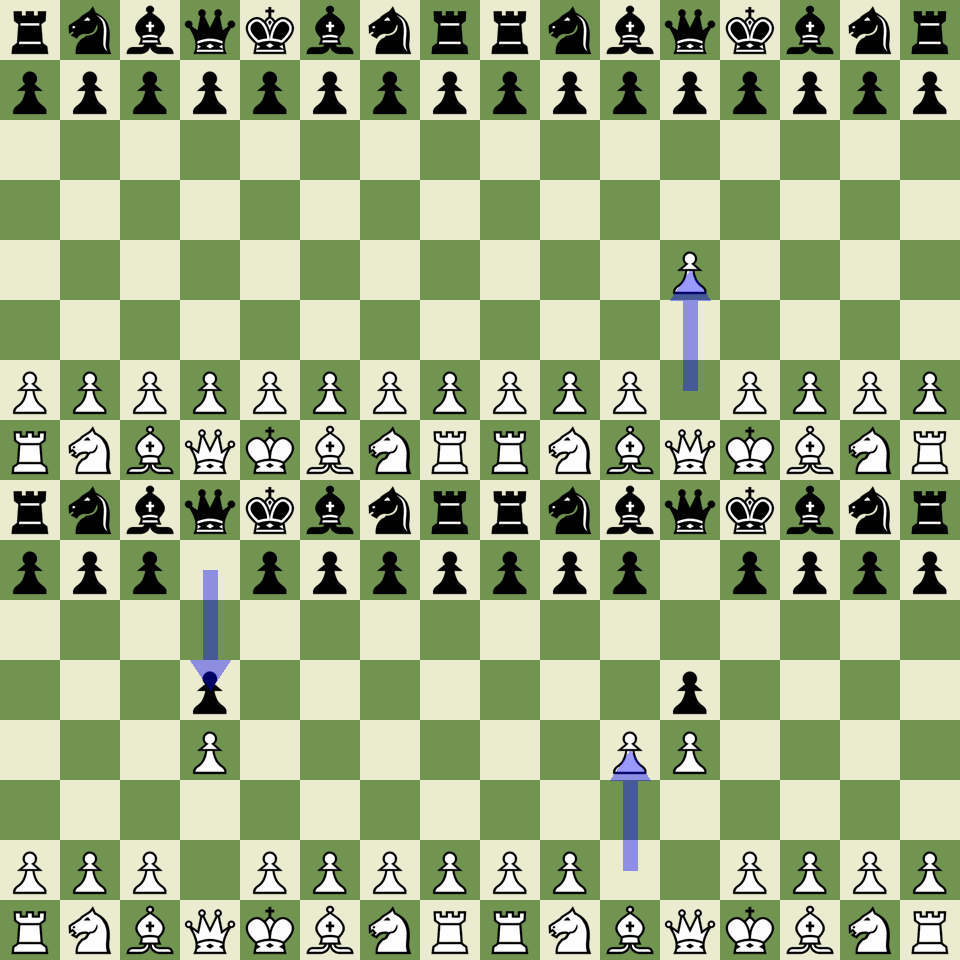
The Queen's Gambit arises after 1.d4 d5 2.c4 and falls under ECO code D06. Among the oldest and most respected openings in chess, the Queen's Gambit sees White sacrifice a pawn to fight for central dominance, and it remains one of the strongest systems after 1. d4. Accepting with 2...dxc4 is perfectly viable, though the extra pawn proves difficult to hold in practice: Black relinquishes control of e4, and White can regain the material while expanding with 3. e4, which also attacks the c4 pawn. The typical continuation, however, is 3. Nf3, which discourages ...e5 and allows White to recover the pawn smoothly after 3...Nf6 4. e3 e6 5. Bxc4. The majority of players at all levels prefer to decline the gambit. If White is permitted to play cxd5, Black ideally wants to recapture with a pawn to keep a foothold on d5 and maintain control of e4. This motivates the two most popular declining options: 2...e6, the Queen's Gambit Declined, and 2...c6, the Slav Defense. With 195.7 million Lichess games across all rating levels, it is one of the most popular openings.
- Black often keeps a pawn on d5 and accepts a cramped game, freeing it later with piece trades and the ...c5 or ...e5 pawn breaks.
- A common trick for Black is delaying ...dxc4 until White's bishop has already moved, so that recapturing on c4 costs a tempo.
- In Slav-style setups a pawn on c6 supports ...b5, letting Black genuinely fight to hold on to the c4 pawn.
History and Notable Players
The earliest known analysis of this opening dates back to late 15th century. It arises from the Queen's Pawn Systems (1...d5). Among the most prolific practitioners on the White side are Aleksey Dreev (392 games), Ivan Farago (380 games), Loek Van Wely (365 games). On the Black side, notable exponents include Aleksey Dreev (495 games), Alexei Shirov (371 games), Evgeny Sveshnikov (353 games).
One of the oldest known chess openings, recorded in the 1490 Göttingen manuscript, examined by Greco in the 17th century and recommended by Stamma in the 18th. It became widespread only after the 1873 Vienna tournament, peaked in the 1920s and 1930s, and opened all but two of the 34 games in the 1927 Capablanca-Alekhine world championship.
Named after: Named for the queenside pawn White appears to sacrifice with 2.c4 - though it is not a true gambit, since Black cannot safely keep the pawn.
Notable players: José Raúl Capablanca, Alexander Alekhine
Philipp Stamma of Aleppo recommended the opening in the 18th century, so it is sometimes named the Aleppo Gambit in his honour - and centuries later a Netflix miniseries borrowed the opening's name for its title.
Statistics
Based on 195.7 million Lichess games across all rating levels:
- White wins: 52.5%
- Black wins: 42.9%
- Draws: 4.6%
White holds a moderate edge statistically, though Black has good practical chances.
Main Lines and Variations
After 1.d4 d5 2.c4, the main continuations include:
Each of these lines leads to distinct types of positions and requires its own understanding of the resulting pawn structures and piece placements.
Common Mistakes to Avoid
- Overextending without backup: When playing a gambit, each attacking move should have a purpose. Random checks and threats without coordination can leave your own position exposed once the initiative fades.
- Releasing central tension too early: The tension between the d5 and c4 pawns is a central feature of this opening. Capturing or pushing too early can give your opponent a free hand in the center.
Practice on Chessiverse
The best way to learn the Queen's Gambit is through practice. On Chessiverse, you can play chess against computer opponents that specialize in this opening. Our AI bots range from beginner to grandmaster level, each with unique playing styles — from aggressive attackers to solid defenders. Choose a bot that matches your rating and work your way up as you master the opening's key ideas.
Performance Across Rating Levels
The picture changes a lot as you climb the rating ladder. Among 1200-rated players, it appears in 3.72% of games — 25,083,703 of them on record — with White winning 53.5% and Black 42.7%. Move up to 1800 Elo and the share shifts to 4.76%, with White winning 51.9% versus Black's 43%. At the top end (2500+ Elo), popularity is 5.21% with 10.9% draws — a clear sign of how much theory rules the line at master level. White's edge erodes by 5.8pp from 1200 to 2500 Elo, suggesting Black's counterplay is easier to find with experience.
Time Control Patterns
The Queen's Gambit skews toward blitz chess. In bullet, it appears in 3.55% of games (94,326,945); White wins 52.8%. Blitz shows 4.22% adoption across 151,606,325 games, White scoring 52.2%. In rapid, the share rises to 3.98% — 44,059,871 games, White 53.3%.
Move Diversity and Theory Depth
Move choice is far from uniform in the Queen's Gambit. At 1200 Elo (25,083,703 games), the top reply is dxc4, played 37% of the time. Three other moves each take at least 5% of games, and the top three moves account for 73.9% of games. Entropy: 2.51. By 2500 (710,352 games), e6 takes over as the top reply at 46.4%; only two other moves still reach 5% and the top three moves account for 91.2% of games. Entropy drops to 1.91. The narrowing is significant — strong players consolidate around a small set of best moves, while amateurs scatter across many plausible-looking options.
Historical Trends
Tracking the Queen's Gambit year over year shows a clear story. Adoption peaked in 2015 at 5.33% (1,183,338 games). By 2025 it sits at 3.77%, 29% below the peak and 22% under its 2013 level, leaving the line in decline.