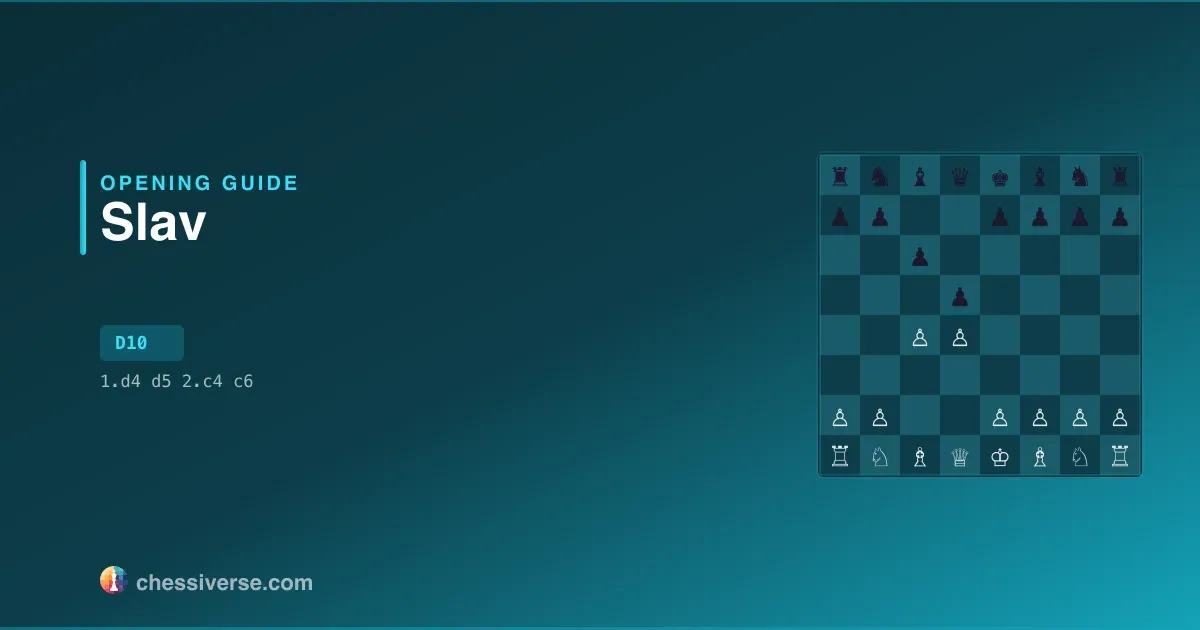
The Slav Defense arises after 1.d4 d5 2.c4 c6 and falls under ECO code D10. Once regarded as an unorthodox way to handle the Queen's Gambit, the Slav has long since established itself as a major opening system in its own right. The logic is straightforward: rather than blocking the light-squared bishop behind an e6 pawn as in the QGD, Black supports d5 with the c-pawn, keeping the c8-h3 diagonal open for future bishop development. This typically allows Black to achieve a more active piece placement compared to the Queen's Gambit Declined. With 49.6 million Lichess games across all rating levels, it is one of the most popular openings.
- By supporting d5 with the c-pawn instead of ...e6, Black keeps the queen's bishop unblocked, fixing the main headache of the Queen's Gambit Declined.
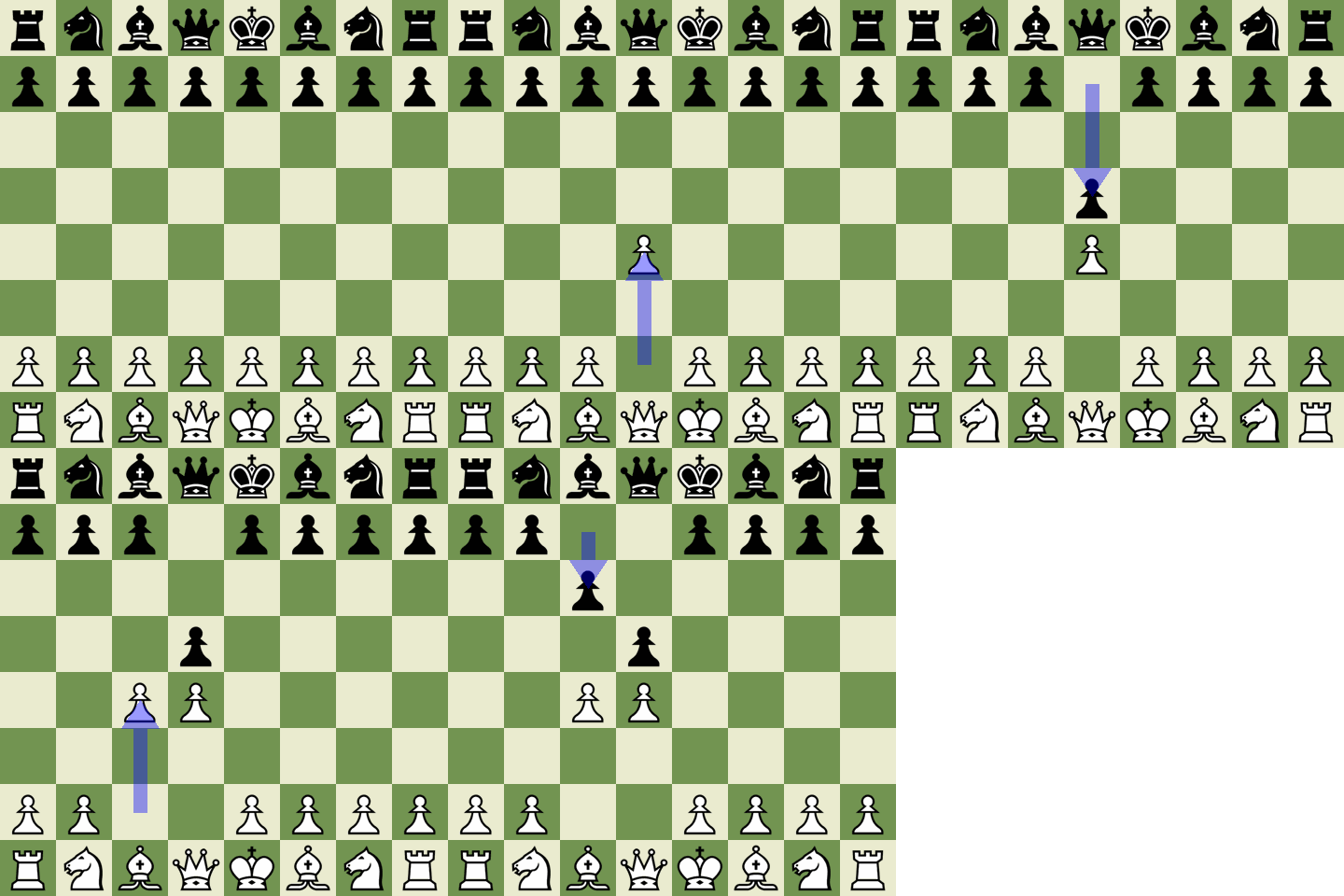
- After capturing on c4, Black can back the extra pawn up with ...b5 and gain space on the queenside.
- Black's pawn structure remains balanced.
History and Notable Players
It arises from the Queen's Gambit. Among the most prolific practitioners on the White side are Loek Van Wely (210 games), Boris Gelfand (195 games), Aleksey Dreev (194 games). On the Black side, notable exponents include Aleksey Dreev (483 games), Alexei Shirov (339 games), Sergey Volkov (300 games).
The Slav was analysed as far back as 1590, but serious exploration only began in the 1920s. It was then tested exhaustively in the two Alekhine-Euwe world championship matches of 1935 and 1937, and Kramnik later played it in six of the eight games he had Black in the 2006 world championship.
Named after: Masters of Slavic descent, among them Alapin, Alekhine, Bogoljubov and Vidmar, helped develop the theory of the opening.
Notable players: Max Euwe, Vasily Smyslov, Vladimir Kramnik, Viswanathan Anand
Eleven of the first thirteen world chess champions played the Slav, one of the primary defenses to the Queen's Gambit.
Statistics
Based on 49.6 million Lichess games across all rating levels:
- White wins: 50.7%
- Black wins: 44.1%
- Draws: 5.1%
White holds a moderate edge statistically, though Black has good practical chances.
Main Lines and Variations
After 1.d4 d5 2.c4 c6, the main continuations include:
Each of these lines leads to distinct types of positions and requires its own understanding of the resulting pawn structures and piece placements.
Common Mistakes to Avoid
- Releasing central tension too early: The tension between the d5 and c4 pawns is a central feature of this opening. Capturing or pushing too early can give your opponent a free hand in the center.
Practice on Chessiverse
The best way to learn the Slav Defense is through practice. On Chessiverse, you can play chess against computer opponents that specialize in this opening. Our AI bots range from beginner to grandmaster level, each with unique playing styles — from aggressive attackers to solid defenders. Choose a bot that matches your rating and work your way up as you master the opening's key ideas.
Performance Across Rating Levels
The picture changes a lot as you climb the rating ladder. The 1200 bracket has 4,006,782 games (0.59% of all games at that level); White wins 51.3%, Black 44.8%, 3.8% are drawn. By 1800, popularity is 1.53% and White's score is 50.5% to Black's 44.1%. At the top end (2500+ Elo), popularity is 1.89% with 10.5% draws — a clear sign of how much theory rules the line at master level.
Time Control Patterns
Look at the same opening across time controls and blitz stands out. In bullet, it appears in 1.07% of games (28,522,550); White wins 51.1%. Blitz shows 1.12% adoption across 40,096,006 games, White scoring 50.7%. In rapid, the share rises to 0.86% — 9,515,078 games, White 51%.
Move Diversity and Theory Depth
Looking at move selection shows how forcing — or not — the position really is. At 1200 Elo (4,006,782 games), the top reply is Nc3, played 46.8% of the time. Four other moves each take at least 5% of games, and the top three moves account for 76.5% of games. Entropy: 2.29. By 2500 (257,806 games), Nf3 takes over as the top reply at 47.3%; only two other moves still reach 5% and the top three moves account for 96.5% of games. Entropy drops to 1.69. The narrowing is significant — strong players consolidate around a small set of best moves, while amateurs scatter across many plausible-looking options.
Historical Trends
Year-over-year data tells you whether this opening is a contemporary fixture or a fading one. Adoption peaked in 2015 at 1.45% (322,323 games). By 2025 it sits at 0.99%, 32% below the peak and roughly back to its 2013 level, leaving the line flat over the full period.