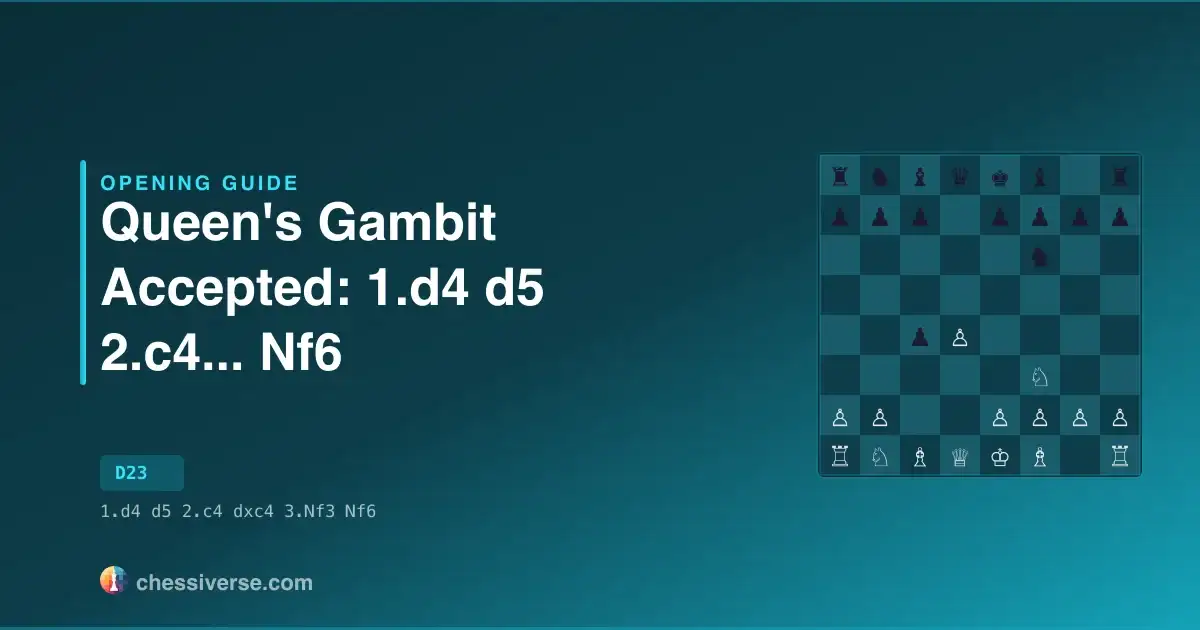





The Queen's Gambit Accepted arises after 1.d4 d5 2.c4 dxc4 and falls under ECO code D20. With a distinguished history stretching back generations, the QGA has been employed by many world champions on both sides of the board. Despite the name, it is hardly a true gambit, since White can reclaim the pawn at once with 3. Qa4+, though this is rarely necessary unless White specifically wants the queen on c4. Holding onto the extra pawn is not advisable for Black: 3...b5 is met by 4. a4, undermining the pawn chain from the base, while 3...Be6 allows 4. e4, seizing a large share of the centre with the added threat of d5 to dislodge the bishop. Black's key strategy is to use the time White spends recovering the pawn to activate pieces and prepare central pawn breaks, typically ...c5 or ...e5. White generally maintains superior central control and can develop an edge more naturally, but precise play is required to convert this advantage. With 49.1 million Lichess games across all rating levels, it is a well-established opening choice.
- Black usually gives the c4 pawn back rather than clinging to it, then strikes at White's centre with ...c5 and ...cxd4 to create long-term targets.
- White uses the free hand in the centre to grab space and build up an attack against Black's position.
- In the classical main line Black plays ...a6 and prepares ...b5, gaining time by chasing White's bishop off c4.
History and Notable Players
It arises from the Queen's Gambit. Among the most prolific practitioners on the White side are Aleksey Dreev (83 games), Zdenko Kozul (71 games), Ivan Farago (59 games). On the Black side, notable exponents include Hrvoje Stevic (145 games), Zoltan Varga (144 games), Sergei Rublevsky (112 games).
Mentioned in chess literature as far back as the 15th century, the QGA received its modern treatment in the 1886 Steinitz-Zukertort world championship, where Steinitz gave the pawn back to target White's centre. Alekhine added further ideas for Black even while the line kept a slightly dubious reputation, and elite players returned to it in force in the late 1990s.
Named after: Named for Black's choice to accept the pawn White offers in the Queen's Gambit by capturing on c4.
Notable players: Wilhelm Steinitz, Alexander Alekhine, Mikhail Botvinnik, Anatoly Karpov
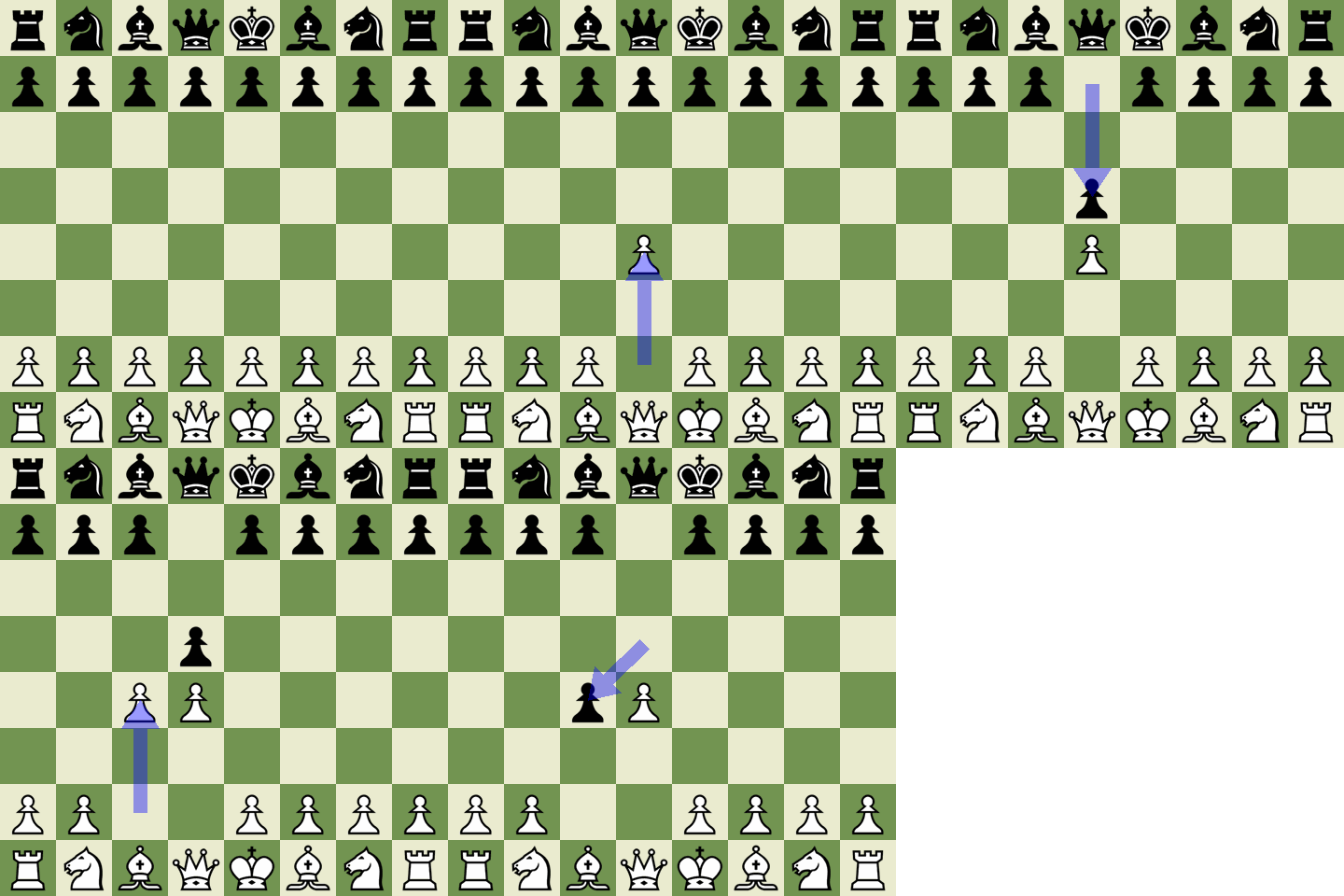
Trying to keep the extra pawn can backfire fast: a trap published by Alessandro Salvio back in 1604 shows that after 3...b5 4.a4 c6 5.axb5 cxb5 6.Qf3, White simply wins a piece along the weakened long diagonal.
Statistics
Based on 49.1 million Lichess games across all rating levels:
- White wins: 55%
- Black wins: 40.8%
- Draws: 4.2%
White has a significant statistical advantage in this line, reflecting the initiative that comes with the first move.
Main Lines and Variations
After 1.d4 d5 2.c4 dxc4, the main continuations include:
Each of these lines leads to distinct types of positions and requires its own understanding of the resulting pawn structures and piece placements.
Practice on Chessiverse
The best way to learn the Queen's Gambit Accepted is through practice. On Chessiverse, you can play chess against computer opponents that specialize in this opening. Our AI bots range from beginner to grandmaster level, each with unique playing styles — from aggressive attackers to solid defenders. Choose a bot that matches your rating and work your way up as you master the opening's key ideas.
Performance Across Rating Levels
Popularity and results vary sharply by rating level. At 1200 Elo, the opening shows up in 1.37% of games (9,217,984 samples). White scores 55.5%, Black 40.7%, draws 3.8%. By 1800, popularity is 0.80% and White's score is 54.6% to Black's 40.8%. At the top end (2500+ Elo), popularity is 0.65% with 11.7% draws — a clear sign of how much theory rules the line at master level. White's edge erodes by 11.3pp from 1200 to 2500 Elo, suggesting Black's counterplay is easier to find with experience.
Time Control Patterns
Time control matters here: rapid players reach for this opening more than others. In bullet, it appears in 0.63% of games (16,810,558); White wins 54.7%. Blitz shows 1.01% adoption across 36,156,968 games, White scoring 54.6%. In rapid, the share rises to 1.17% — 12,981,717 games, White 56.1%.
Move Diversity and Theory Depth
Move choice is far from uniform in the Queen's Gambit Accepted. At 1200 Elo (9,217,984 games), the top reply is e4, played 30% of the time. Three other moves each take at least 5% of games, and the top three moves account for 87.9% of games. Entropy: 2.16. By 2500 (88,215 games), Nf3 takes over as the top reply at 45%; three other moves reach 5% and the top three moves account for 92.6% of games. Entropy drops to 1.81.
Historical Trends
Year-over-year data tells you whether this opening is a contemporary fixture or a fading one. Adoption peaked in 2013 at 1.43% (41,135 games). By 2025 it sits at 0.92%, down 36% from that high, leaving the line in decline.