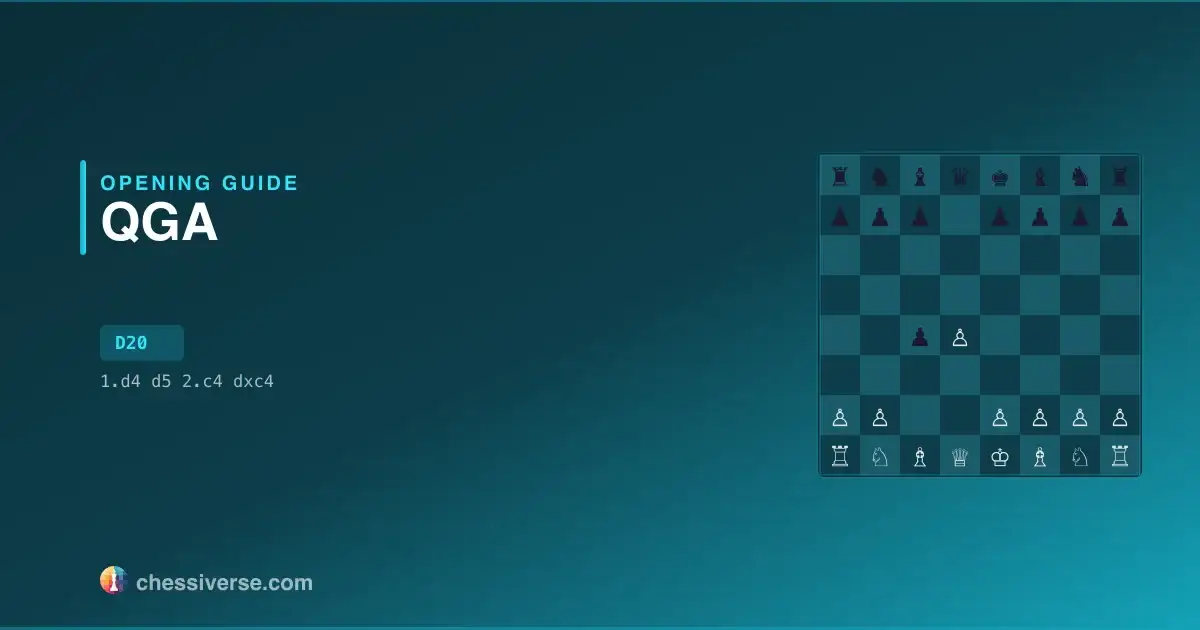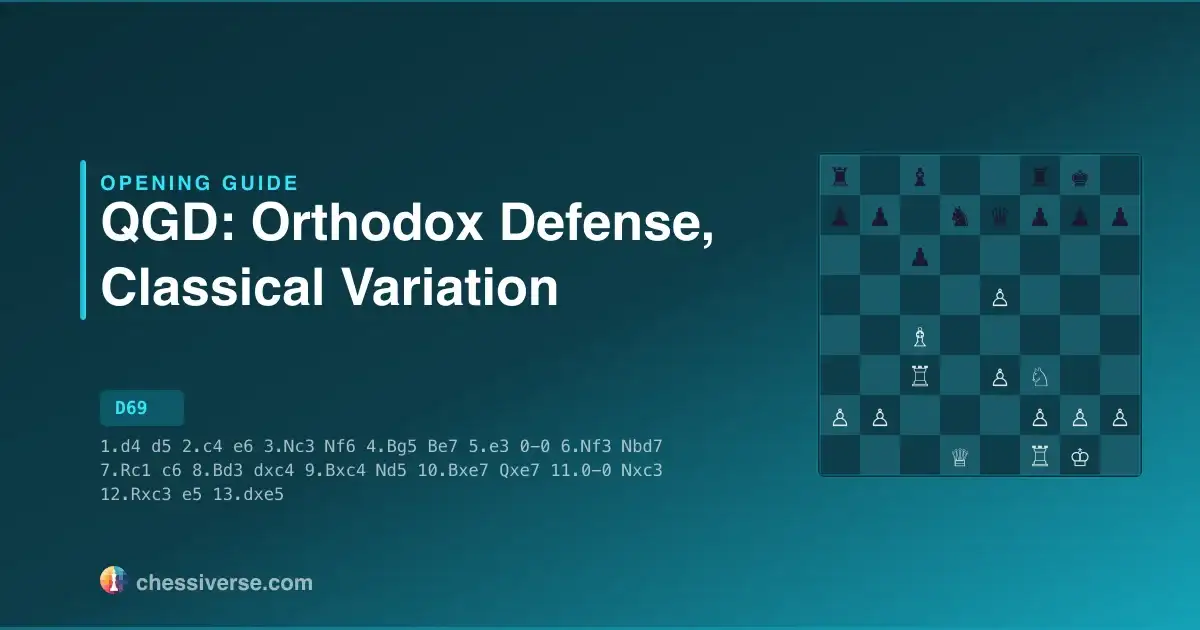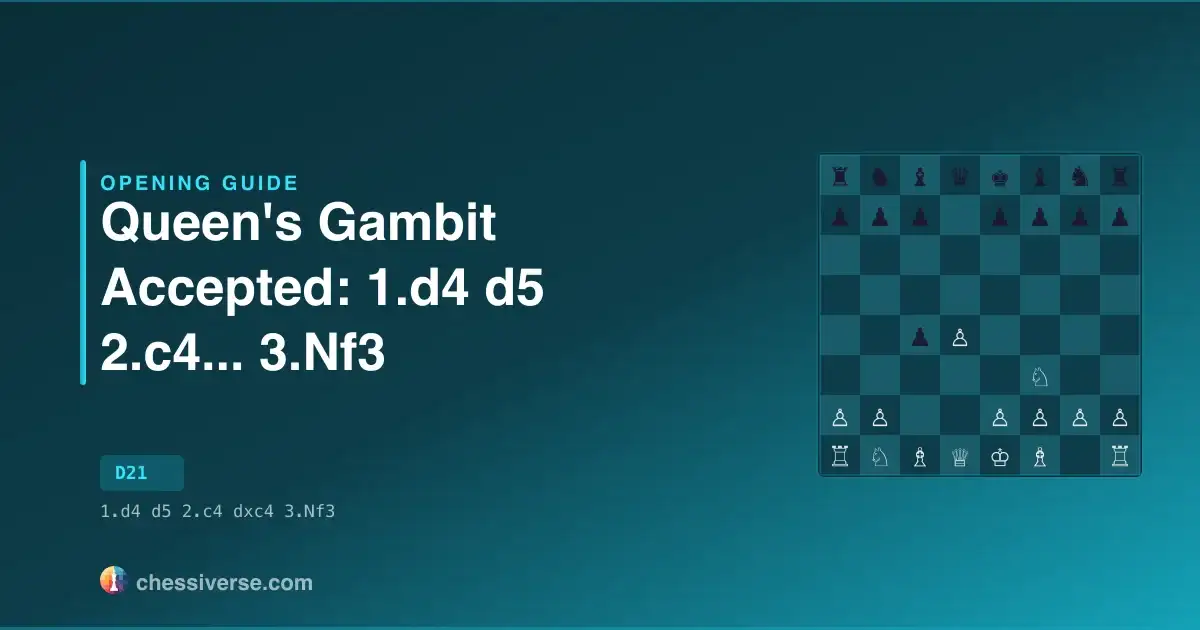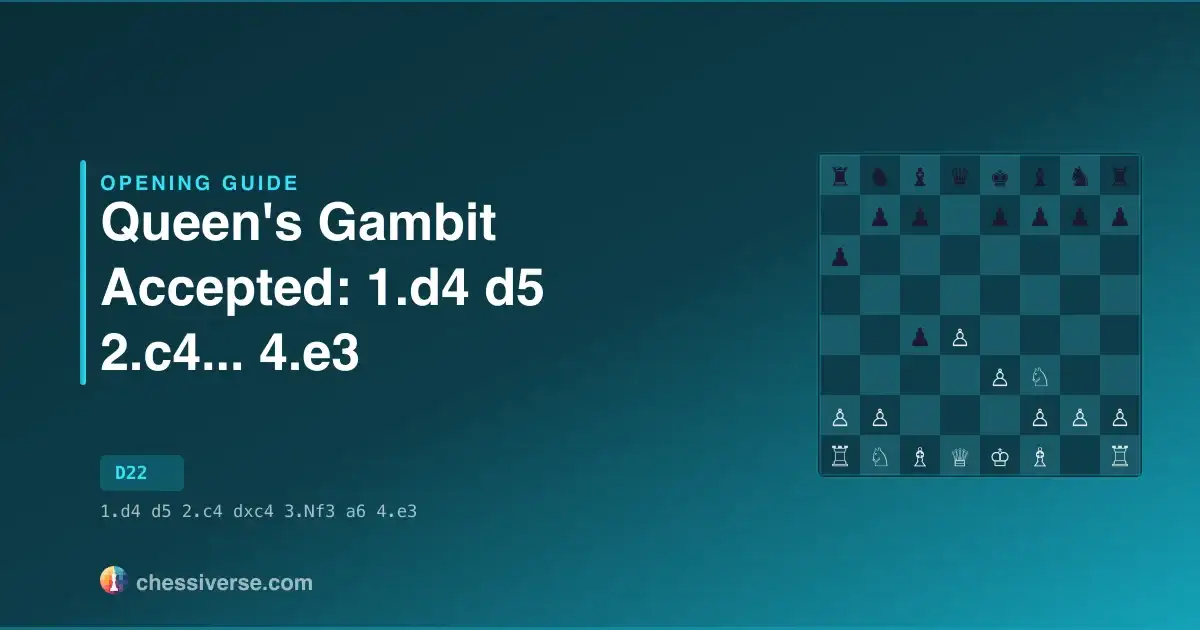
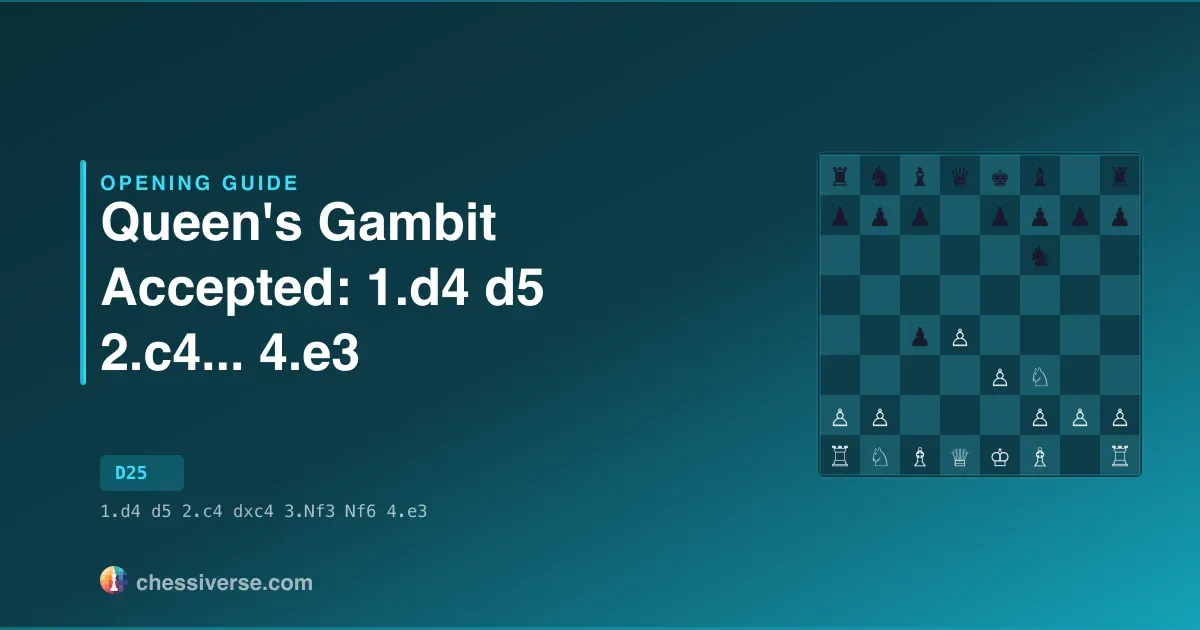
Queen's Gambit Accepted: 1.d4 d5 2.c4...... 4.e3

-13%
D251.d4 d5 2.c4 dxc4 3.Nf3 Nf6 4.e3
May 3, 2028
TL;DR

Classical QGA in textbook form. 4.e3 prepares Bxc4 and keeps the e3-e4 push in reserve; the dark-squared bishop hibernates behind its pawns but wakes up the moment the centre breaks. The slow-squeeze tabiya for both sides.

Reviewed by

IM John Bartholomew
IM John BartholomewCo-Founder & Chess Educator

International Master and chess educator. Co-founded Chessable and joined Chessiverse as co-founder. Best known for his "Climbing the Rating Ladder" YouTube series and structured opening courses.

Queen's Gambit Accepted: 1.d4 d5 2.c4...... 4.e3: A Complete Guide
Queen's Gambit Accepted: 1.d4 d5 2.c4...... 4.e3 - Opening Moves
Summary

The Queen's Gambit Accepted: 1.d4 d5 2.c4... 4.e3 begins with 1.d4 d5 2.c4 dxc4 3.Nf3 Nf6 4.e3 (ECO D25). The classical recovery. White opens the bishop's diagonal, prepares Bxc4, and commits to the calm positional QGA where small advantages are built one move at a time.

Strategic Overview

4.e3 is the heartbeat of the classical QGA. The pawn move accomplishes two things at once: it opens the f1-a6 diagonal for the bishop, which will swing out to capture on c4 next move, and it supports a future d4-d5 advance if the position calls for it. The price is that the dark-squared bishop is now locked in behind its own pawn chain for a while — that bishop only comes to life after a later e3-e4 break or via a different square once the centre clarifies. White's whole strategic plan in this variation is the slow squeeze: recover the pawn, finish development, find the right moment for either e4 (opening the centre and the bishop) or a piece-play plan on the queenside. Black has several setups: ...e6 followed by ...c5 is the classical challenge to the centre, while ...g6 fianchetto setups offer a more modern flexible approach. The position is fundamentally balanced — White has a small space advantage and the initiative, Black has solid structure and natural piece development. This is a textbook QGA tabiya and the middlegames that follow are some of the most thoroughly mapped in chess.

Key Ideas

A few ideas come up again and again in this opening:

  • e3 opens the diagonal for Bxc4 — The whole point of 4.e3 is making the next move possible — the bishop comes out and recovers the pawn on c4. The structural concession (a locked-in dark-squared bishop) is the accepted price for cleanly winning material back.
  • The dark-squared bishop is a long-term project — With pawns on d4 and e3, the c1-bishop has no obvious diagonal. It usually waits for the eventual e4 push to come to life, or finds an indirect route via d2 or b2 in some setups. Managing that piece is the recurring positional theme.
  • Black challenges with ...c5 — Black's main strategic plan involves ...e6 and ...c5, directly challenging White's d4-pawn. The resulting exchanges create the typical QGA pawn structures — hanging pawns, isolated queen pawn, or open positions — that define the middlegame.

History and Notable Players

It arises from the Queen's Gambit Accepted: 1.d4 d5 2.c4... Nf6. Among the most prolific White practitioners are Zdenko Kozul (45 games), Svetozar Gligoric (42 games), Wolfgang Uhlmann (32 games). Black-side regulars include Hrvoje Stevic (82 games), Aleksandr Karpatchev (52 games), Milan Matulovic (50 games).

Performance Across Rating Levels

Popularity and results vary sharply by rating level. At 1200 Elo, the opening shows up in 0.02% of games (162,750 samples). White scores 56.6%, Black 39.6%, draws 3.8%. By 1800, popularity is 0.02% and White's score is 56.5% to Black's 38.4%. At the top end (2500+ Elo), popularity is 0.29% with 13.9% draws — a clear sign of how much theory rules the line at master level. White's edge erodes by 13.0pp from 1200 to 2500 Elo, suggesting Black's counterplay is easier to find with experience.

Time Control Patterns

Look at the same opening across time controls and bullet stands out. In bullet, it appears in 0.03% of games (774,660); White wins 53.5%. Blitz shows 0.03% adoption across 1,042,028 games, White scoring 53.6%. In rapid, the share rises to 0.02% — 249,964 games, White 58%. White's score swings 4.5pp across formats, so time control isn't just a stylistic choice here — it shifts the actual results.

Move Diversity and Theory Depth

Looking at move selection shows how forcing — or not — the position really is. At 1200 Elo, the top reply is Nc6, played 21.7% of the time. There are 6 other moves seeing meaningful share, and 59.6% of games stick to established theory. Entropy: 2.96. By 2500, e6 dominates at 58.2% of replies; only 3 viable alternatives remain and 89.9% of moves are theory. Entropy drops to 1.87. That entropy collapse is the signature of a line where preparation pays off: at the top, players know the best move and play it.

Tracking the Queen's Gambit Accepted: 1.d4 d5 2.c4... 4.e3 year over year shows a clear story. Adoption peaked in 2017 at 0.04% (41,313 games). By 2025 it sits at 0.03% — a 13% shift overall, leaving the line in decline.

Main Lines and Variations

The main branches off 1.d4 d5 2.c4 dxc4 3.Nf3 Nf6 4.e3 include:

Each branch leads to a different middlegame character — the resulting pawn structure decides what kind of game you get.

Common Mistakes

  • Drifting away from main theory — At 400 Elo, theory adherence sits at 60.4% — versus 68.3% at 2000. The most popular deviation is b5 (played 10.3% of the time at 400, much less so up top). It looks fine but quietly hands the better-prepared side an edge.
  • Neglecting development — It can feel productive to make extra pawn moves early, but falling behind in piece development is what loses most amateur games — especially in open positions where active pieces find squares fast.
  • Overextending the attack — Gambits look like permission to throw everything forward. They aren't — every attacking move should improve a piece. Random checks and threats burn the initiative once they fail to coordinate.

Practice on Chessiverse

Ready to try the Queen's Gambit Accepted: 1.d4 d5 2.c4... 4.e3 against a bot? Pick an opponent at your level and play a game.

Quick Facts

Main Line1.d4 d5 2.c4 dxc4 3.Nf3 Nf6 4.e3
DifficultyAdvanced
Style

Theoretician openings have deep, well-studied lines where knowledge of specific variations gives a significant advantage. Preparation and memorization of key lines are essential.

1,294,608games on Lichess
54.4%
5.6%
40%
White wins Draws Black wins

Top Players

As White
As Black

Data from Lichess opening explorer (blitz & rapid)

Most Popular At2500
SharpnessBalanced

Popularity by Rating

Percentage of all games at each rating bracket that feature this opening.

Data from Lichess opening explorer (blitz & rapid games)

Theory Adherence by Rating

How often players choose the single most popular move at this position. Higher = more predictable play.

Black to move after the opening line

Popularity Over Time

Share of all Lichess blitz + rapid games featuring this opening, by year.

Top Moves by Rating

Black to move after the opening line

RatingMost Popular2nd3rd
400Nc632.4%e615.5%Bg412.4%
1000Nc627.4%e617.3%b514.2%
1200Nc621.7%e620.3%b517.6%
1400e624.9%Bg417.9%b517.3%
1600e629.3%Bg420.3%b515.6%
1800e633.5%Bg420.8%b512.4%
2000e641.9%Bg418%c58.5%
2200e652.4%Bg417.5%a610.4%
2500e658.2%Bg418.5%a613.2%

Popularity by Time Control

Bullet
0.03%775K
Blitz
0.03%1.0M
Rapid
0.02%250K
1% more decisive in bullet
Raw data tables (Lichess blitz + rapid)
Queen's Gambit Accepted: 1.d4 d5 2.c4...... 4.e3: popularity and win rates by player rating
Rating (Elo)Share %GamesWhite win %Black win %Draw %Sharpness
4000.0132,52455.540.73.90.961
10000.0294,53655.740.34.00.960
12000.02162,75056.639.63.80.962
14000.02209,45857.438.73.90.961
16000.02211,04557.138.74.20.958
18000.02193,75756.538.45.10.949
20000.04172,45052.540.66.90.931
22000.11178,78147.143.49.50.905
25000.2939,30743.642.513.90.861
Queen's Gambit Accepted: 1.d4 d5 2.c4...... 4.e3: move-choice theory adherence by rating
Rating (Elo)Top moveTop move %Viable movesTheory %Entropy
400Nc632.4760.42.916
1000Nc627.4759.02.963
1200Nc621.7659.62.964
1400e624.9660.12.917
1600e629.3565.32.891
1800e633.5666.82.878
2000e641.9568.32.692
2200e652.4480.42.221
2500e658.2389.91.869
Queen's Gambit Accepted: 1.d4 d5 2.c4...... 4.e3: popularity over time
YearShare %GamesWhite win %Black win %Draw %
20130.0383664.131.54.4
20140.032,65261.534.44.1
20150.048,01759.635.94.5
20160.0422,13158.936.54.6
20170.0441,31356.638.64.8
20180.0465,49855.939.44.7
20190.0394,60555.439.84.9
20200.03181,30455.139.25.7
20210.03208,71154.639.85.5
20220.03197,58654.140.45.5
20230.02197,81953.840.55.7
20240.02181,63553.440.75.9
20250.03187,64853.340.56.2
Queen's Gambit Accepted: 1.d4 d5 2.c4...... 4.e3: popularity by time control
FormatShare %GamesWhite win %Black win %Draw %Sharpness
bullet0.03774,66053.543.03.60.964
blitz0.031,042,02853.640.75.70.943
rapid0.02249,96458.036.95.00.950
Queen's Gambit Accepted: 1.d4 d5 2.c4...... 4.e3: top candidate moves by rating bracket
Rating (Elo)1st move1st %2nd move2nd %3rd move3rd %
400Nc632.4e615.5Bg412.4
1000Nc627.4e617.3b514.2
1200Nc621.7e620.3b517.6
1400e624.9Bg417.9b517.3
1600e629.3Bg420.3b515.6
1800e633.5Bg420.8b512.4
2000e641.9Bg418.0c58.5
2200e652.4Bg417.5a610.4
2500e658.2Bg418.5a613.2
Queen's Gambit Accepted: 1.d4 d5 2.c4...... 4.e3: top practitioners by side
SidePlayerGames
WhiteZdenko Kozul45
WhiteSvetozar Gligoric42
WhiteWolfgang Uhlmann32
BlackHrvoje Stevic82
BlackAleksandr Karpatchev52
BlackMilan Matulovic50

Frequently Asked Questions

What is the Queen's Gambit Accepted: 1.d4 d5 2.c4... 4.e3?

The Queen's Gambit Accepted: 1.d4 d5 2.c4... 4.e3 begins with 1.d4 d5 2.c4 dxc4 3.Nf3 Nf6 4.e3 and is classified under ECO code D25. This move prepares to develop the kingside and win c4..

Is the Queen's Gambit Accepted: 1.d4 d5 2.c4... 4.e3 good for beginners?

The Queen's Gambit Accepted: 1.d4 d5 2.c4... 4.e3 can be played at any level. Beginners should focus on understanding the key strategic ideas rather than memorizing long theoretical lines. Our AI bots at various rating levels provide a great way to practice the opening concepts.

What are the main variations of the Queen's Gambit Accepted: 1.d4 d5 2.c4... 4.e3?

The main continuations include: Queen's Gambit Accepted: 1.d4 d5 2.c4... e6. Each variation leads to distinct types of positions with their own strategic themes.

What are the win rates for the Queen's Gambit Accepted: 1.d4 d5 2.c4... 4.e3?

In a database of 1,294,608 master games, White wins 54.4% of the time, Black wins 40%, and 5.6% are drawn. Notable players on the White side include Zdenko Kozul and Svetozar Gligoric. On the Black side, Hrvoje Stevic and Aleksandr Karpatchev are among the most frequent practitioners.

Reviewed by

IM John Bartholomew
IM John BartholomewCo-Founder & Chess Educator

International Master and chess educator. Co-founded Chessable and joined Chessiverse as co-founder. Best known for his "Climbing the Rating Ladder" YouTube series and structured opening courses.

Practice This Opening on Chessiverse

Play against 1000+ AI bots with unique personalities and opening repertoires. From beginner-friendly to grandmaster-level opponents, find the perfect sparring partner for any opening.

Play Now

Not sure which opening fits you? Take the free chess personality test — your style determines which openings will work with you.

Back to Articles