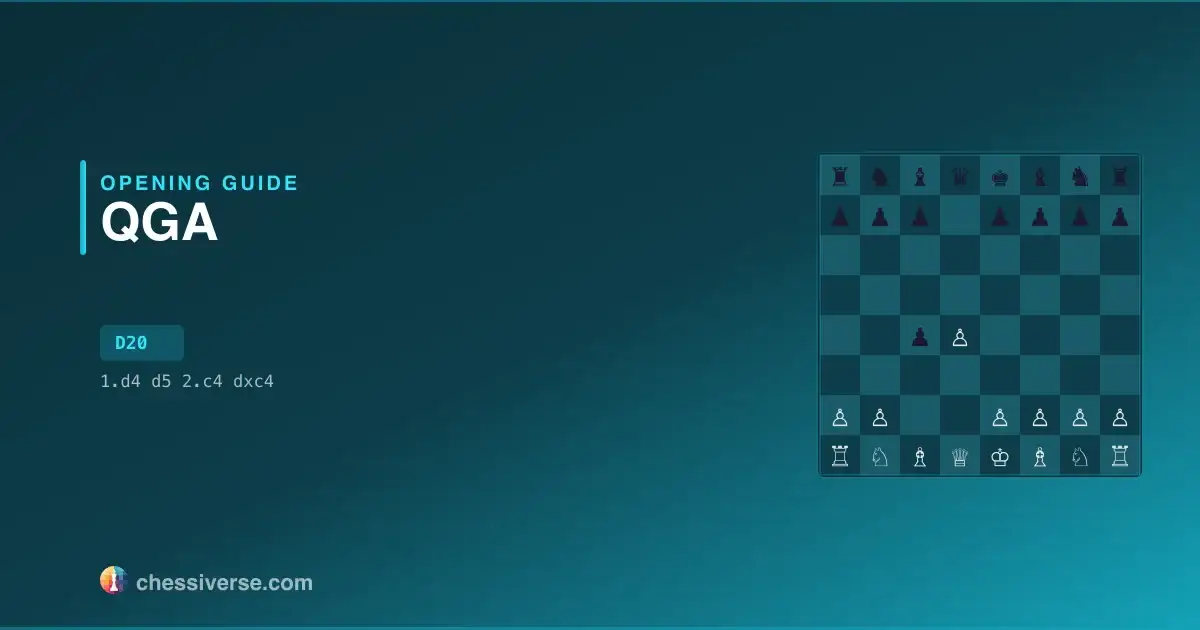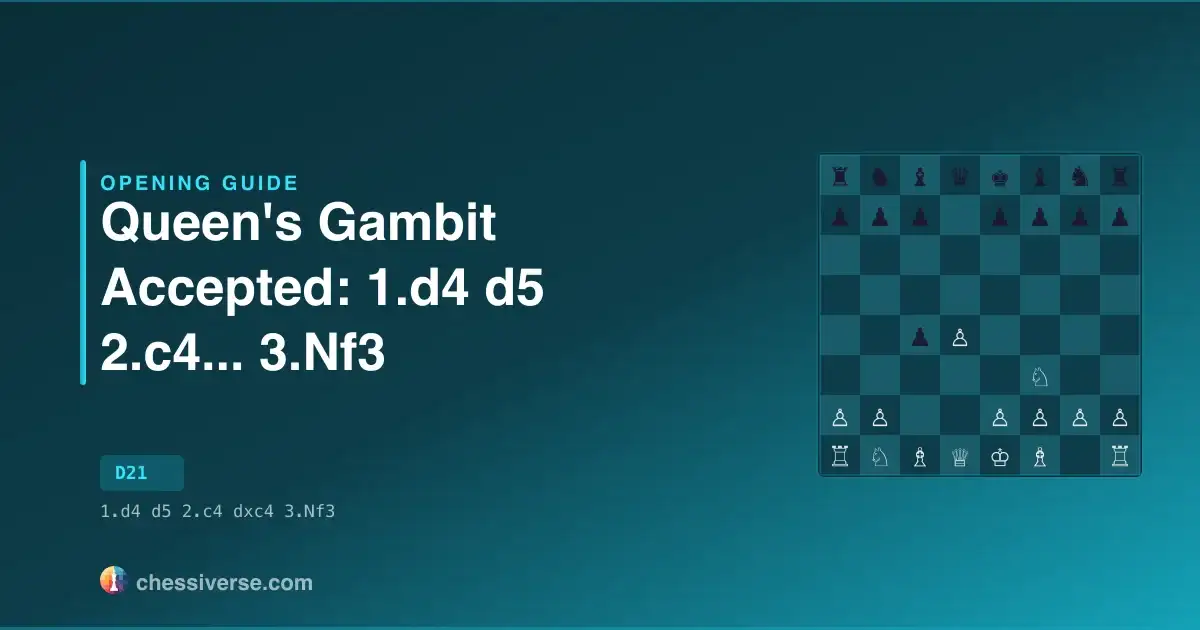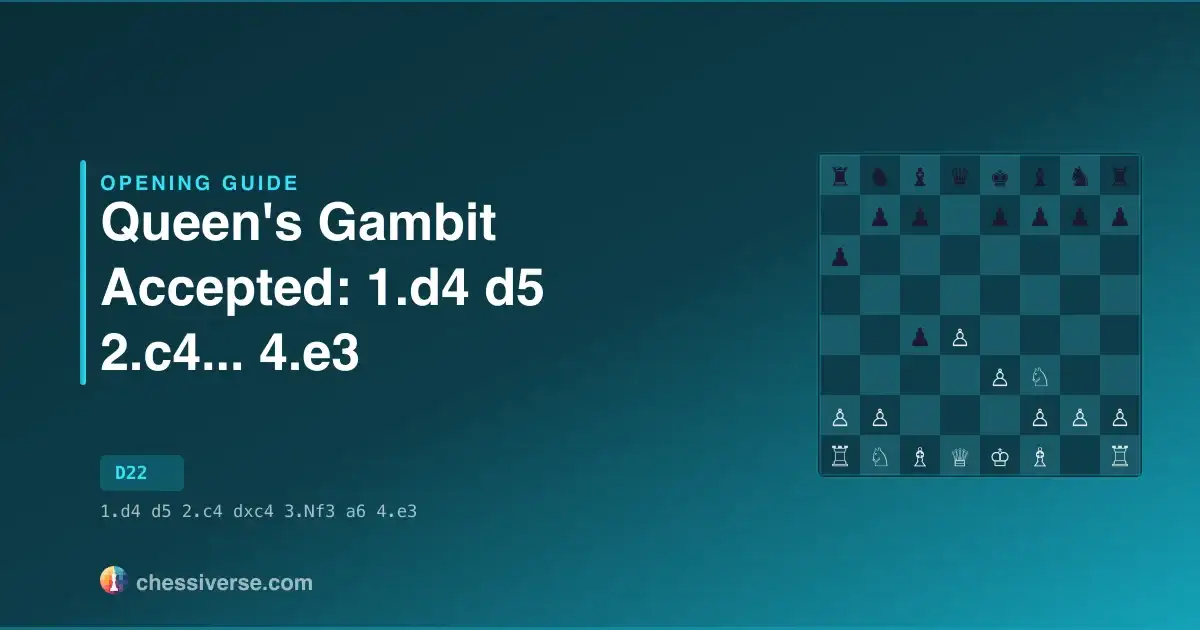


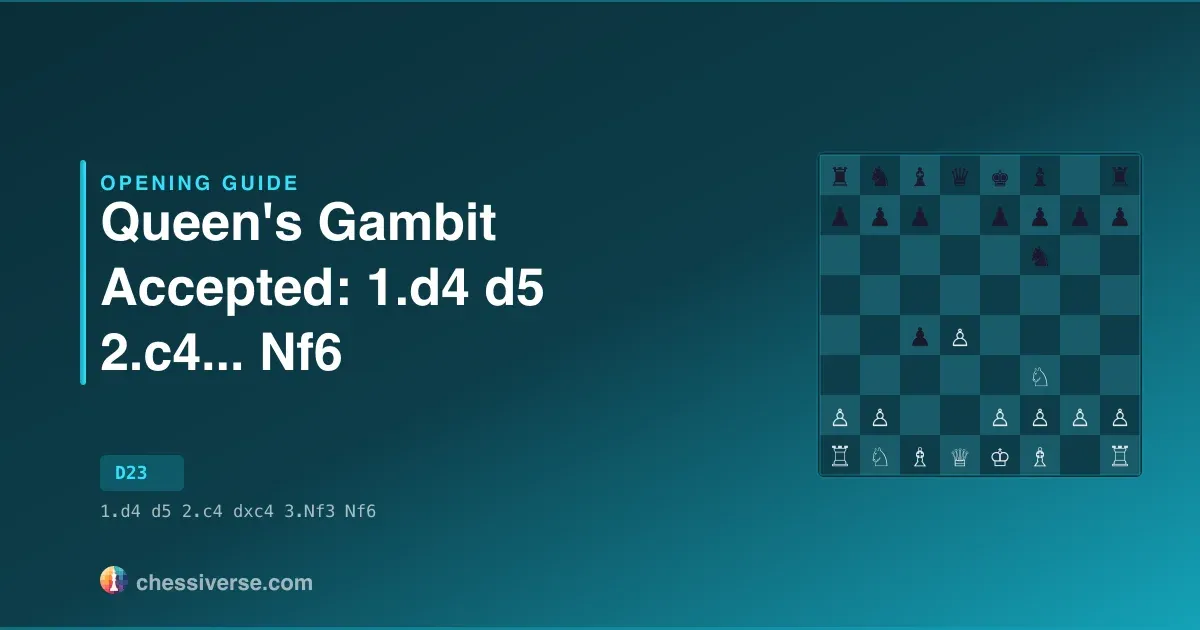
1.d4 d5 2.c4 dxc4 3.Nf3 Nf6 opens the Queen's Gambit Accepted: Normal Variation (3...Nf6), ECO D23. Black develops with a single purpose: stop White's e4 push. The knight on f6 controls the key central square and keeps the QGA from becoming a one-sided central feast.
Strategic Overview
3...Nf6 is the bread-and-butter response in the QGA. The move develops naturally, prepares castling, and most importantly prevents White from setting up the dream centre with e4. Without ...Nf6 defending e4, White could play e4 next move and dominate the centre with a classical pawn duo — the c4-pawn is essentially returned, but in exchange White gets a huge space advantage and easy attacking play. With the knight on f6, that plan is defused, and White has to be content with the more modest e3 set-up. From this position the QGA enters its classical theoretical waters with 4.e3, where White prepares Bxc4 and gradual central expansion. Black's standard plan involves ...e6, ...c5 (challenging the d4-pawn directly), and developing the queenside efficiently. The QGA's whole identity comes from the asymmetric pawn structures that arise after the typical ...c5/d4xc5 exchange — Black usually ends up with a slight isolated-queen-pawn or hanging-pawns structure to manage. At master level it's a respected solid choice; at amateur level it scores well because the plans are clear and the middlegames are well-mapped.
Key Ideas
A few ideas come up again and again in this opening:
- Stopping e4 is the whole point of ...Nf6 — Without the knight on f6, White just plays e4 and builds a classical centre with the pawn duo on d4 and e4. The move ...Nf6 isn't just development — it's the structural barrier that defines what kind of game arises.
- Black plans ...e6 and ...c5 — The classical follow-up is to free the kingside with ...e6 (developing the bishop) and challenge the centre with ...c5. The typical exchanges that follow give Black flexible pawn structures and active piece play.
- Hanging-pawn structures are the norm — QGA middlegames frequently feature hanging pawns on c5 and d5 for Black, or an isolated queen pawn after exchanges. Comfort with these structures — when to advance, when to defend — is the key practical skill in the opening.
History and Notable Players
It arises from the Queen's Gambit Accepted: Normal Variation. Among the most prolific White practitioners are Svetozar Gligoric (49 games), Zdenko Kozul (45 games), Miso Cebalo (37 games). Black-side regulars include Hrvoje Stevic (94 games), Robert Huebner (67 games), Milan Matulovic (66 games).
Performance Across Rating Levels
How well the Queen's Gambit Accepted: Normal Variation (3...Nf6) works depends on what level you're playing at. The 1200 bracket has 377,756 games (0.06% of all games at that level); White wins 56.3%, Black 40%, 3.8% are drawn. Move up to 1800 Elo and the share shifts to 0.06%, with White winning 55.5% versus Black's 39.6%. Among 2500-rated players the line appears in 0.37% of games and draws spike to 12.9%, indicating tight preparation. White's edge erodes by 12.3pp from 1200 to 2500 Elo, suggesting Black's counterplay is easier to find with experience.
Time Control Patterns
The Queen's Gambit Accepted: Normal Variation (3...Nf6) skews toward bullet chess. In bullet, it appears in 0.07% of games (1,778,727); White wins 54.5%. Blitz shows 0.06% adoption across 2,332,758 games, White scoring 53.9%. In rapid, the share rises to 0.05% — 584,589 games, White 56.6%. White's score swings 2.7pp across formats, so time control isn't just a stylistic choice here — it shifts the actual results.
Move Diversity and Theory Depth
What players actually play after the opening moves depends heavily on rating. At 1200 Elo (377,024 games), the top reply is Nc3, played 40.7% of the time. Four other moves each take at least 5% of games, and the top three moves account for 81.2% of games. Entropy: 2.19. By 2500 (49,907 games), e3 takes over as the top reply at 76.9%; only one other move still reaches 5% and the top three moves account for 95.8% of games. Entropy drops to 1.14. That entropy collapse is the signature of a line where preparation pays off: at the top, players know the best move and play it.
Historical Trends
Year-over-year data tells you whether this opening is a contemporary fixture or a fading one. Adoption peaked in 2015 at 0.07% (16,070 games). By 2025 it sits at 0.06%, 19% below the peak and roughly back to its 2013 level, leaving the line flat over the full period.
Main Lines and Variations
From the position after 1.d4 d5 2.c4 dxc4 3.Nf3 Nf6, the recognised continuations are:
Each branch leads to a different middlegame character — the resulting pawn structure decides what kind of game you get.
Common Mistakes
- Drifting away from main theory — At 400 Elo, the three most-played moves cover 77.2% of games, against 91.6% at 2000. The most popular deviation is e4 (played 6.2% of the time at 400, much less so up top). It looks fine but quietly hands the better-prepared side an edge.
- Neglecting development — It can feel productive to make extra pawn moves early, but falling behind in piece development is what loses most amateur games — especially in open positions where active pieces find squares fast.
- Overextending the attack — Gambits look like permission to throw everything forward. They aren't — every attacking move should improve a piece. Random checks and threats burn the initiative once they fail to coordinate.
Practice on Chessiverse
Ready to try the Queen's Gambit Accepted: Normal Variation (3...Nf6) against a bot? Pick an opponent at your level and play a game.